

Commentary
Peter Kellner
{
  "authors": [
    "Peter Kellner"
  ],
  "type": "commentary",
  "blog": "Strategic Europe",
  "centerAffiliationAll": "",
  "centers": [
    "Carnegie Endowment for International Peace",
    "Carnegie Europe"
  ],
  "collections": [
    "EU Integration and Enlargement",
    "Brexit and UK Politics"
  ],
  "englishNewsletterAll": "",
  "nonEnglishNewsletterAll": "",
  "primaryCenter": "Carnegie Europe",
  "programAffiliation": "",
  "programs": [],
  "projects": [],
  "regions": [
    "Europe",
    "Western Europe",
    "United Kingdom"
  ],
  "topics": [
    "EU"
  ]
}
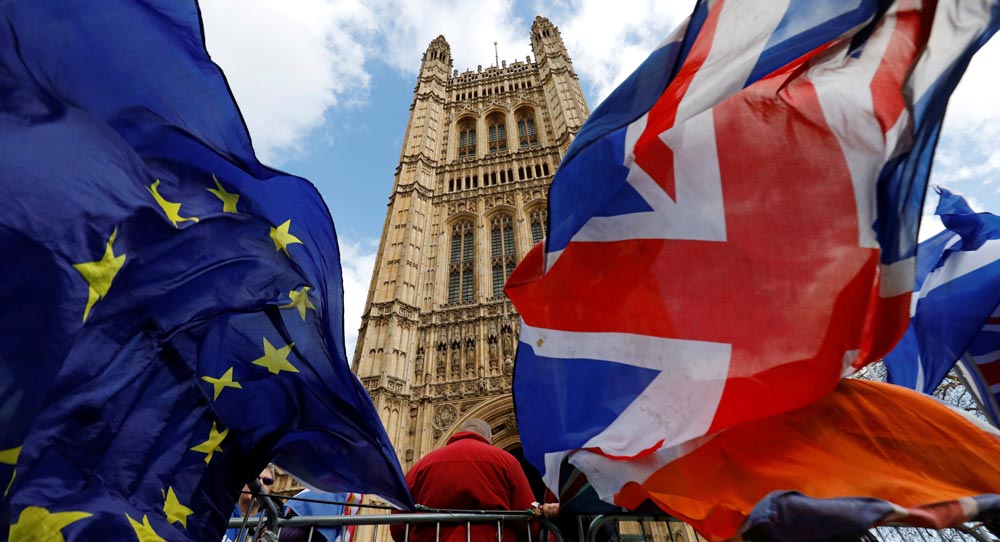
Source: Getty
Britain’s reputation for competent, pragmatic political stability has been built up over centuries. It is now being trashed daily before our eyes.
I bring good news—and bad. The good news is that the nature of the problem facing Britain’s Parliament on Brexit is, in principle, easy to solve. The bad news is that, in practice, it has so far proved utterly intractable.
The problem is how to choose which of four policies Britain should now pursue. If we were holding an election with four candidates, the process would be straightforward. We could have a first-past-the-post contest. The winner would be the candidate with the largest number of votes. Alternatively, we could have a preferential system; so that if no candidate wins an outright majority of first preferences then second—and, if necessary, third—choices come into play until a clear winner emerges.
Whatever system is used, an election ensures a winner, even if s/he starts out lacking majority support.That is not how Britain’s Parliament works. Its decisions need majority support. If no majority emerges, it can end up with a policy that few MPs want. It is as if the winner of an election were someone who didn’t stand, because none of the declared candidates reached the 50 percent mark.
In recent days, the UK government has lost two significant votes. MPs have rejected Theresa May’s withdrawal agreement and have ruled out a no-deal Brexit in all circumstances. They have also rejected some of the alternative proposals for solving the crisis. So far, no specific plan has secured a majority.
What now? The problem is that there are four distinct groups of MPs, and none of the groups commands a majority.
In addition to this week’s losing factions—Group 1 (MPs who have no fear of leaving the EU without a deal) and Group 2 (supporters of the Withdrawal Agreement)—there is Group 3: MPs who favor leaving the EU but want a “soft” Brexit that goes further than the withdrawal agreement in retaining the closest possible trading links with the EU, in order to minimize the damage that Brexit inflicts on Britain’s economy. There are slightly different versions of this option, known by such names as “Norway-plus” or “Common Market 2.0.”
Then there’s Group 4: MPs who believe that leaving the EU is a profound mistake. Most of them want a new referendum, to decide whether the UK should remain in the EU or go ahead with one of the above versions of Leave; a small minority would simply revoke Britain’s application to leave the EU without a referendum.
Putting numbers to each group is not easy. Some MPs hover between groups. To some extent, the size of the vote at any moment will depend on timing and political context—such as the state of the battles consuming Brussels; Theresa May’s cabinet; and the shadow cabinet of Labour’s leader, Jeremy Corbyn.
However, it is clear is that a majority of MPs—at least 400 or so out of 650—would personally prefer the kind of Customs Union and/or Single Market-style relationship with the EU that the UK currently enjoys. If Groups 3 and 4 joined forces, they would triumph.
However, most MPs in Group 4 think a “soft” Brexit is ridiculous: it would leave the UK bound by EU rules but with no say in them. Meanwhile, most MPs in Group 3 are fearful of overturning the 2016 referendum: they think the commitment to leave the EU is paramount. If Parliament is to break this impasse, dozens—and maybe a hundred-plus—MPs will have to eat their words and support a solution they have so far rejected.
In the short term—between now and March 29, when the UK is currently scheduled to leave the EU—the prime minister will have at least one more attempt, possibly two, to revive her withdrawal agreement, despite MPs having voted it down twice by large majorities. She hopes that Group 1, the no-deal brigade, will crack, fearing that the alternative is that either Group 3 or Group 4 will eventually prevail.
The odds are currently against her. Mrs. May could well lose by less; but there are probably enough hardline Group 1 MPs to ensure her defeat. For some pro-Brexit Conservatives, leaving Europe trumps all other causes. Some would even rejoice if the prime minister falls: they would hope to elect a new Conservative Party leader, who would share their passion for the UK to make a clean break with the EU.
We should be clear: nothing is certain. Let us say Mrs. May has a 30 percent chance of securing a majority for her withdrawal agreement before March 29. That means there is a 70 percent chance that the UK will seek an extension to the Brexit process.
At this point, the pressure would shift to Groups 3 and 4—those who favor a soft Brexit and those who want a People’s Vote and the chance to block Brexit altogether. Can they make common cause? This is far from clear. Although both groups share a strong desire to maintain the closest possible trading links with the EU, there is increasing bad blood between them on the fundamental politics of the choice: whether to uphold or challenge the sanctity of the 2016 referendum result.
It is—just—possible that the prime minister herself will untie the knot. People close to her are attracted to a proposal advanced by two Labour backbench MPs, Peter Kyle and Phil Wilson. They want, in essence, to bring Groups 2 and 4 together. They propose that Parliament should approve the withdrawal agreement, subject to a “confirmatory vote.” This would be a referendum, but of a particular kind. If the electorate approves the deal, it would automatically come into effect, say one month after the public vote.
If a majority opposes the deal, the UK would remain in the EU. Either way, the saga would come to a clear end and not drag on. Mrs. May might decide—and the word “might” must be stressed; it is very far from certain—that, if Parliament won’t support her plan otherwise, this gives her some chance of implementing the agreement on which she has worked for the past two years.
A host of questions arise. Will the EU grant an extension—and, if it does, for how long and on what terms? A second referendum would take months to organize: would the UK have to participate in this year’s elections to the European Parliament? Will the British government hold together long enough for the time-consuming processes needed to sort out the Brexit mess to be completed? If not, could we drift by default toward a form of Brexit that few MPs want, because no majority can be found for any specific alternative?
Anyone who claims to know for certain where the UK will end up is a fool or a knave. Just one thing may be confidently predicted. Britain’s reputation for competent, pragmatic political stability has been built up over centuries. It is being trashed daily before our eyes. It will take years, perhaps decade, for it to be restored.

Peter Kellner
Former Nonresident Scholar, Carnegie Europe
Kellner was a nonresident scholar at Carnegie Europe, where his research focused on Brexit, populism, and electoral democracy.
Recent Work
Peter Kellner
Peter Kellner
Carnegie does not take institutional positions on public policy issues; the views represented herein are those of the author(s) and do not necessarily reflect the views of Carnegie, its staff, or its trustees.
European reactions to the war in Iran have lost sight of wider political dynamics. The EU must position itself for the next phase of the crisis without giving up on its principles.

Richard Youngs
Europe isn’t as weak in the new geopolitics of power as many would believe. But to leverage its assets and claim a sphere of influence, Brussels must stop undercutting itself.

Dimitar Bechev
Europe’s reaction to the war in Iran has been disunited and meek, a far cry from its previously leading role in diplomacy with Tehran. To avoid being condemned to the sidelines while escalation continues, Brussels needs to stand up for international law.

Pierre Vimont
France and Germany’s failure to agree on the Future Combat Air System (FCAS) raises questions about European defense. Amid industrial rivalries and competing strategic cultures, what does the future of European military industrial projects look like?

Rym Momtaz, ed.
France has stopped clinging to notions of being a great power and is embracing the middle power moment. But Emmanuel Macron has his work cut out if he is to secure his country’s global standing before his term in office ends.
Rym Momtaz