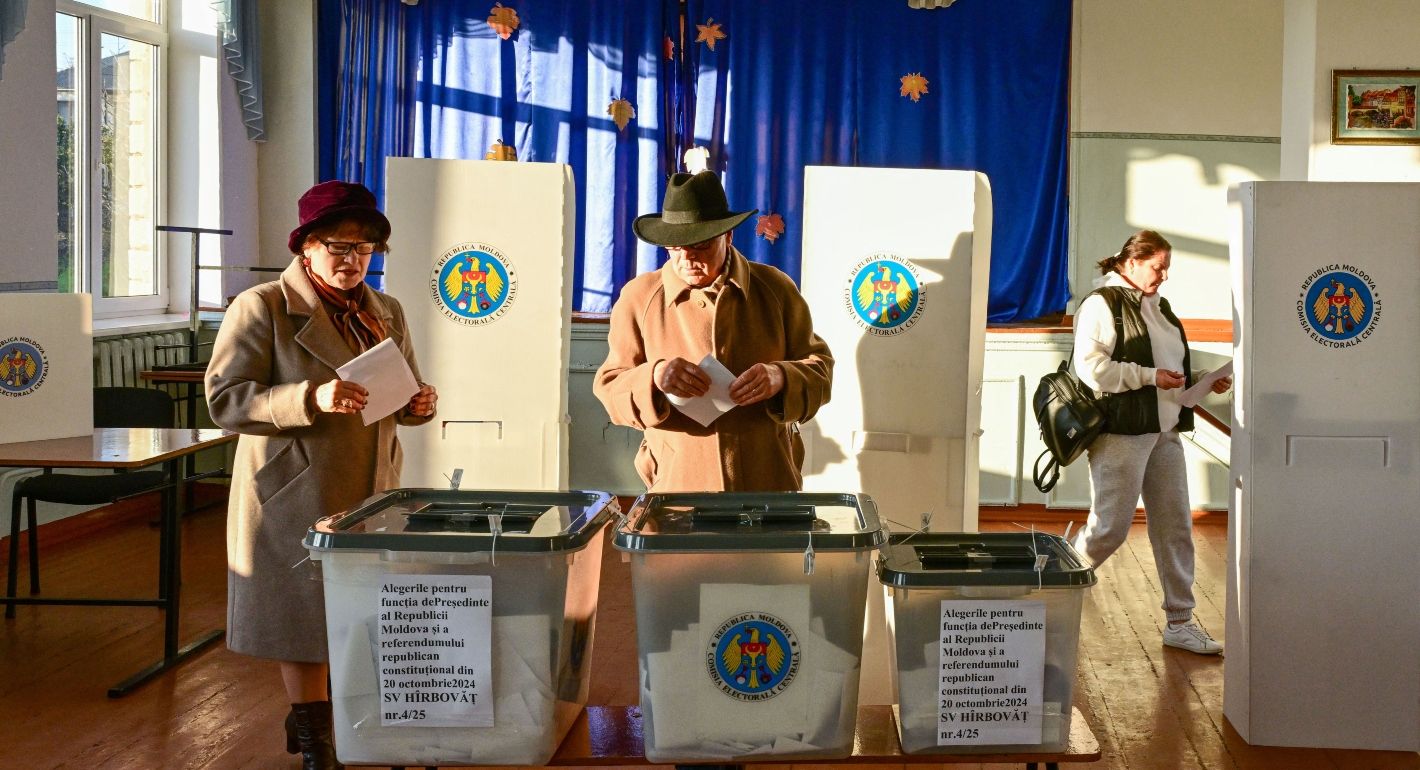
When Moldova’s President Maia Sandu announced a referendum on inscribing the goal of EU accession in the country’s constitution, she made a risky bet.
Throughout the years, polls had consistently shown a majority of the Moldovan population was undecided about moving closer to the EU. Yet, Sandu won her bet. Despite infinitely slim margins, 50.38 percent of voters supported EU membership. She was also able to garner more votes in the first round of the presidential election than she did four years ago.
Sandu’s government spent the past four years deepening interconnections with neighboring EU-member Romania and integrating Moldova into the European power grid. Chișinău also diversified its energy sources to reduce its dependency on Russia and its satellite, the separatist Transnistrian “republic,” whose power station in Cuciurgan used to be Moldova’s only supplier.
Trade volumes with the EU have far exceeded those with Russia. The number of Moldovans working in Russia has declined significantly and is now only a fraction of the over one million living in the EU. And the war in Ukraine provided a singular opportunity to sign a security and defense partnership with the EU, despite Moldova’s constitutional neutrality. It also paved the way for a decisive step: applying for EU membership. This was followed by the official opening of accession negotiations.
Yet despite this structural turn toward the EU driven by Sandu’s political leadership on the back of the geopolitical momentum created by the war in Ukraine, skepticism of the EU’s reliability as a geopolitical force able to counter Russia remains high among the population. Meanwhile, Russia has been relentless in exploiting internal divisions to prevent the small ex-Soviet republic from making a definitive exit from Moscow’s influence.
While Moldova’s choice has often been branded as one between Brussels and Moscow, this is an oversimplification. Like many of Russia’s neighbors, especially in the wake of the invasion of Ukraine, Moldova has no illusions about the Kremlin. Confronted with the EU’s reluctance in recent years to project influence, power, and strategic clarity in the region, and losing ground to China, Russia, Turkey, and the Gulf States, most of these countries have been drifting away from the Euro-Atlantic sphere. Instead, they have pursued multi-vector foreign and security policies, seeking to balance their aggressive neighbor by engaging with everyone and leveraging whatever advantage they may have.
Moreover, the Moldovan population still has mixed feelings about the previous spell of enthusiasm for the EU, under the Alliance for European Integration in 2009-2013. The movement championing rapprochement with the EU ended in failed reforms and higher levels of state capture and corruption, as EU officials were indulgently looking on. Some Moldovans don’t trust the ruling Action and Solidarity Party (PAS), either. Insufficient grassroots communication, the marginalization of other pro-European political competitors, and attempts to ban pro-Russian forces from the electoral process altogether has certainly not helped PAS win over the undecided.
Furthermore, many Moldovans feel both Russian and European, as a result of a brutal decades-long process of Russification, and as such have trouble imagining the Republic of Moldova as a sovereign state. Often they feel they are merely enjoying a brief respite in a troubled history marked by dependence on either Bucharest or Moscow. It is this perception of vulnerability, reinforced by the presence of Russian troops in the breakaway Transnistria since the early 1990s, that fosters a trend toward accommodating Russia.
Moscow has thrown its whole arsenal of subversive operations at the small republic since it elected a pro-democratic leadership. It has sought to overthrow the government and destabilize the country by sowing divisions and undercutting living standards. Russia cut gas supplies to Moldova at the end of 2022, in a bid to exacerbate the country’s economic hardship as it was battling high inflation after the Covid-19 pandemic and the start of the war in Ukraine.
Furthermore, Moscow launched cyber-attacks and massive disinformation campaigns, especially through media outlets owned by pro-Russian agents. It created artificial political forces, such as those around fugitive oligarch Ilan Shor, which have regularly been organizing anti-government protests and have been accused of engaging in a scheme to buy hundreds of thousands of votes. The Kremlin also activated pro-Russian politicians, such as Evgenya Gutul and Irina Vlah, in support of the autonomy of the Gagauz people.
While Russia’s efforts did not yield its desired result, it would be a mistake for the EU to boast about the success of the referendum. Grand declarations from the EU and even the extension of an accession perspective to the Eastern European trio—Georgia, Moldova, and Ukraine—will not suffice. As long as Western support for Ukraine is not resolute enough to help it prevail in a war that may eventually end in painful concessions for Kyiv, Moldovans look on and reckon that they will not be better off in case of a military incursion by Russia, in a country with virtually no army or strategic depth.
Moldova’s vote this past Sunday, October 20, has shown yet again that Russia can be defeated, just as Ukraine has been demonstrating since 2022—but only with firm support from Western partners. The Georgia scenario, in which a pro-European president’s power is limited by an anti-European government, has not been averted in Moldova. Moscow will now deploy all its resources in the battle for Moldova’s parliamentary vote next year. The EU needs to respond with a commensurate level of effort to build up Moldova’s resilience in every way ahead of next year’s challenges.
Brussels must also double down on supporting Georgian society if the parliamentary election on October 26 doesn’t result in an ouster of the government de facto led by Bidzina Ivanishvili. This is not only in these countries’ interest: if pro-democratic forces fail in Moldova and Georgia, the EU will have lost its neighborhood to an empowered Russia and its revisionist allies.
Oana Popescu-Zamfir is the director of the GlobalFocus Center in Bucharest, Romania.