

Commentary
French President Emmanuel Macron has unveiled his country’s new nuclear doctrine. Are the changes he has made enough to reassure France’s European partners in the current geopolitical context?
Rym Momtaz, ed.
{
  "authors": [
    "Gabrielius Landsbergis"
  ],
  "type": "commentary",
  "blog": "Strategic Europe",
  "centerAffiliationAll": "",
  "centers": [
    "Carnegie Endowment for International Peace",
    "Carnegie Europe"
  ],
  "collections": [
    "EU Integration and Enlargement"
  ],
  "englishNewsletterAll": "",
  "nonEnglishNewsletterAll": "",
  "primaryCenter": "Carnegie Europe",
  "programAffiliation": "",
  "programs": [],
  "projects": [],
  "regions": [
    "Europe",
    "Central Europe",
    "Ukraine"
  ],
  "topics": [
    "EU",
    "EU Enlargement",
    "Foreign Policy"
  ]
}
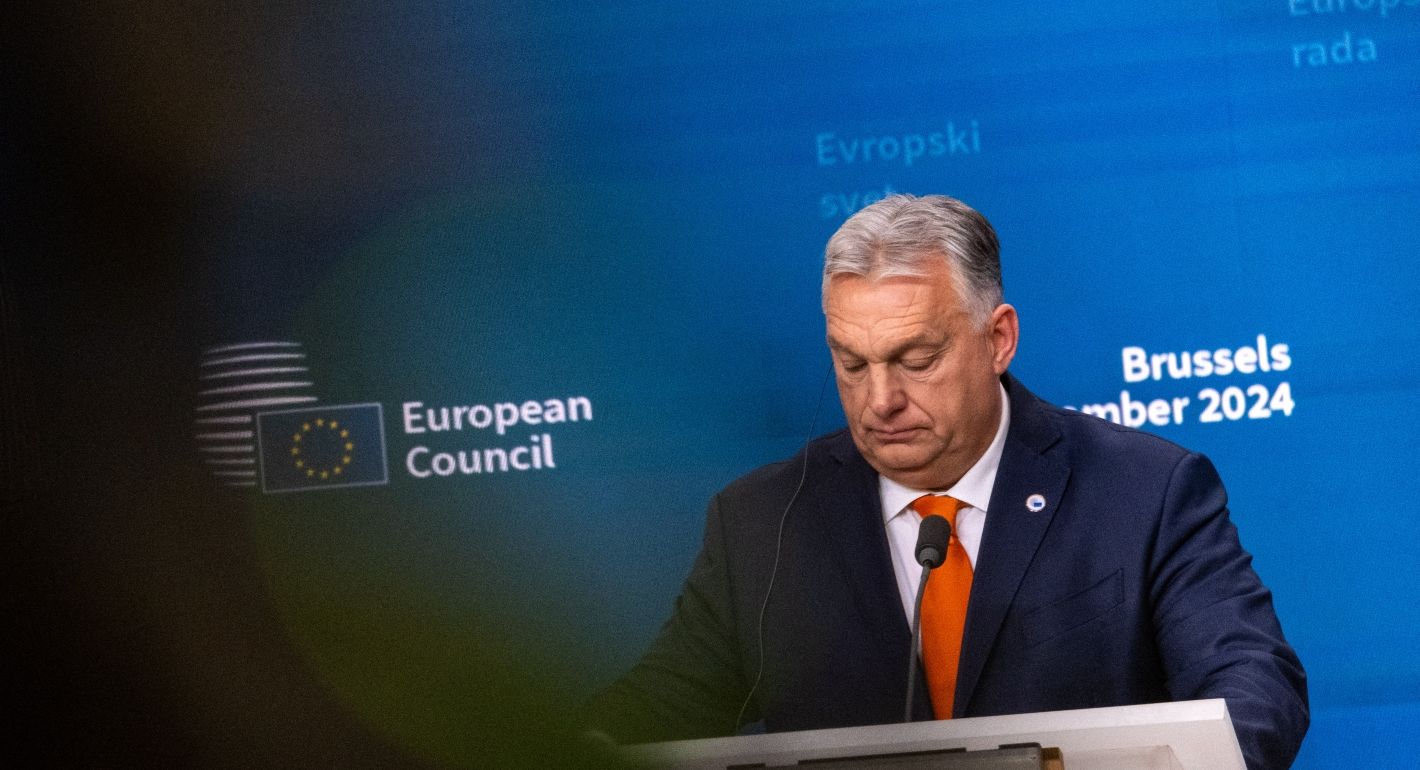
Source: Getty
Hungary’s attempts to paralyze EU foreign policy through vetoes and blackmail continue. By failing to make Budapest pay, Brussels is normalizing such behavior and inviting further disruption.
Every six months, the EU’s sanctions against Russia are renewed—but only after an eleventh-hour deal is struck with Hungary. In fact, no EU geopolitical decision related to the war in Ukraine or its defense against Russia has escaped Hungary’s blackmail since the full-scale invasion of Ukraine in 2022.
One striking example comes from 2023, when the EU was poised for a historic moment: launching accession talks with war-torn Ukraine, arguably one of the most resolute geopolitical signals that could be sent in response to Russia’s aggression. Despite the immense challenges of doing so during an ongoing invasion, Ukraine had made remarkable progress in meeting the preconditions. It had implemented the necessary reforms and the EU had found the political resolve to forge ahead.
And yet, at every meeting, Budapest raised objections, claiming Ukraine fell short in ensuring minority rights and reducing corruption. This was beyond ironic given Hungary’s own lackluster track record. As the Hungarian saying goes: “The owl told the sparrow it has a big head.”
These stonewalling tactics seemed to come straight out of the Kremlin’s playbook, isolating Kyiv and undermining Brussels. Hungary didn’t even try to hide it.
Rather than being made to pay for weakening the EU, Hungary was eventually paid off and Viktor Orbán was allowed to save face by leaving the room during the vote on opening EU accession talks with Ukraine. This has become Brussels’s preferred way of dealing with Budapest and achieving a kind of unity—but at what cost to the EU’s credibility?
The EU is simultaneously facing the biggest external threat to its security since its creation and division within its ranks by member states more committed to their narrow interests and relationship with Moscow than to their responsibilities as EU members. By leaving Hungary unpunished, and indeed rewarding Orbán for his destructive behavior, Brussels is normalizing blackmail and asking for more of it.
Hungary blocks more than half of the EU’s foreign policy decisions. It continues to obstruct the European Peace Facility, a fund designed to support Ukraine’s defense. Whatever is proposed, EU diplomats have learned to brace themselves for a Hungarian veto.
And Orbán is recruiting more member states to join his axis of paralysis. Slovakia has already become a reliable sidekick. Austria, Romania, and the Czech Republic could soon be joining, too.
The principle of unity that underpinned the European project has been twisted and weaponized. In today’s world, this means paralysis in the face of rapidly unfolding geopolitical and technological developments.
History offers a chilling parallel. In the eighteenth century, the Polish-Lithuanian Commonwealth, once a major European power, was crippled by the liberum veto—a system that allowed any single noble to block all parliamentary decisions. This eventually led to legislative paralysis.
When the time came to vote on assembling an army to resist the Russian, Prussian, and Austrian partition, parliament failed to reach a consensus. The commonwealth ceased to exist soon after that, carved up by its enemies. History later revealed that the group responsible for blocking those crucial decisions, known as the Targowica Confederation, was acting in close cooperation with Catherine the Great, empress of guess which country.
The EU now faces a similar test: Will it allow one state, acting against the interests of all, to repeatedly hold the union to ransom?
Recently the geopolitical stakes rose even higher. It is not inconceivable that Hungary would, for example, block retaliatory tariffs against the United States, or disagree with increasing common borrowing for defense if the United States begins to withdraw. Also, the need to regularly renew sanctions against Russia gives Hungary, or any other wannabe disruptor, a very effective way to twist the European Commission’s arm.
Thankfully, the EU is not powerless to stop all this. The Treaty on European Union’s includes Article 7 is, a mechanism designed for this very situation—a member state systematically ignoring European values. The process is complex, but it exists.
Under Article 7(1), proceedings can be initiated if there is a "clear risk" of a serious breach of European values. This must be confirmed by a majority vote in the European Parliament. If the risk is confirmed, Article 7(2) allows for the European Council to find the accused member in breach. If that happens, Article 7(3) enables the imposition of sanctions, including the suspension of voting rights.
This process is admittedly difficult to complete because it requires the collective consent of all member states except the accused. However, Article 7 remains the best tool at the EU’s disposal for dealing with rogues—because at least the rogue can’t block the process.
It is entirely possible that other, less committed disruptors would back down if they saw Hungary was being made an example of. Most importantly, if the Article 7 process were fully enforced against Hungary, European values would be shown to be more than just words on paper; they would be affirmed as core principles, with real consequences for ignoring them.
If the EU fails to act, this crisis will involve more members than Hungary. It will spread like cancer. Politicians in other EU member states will see that blackmail works, corruption pays, and the defense of European values is transactional. When there is more than one rogue state, the Article 7 process becomes almost impossible.
So the crisis Hungary has caused could either be the perfect opportunity to strengthen the defense of our shared values, or the straw that breaks Europe’s back. It is perhaps worth remembering the horrifying reason these values were considered so important in the 1950s and thinking twice before treating them like poker chips.
Gabrielius Landsbergis is a former minister of foreign affairs of Lithuania.

Gabrielius Landsbergis
Former minister of foreign affairs of Lithuania
Carnegie does not take institutional positions on public policy issues; the views represented herein are those of the author(s) and do not necessarily reflect the views of Carnegie, its staff, or its trustees.
French President Emmanuel Macron has unveiled his country’s new nuclear doctrine. Are the changes he has made enough to reassure France’s European partners in the current geopolitical context?

Rym Momtaz, ed.
European reactions to the war in Iran have lost sight of wider political dynamics. The EU must position itself for the next phase of the crisis without giving up on its principles.

Richard Youngs
Europe isn’t as weak in the new geopolitics of power as many would believe. But to leverage its assets and claim a sphere of influence, Brussels must stop undercutting itself.

Dimitar Bechev
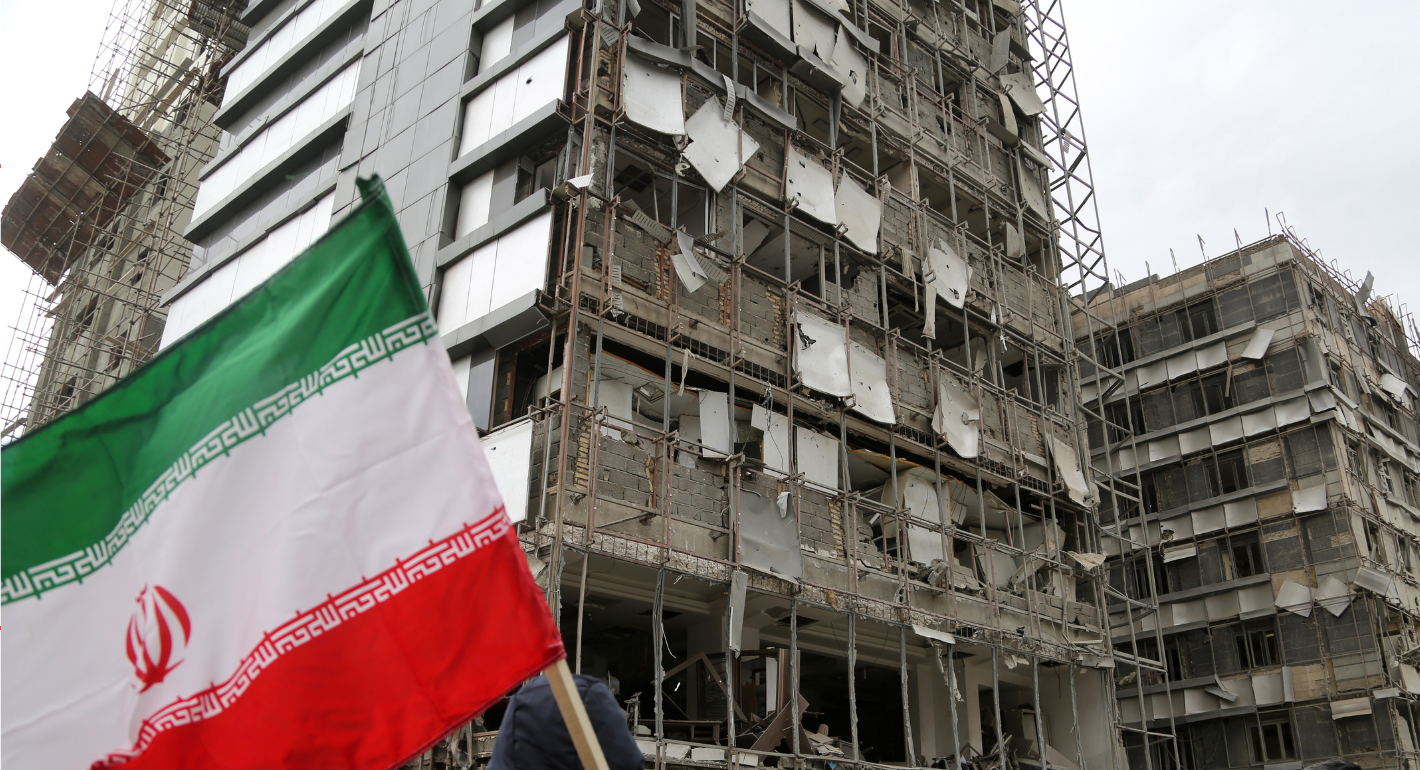
Europe’s reaction to the war in Iran has been disunited and meek, a far cry from its previously leading role in diplomacy with Tehran. To avoid being condemned to the sidelines while escalation continues, Brussels needs to stand up for international law.

Pierre Vimont
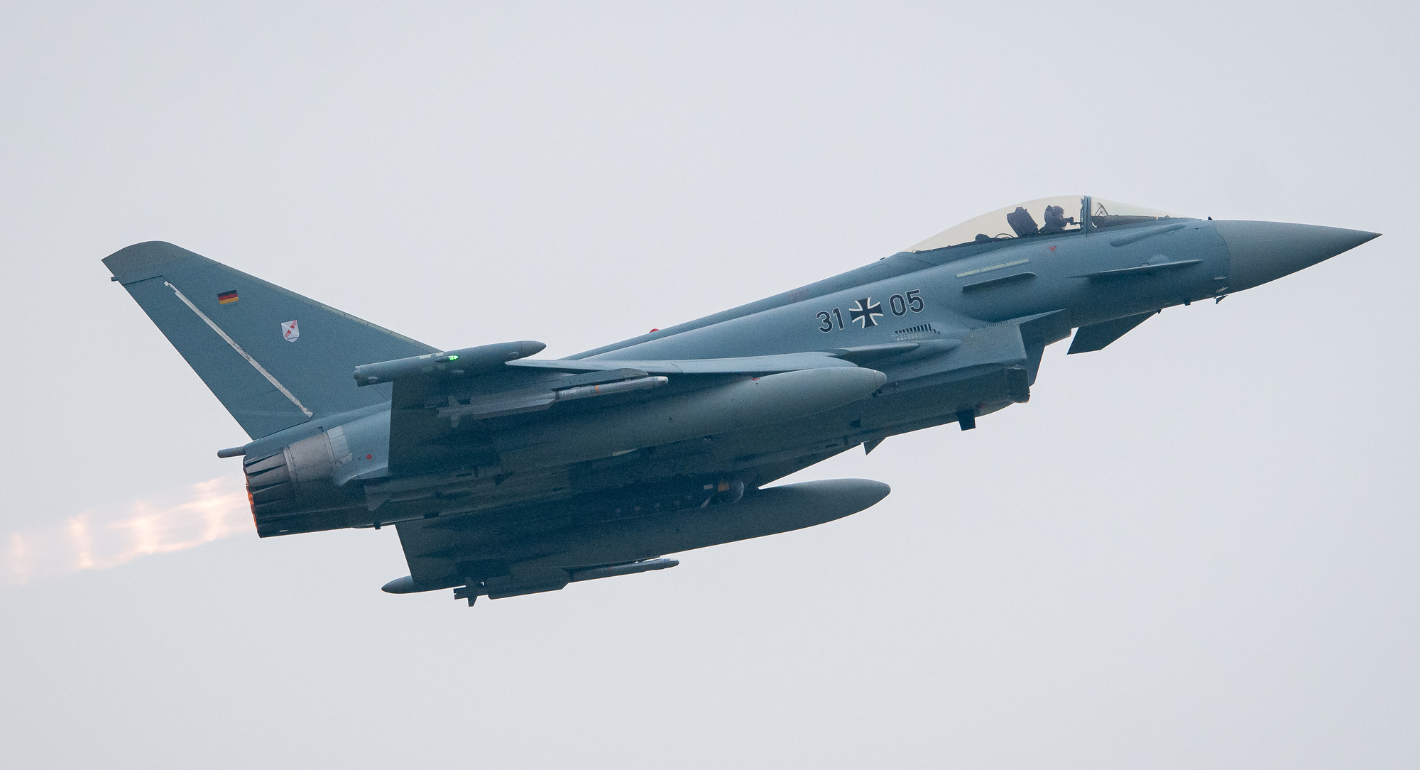
France and Germany’s failure to agree on the Future Combat Air System (FCAS) raises questions about European defense. Amid industrial rivalries and competing strategic cultures, what does the future of European military industrial projects look like?
Rym Momtaz, ed.