

{
  "authors": [
    "Lisa Aronsson",
    "Jamie Shea",
    "Peter Spiegel",
    "Jan Techau"
  ],
  "type": "event",
  "centerAffiliationAll": "",
  "centers": [
    "Carnegie Endowment for International Peace",
    "Carnegie Europe",
    "Carnegie China"
  ],
  "collections": [
    "China’s Foreign Relations"
  ],
  "englishNewsletterAll": "",
  "nonEnglishNewsletterAll": "",
  "primaryCenter": "Carnegie Endowment for International Peace",
  "programAffiliation": "",
  "programs": [],
  "projects": [],
  "regions": [
    "North America",
    "United States",
    "Western Europe",
    "United Kingdom",
    "France",
    "Germany",
    "Europe"
  ],
  "topics": [
    "Security",
    "Military",
    "Foreign Policy",
    "Global Governance"
  ]
}
The Chicago Summit and NATO's New Challenges
Tue, May 8th, 2012
Brussels
IMGXYZ3710IMGZYXThe next years will see most, if not all, of the North Atlantic Treaty Organization’s (NATO) major military operations draw down. The Alliance could find itself, for the first time in twenty years, without a major operation to run. This will bring new challenges as NATO struggles to stay relevant and as its members wrestle with competing priorities.
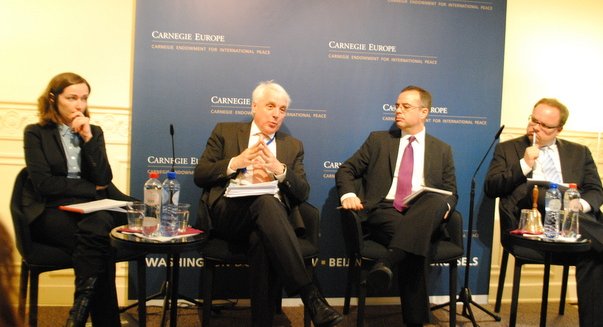
Jamie Shea, deputy assistant secretary general for Emerging Security Challenges at NATO, Lisa Aronsson, head of the Transatlantic Programme at the Royal United Services Institute, and Carnegie’s Jan Techau discussed these challenges. This event marked the launch of Keeping NATO Relevant, a Carnegie Europe policy outlook written by Jamie Shea. The Financial Times' Peter Spiegel moderated.
Discussion Highlights
- New Challenges Facing NATO: Ahead of the Chicago Summit, Shea outlined two major challenges looming in NATO’s future, both of which, he argued, must be addressed systematically:
- After 2014, NATO could be in a situation where–for the first time since 1949–it is neither planning for or conducting an operation, and has no adversary to focus its planning around. Shea argued that if this happens, it will lead to a major cultural shift in the Alliance.
- Shea warned that NATO also risks a weakening of its interoperability following the end of the International Security Assistance Force in Afghanistan (ISAF) mission.
- After 2014, NATO could be in a situation where–for the first time since 1949–it is neither planning for or conducting an operation, and has no adversary to focus its planning around. Shea argued that if this happens, it will lead to a major cultural shift in the Alliance.
- The Chicago Summit: A Turning Point: Panelists agreed the upcoming Chicago Summit provides an opportunity to redefine the size, mandate, and financial framework for the continuing NATO presence in Afghanistan. Shea insisted that certain “flagship programs”—missile defense, Baltic air policing, and air-to-ground surveillance—should be prioritized in Chicago to highlight how multinational sharing can enable allied capabilities. Furthermore, he added that NATO should use the opportunity in Chicago to lay out a vision of how essential relations can be developed in and beyond operations. Aronsson added that NATO needs to be recast as a coherent strategic security community.
- A Strategic Look Ahead: In the long term, Shea urged that member states must find a way to preserve a standing-start NATO that has enough residual capability to initiate operations quickly, providing the first 50 percent of any military effort. With his “50/50 challenge,” Shea emphasized the importance of a multinational Alliance, highlighting the need to strengthen political confidence among NATO members to form clusters of capability to provide the remaining 50 percent effort, and equitably distribute the costs of operations to the broader NATO community.
- Staying Relevant: Spiegel agreed that, ideally, the NATO secretary general’s “Smart Defense” initiative will transform the Alliance’s mind-set in handling capability development and procurement to achieve a sustainable balance between prioritization, specialization, and collaboration. Techau argued that the flexibility and transparency of its political framework is an indispensable component for maintaining peace and stability in Europe, and is key to NATO’s relevance in the future.
Carnegie does not take institutional positions on public policy issues; the views represented herein are those of the author(s) and do not necessarily reflect the views of Carnegie, its staff, or its trustees.
Event Speakers
Lisa Aronsson
Jamie Shea
Jamie Shea is an associate fellow in the International Security Department at Chatham House and a professor of strategy and security at the University of Exeter. He was a NATO official for nearly four decades.
Peter Spiegel
The Financial Times
Director, Europe Team, Eurasia Group
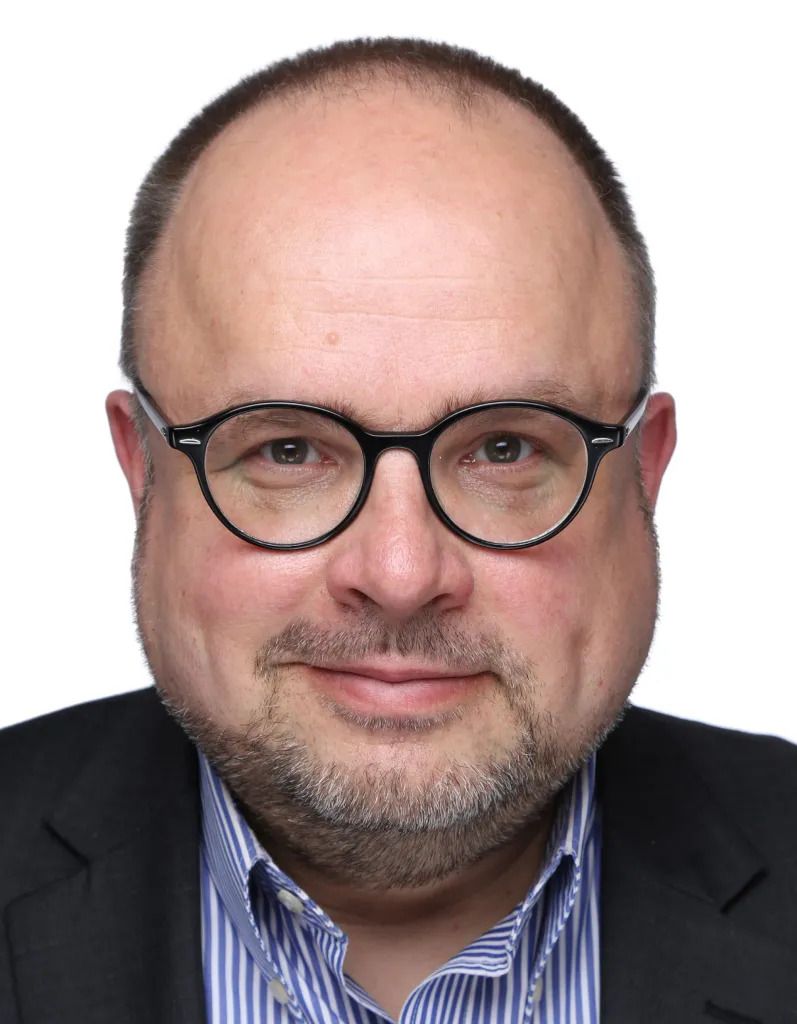
Techau is director with Eurasia Group's Europe team, covering Germany and European security from Berlin. Previously, he was director of Carnegie Europe.