

Paper
Paul Salem
{
  "authors": [
    "Paul Salem"
  ],
  "type": "legacyinthemedia",
  "centerAffiliationAll": "dc",
  "centers": [
    "Carnegie Endowment for International Peace",
    "Malcolm H. Kerr Carnegie Middle East Center"
  ],
  "collections": [],
  "englishNewsletterAll": "menaTransitions",
  "nonEnglishNewsletterAll": "",
  "primaryCenter": "Malcolm H. Kerr Carnegie Middle East Center",
  "programAffiliation": "MEP",
  "programs": [
    "Middle East"
  ],
  "projects": [],
  "regions": [
    "Lebanon"
  ],
  "topics": [
    "Political Reform"
  ]
}
Source: Getty
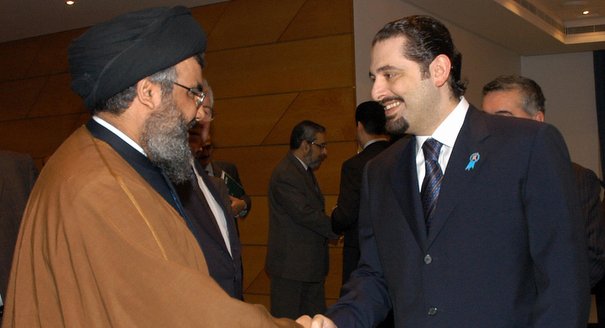
On June 7, Lebanon chooses between the incumbents and the Islamists - but only a grand coalition government makes sense.
Source: Foreign Policy

Hezbollah is a surprisingly efficient organization, despite the fact that it is many things at once. It is the dominant Shiite political party and a strong opposition voice inside and outside parliament. It also acts as an army: resisting Israeli occupation from 1982 to 2000 and fighting Israel to a draw in 2006; receiving arms, training, and financing from Iran; and serving as a military proxy for Iran and Syria. Additionally, it is an Islamist movement that adheres to the principles of the Iranian Revolution (though it has accepted that those principles cannot be implemented in Lebanon). It provides hospitals, schools, and social services in Shiite areas of the country. In many ways, Hezbollah acts as a state-within-a-state -- sharing power with other groups in the government, but maintaining its own army, finances, and foreign policy.
This is Hezbollah's preferred mode of operation: benefiting from the cover of the legitimate multicommunal Lebanese republic, while maintaining enough military and political influence to be left alone. The problem for Hezbollah is that this model does not translate easily into national office and plays badly on an international stage.
Indeed, numerous problems -- domestic and foreign, economic and political -- would worry the Islamist movement if it came to dominate the next government. First, the March 8 coalition that would be elected contains other parties: the Amal movement, a more secular Shiite party, and the Free Patriotic Movement, a group of Christians led by retired Gen. Michel Aoun. Within the March 8 coalition, Hezbollah is the strongest partner, but it does not dictate terms unilaterally. March 8 is about half Shiite and half Christian, and if it wins it would be largely due to the strong showing of Aoun in the Christian districts. Thus, Hezbollah would have to appease Aoun, whose possible demands -- including the presidency -- may not suit Hezbollah.
If elected, this coalition would likely have to reach out to an additional partner for its foreign-policy and economic expertise. Hezbollah's leader, Hassan Nasrallah, has approached the pro-Western March 14 coalition, led by Saad Hariri (the son of assassinated former Prime Minister Rafik Hariri). The coalition possesses considerable economic weight and would help protect the nascent government from international and Arab isolation. But Hariri would be a reluctant partner: He's politically powerful and ambitious himself and might rather see the Hezbollah-led government govern and fail rather than help prop it up.
Regardless of its precise makeup, once in power, a Hezbollah-led government would encounter serious policy challenges. Although most states would likely maintain some modicum of relations with a Hezbollah-led government -- unlike with the Hamas government in Gaza -- political, military, and economic support would decline dramatically. The United States would curtail support for the Lebanese military -- almost $500 million since 2006. European countries might suspend large-scale economic aid. And Saudi Arabia and the countries of the Gulf Cooperation Council, which have been strong backers of fiscal and monetary stability in Lebanon, would scale down their public and private investments.
The state is already carrying a public debt that is 186 percent of GDP and regularly runs a massive deficit. If international support were to decline, it would spell serious trouble for a Lebanon already struggling to avoid widespread unemployment and economic collapse. In addition, despite its populist rhetoric, a Hezbollah-led government would be hard-pressed to broaden social programs and reduce taxes.
Hezbollah also knows that an outright electoral victory might make Israel less hesitant to attack; in such a case, Lebanon's Western friends, supportive of the March 14 coalition, might not help it. Nasrallah has intimated that in such a circumstance, he would turn to Iran for military and economic support, which would trigger negative reactions from the United States, numerous European countries, and Sunni Arab countries.
Ultimately, shouldering such complex domestic and foreign-policy burdens might not be what Hezbollah wants. The Party of God has been most comfortable as an autonomous resistance movement and one of several partners in government. But if the March 8 coalition wins June 7's election, it would be best for Lebanon if the coalition does not rule alone and instead joins with the pro-Western March 14 coalition.
Senior Fellow at the Middle East Institute
Paul Salem is a senior fellow at the Middle East Institute.
Recent Work
Paul Salem
Paul Salem
Carnegie does not take institutional positions on public policy issues; the views represented herein are those of the author(s) and do not necessarily reflect the views of Carnegie, its staff, or its trustees.

Before the next wave of EU enlargement takes place, the union needs to grapple with thorny questions of how power is distributed among its members.


Emil Sondaj Hansen, Ditte Brasso Sørensen

As the EU confronts profound challenges, several leaders have called for fundamental reform to the union’s model—but only modest, superficial changes have resulted. What if Europe really could be reimagined from zero today: What should such a redesigned European order look like?

Richard Youngs, ed.
Europe seems to have accepted its sidelining in the Middle East. The EU must reassert its support for the international rules-based order and step up engagement.

Rym Momtaz
Preparing candidate countries for EU membership is no longer enough. As the enlargement process becomes a reality, the union must also prepare its own societies.

Iliriana Gjoni
Countries face several hurdles in joining the EU, including the final stage of ratifying their accession treaties. Procedural reforms and substantive adjustments could help move the process forward.

Stefan Lehne