

Commentary
Are Germany’s economic, industrial, and political struggles becoming a liability for the EU’s ability to rise to the geopolitical moment?
Rym Momtaz, ed.
{
  "authors": [
    "Michele Dunne",
    "Deepti Choubey",
    "James F. Collins"
  ],
  "type": "questionAnswer",
  "centerAffiliationAll": "dc",
  "centers": [
    "Carnegie Endowment for International Peace",
    "Carnegie Europe",
    "Carnegie Russia Eurasia Center"
  ],
  "collections": [
    "U.S. Nuclear Policy"
  ],
  "englishNewsletterAll": "ctw",
  "nonEnglishNewsletterAll": "",
  "primaryCenter": "Carnegie Endowment for International Peace",
  "programAffiliation": "russia",
  "programs": [
    "Russia and Eurasia",
    "Nuclear Policy",
    "Middle East"
  ],
  "projects": [
    "Eurasia in Transition"
  ],
  "regions": [
    "North America",
    "United States",
    "Caucasus",
    "Russia"
  ],
  "topics": [
    "Security",
    "Foreign Policy",
    "Nuclear Policy",
    "Nuclear Energy"
  ]
}
Source: Getty
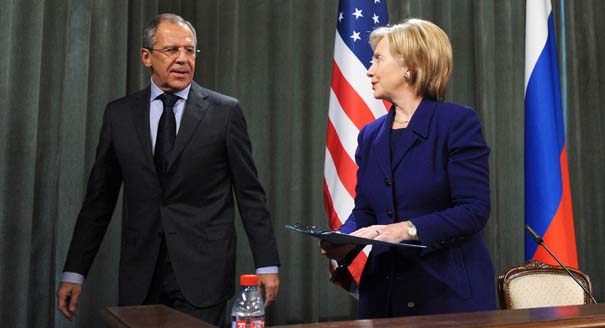
U.S. Secretary of State Clinton leaves for Moscow for a Quartet meeting on efforts to revive Israeli–Palestinian peace talks. She will also meet with President Medvedev to address the bilateral agenda, not least the successor agreement to START and Iran's nuclear program.
U.S. Secretary of State Clinton leaves for Moscow today for a Quartet meeting on efforts to revive Israeli–Palestinian peace talks. She will also meet with President Medvedev to address the bilateral agenda, not least the successor agreement to START and Iran's nuclear program.
In a video Q&A, Carnegie experts analyze these key issues. Michele Dunne discusses the Quartet meeting and whether the uproar following Vice President Biden's trip to the Middle East has derailed the process. Deepti Choubey talks about the follow-on to START and efforts to address concerns about Iran’s nuclear program. And Ambassador James Collins evaluates U.S.–Russian relations and the success—so far—of the reset.
Dunne: The Quartet meeting that will be held in Moscow this week is going to be very different from the one that was envisaged when they first planned the meeting a couple of months ago. The idea had been that the proximity talks between Israel and the Palestinians would have now been launched and that the Quartet would give support for the talks and perhaps make some statements on what would be on the agenda and where it hoped the talks would go.
The idea was that the indirect talks would go on for a few months, with the hope that they would lead to direct negotiations. That’s what was supposed to happen at the Quartet meeting. But now, in light of Vice President Biden’s visit to Israel, the incident over an East Jerusalem settlement, and the dust-up in relations between the United States and Israel, it’s going to be a completely different Quartet meeting.
We are probably going to see some stiff statements out of the Quartet, which is made up of the United States, European Union, Russia, and the United Nations—which will be represented at the foreign minister level. I think we are going to see some criticism of Israel and see expectations laid out for what Israel should do to prove that it’s really interested in moving forward with these talks with the Palestinians.
Aside from the United States, the other members of the Quartet are typically more sympathetic to the Palestinian side of things and less to the Israeli side of things than the United States is. Those parties, represented by Lavrov, Ashton, and Ban Ki-moon, are going to be ready to criticize Israel in this meeting. They have perhaps long felt that Israel deserves more nudging than it has received from the United States.
The question for the United States is how far to go with this and where are they going with this. The Obama administration engaged in a confrontation with Israel over settlements last year and then ultimately backed down. The question now is how far they want to go in criticizing Israel and putting pressure on Israel.
Choubey: All signals point to being very close to concluding negotiations to the START follow-on treaty. We hope that in the next few weeks negotiations will be closed and the United States and Russia will be able move forward with signing the treaty.
The White House has rightly signaled that it does not want to time bound these negotiations because they want to get it correct. It is important to note, however, that having a signed agreement would be an important signal that the United States and Russia can send when their delegations go the May 2010 Non-Proliferation Treaty Review Conference.
That said, it is also important for us not to overestimate what the value of these modest stockpile reductions will be, particularly to critical non–nuclear-weapon states of the non-aligned movement.
Choubey: Last year, the P5+1—the major powers of the UN Security Council and Germany—agreed to a dual track strategy of engagement and pressure in order to resolve concerns that the international community has about Iran’s nuclear program.
One track was engagement, in terms of talks and a low-enriched uranium deal. On the other hand, there is the option of pressure, primarily in the form of economic sanctions. For a variety of reasons, the Iranians have found it difficult to engage in the offers of negotiations. One reason is the current domestic political disarray in Iran. What we’re seeing now is the P5+1 exploring this option of pressure through sanctions.
Unsurprisingly, there are differences in opinion among some of the members of the P5+1 about how quickly to proceed on the sanctions track and what it should include. More aggressive timelines are being set out by the French, British, and of course the United States, but there have been questions and concerns raised by Russia and China. What we see now is a diplomatic effort among the P5+1 to bring everyone onto the same page about when is the right time for sanctions and what it should include.
Without a doubt, Russia’s support of the two-track strategy is crucial. Since the revelation of the second secret enrichment facility last September, Russia has been on board with the P5+1 strategy.
Currently, Russia is an important counterweight to what’s happening with China. There are concerns about whether the Chinese will be on board, but as Russia is increasingly supportive of what the rest of the major powers want to do it creates an interesting tension about whether China wants to be the odd man out when the major powers decide how to move forward.
Collins: We are approaching the first anniversary of reset, at least in a formal sense. In April, President Medvedev and President Obama met in London and they signed two statements. One specifically on getting moving on a follow-on to START and secondarily, a broader statement setting out the bilateral agenda—what it would be, how we would proceed, and what the priorities should be.
The way to look at reset is to asses how we’ve done on that—this was the leaders’ own definition of what it should be about. We have made a good beginning and we have moved substantially and positively on two major items. In many other respects it is still a beginning and in some ways it is fragile.
Where have we done well? We’ve done well with the START follow-on. Those negotiations by all accounts are coming to their final stage and people are now beginning to talk about when we will do the signature.
The Afghanistan agreement that was signed in July between the two presidents has successfully reshaped American–Russian cooperation and the joint approach to Afghanistan. There are still issues. In some cases, we have a different set of priorities about how to deal with the narcotics dimension of the Afghanistan problem. The Russian side is not so much concerned about what we’re up to at the moment, but Russia is concerned about how it will play out and what our longer-term approach to Afghanistan is going to be. For the moment, it seems to be a success story.
On the bilateral commission, it is a good beginning—not as much as people had hoped but probably more than we realistically expected.
Things are moving well on many of the areas where we had already been working together—on arms control, proliferation issues, and counterterrorism. In areas where things had fallen by the wayside over the previous administration’s tenure it’s been hard to get things started again—areas like health, for example.
Finally, the area where we’ve had less success is on the economic dimension. We still don’t have Russia in the World Trade Organization. In significant ways, trade is not really different from what it has been and we don’t really see all that much progress on a lot of economic issues. We’ve watched another year of spats and troubles over poultry and pork exports to Russia.
The economic side has not been terribly successful so far. There is an ambitious agenda out there for the working group on business development, but that has more potential than achievement so far.

Former Nonresident Scholar, Middle East Program
Michele Dunne was a nonresident scholar in Carnegie’s Middle East Program, where her research focuses on political and economic change in Arab countries, particularly Egypt, as well as U.S. policy in the Middle East.
Former Deputy Director, Nuclear Policy Program
Choubey was previously the director of the Peace and Security Initiative for the Ploughshares Fund. She also worked for Ambassador Nancy Soderberg in the New York office of the International Crisis Group.
Nonresident Senior Fellow, Russia and Eurasia Program; Diplomat in Residence
Ambassador Collins was the U.S. ambassador to the Russian Federation from 1997 to 2001 and is an expert on the former Soviet Union, its successor states, and the Middle East.
Carnegie does not take institutional positions on public policy issues; the views represented herein are those of the author(s) and do not necessarily reflect the views of Carnegie, its staff, or its trustees.

Are Germany’s economic, industrial, and political struggles becoming a liability for the EU’s ability to rise to the geopolitical moment?

Rym Momtaz, ed.

European Commission President Ursula von der Leyen is about to give her annual address on the state of the EU. Here’s what she won’t—but should—say.
Rym Momtaz

Radical-right parties are expected to do well in upcoming elections in four of the EU's biggest member states. If successful, they could prevent the union from addressing key challenges ahead.

Stefan Lehne

The aftermath of the Ceuta crisis shows Europe has drawn the wrong lessons. Rather than doubling down on failed migration policies, the EU needs to address the underlying roots of such episodes.

Richard Youngs

Canadian Prime Minister Mark Carney has twice inspired praise for standing up to U.S. President Donald Trump: at the 2026 World Economic Forum in Davos and on Canada-U.S. trade negotiations. Is Carney showing a third way better than the EU has in dealing with the Trump administration?
Rym Momtaz, ed.