

Commentary
Alexey Malashenko
{
  "authors": [
    "Alexey Malashenko"
  ],
  "type": "legacyinthemedia",
  "centerAffiliationAll": "",
  "centers": [
    "Carnegie Endowment for International Peace",
    "Carnegie Europe",
    "Carnegie Russia Eurasia Center"
  ],
  "collections": [],
  "englishNewsletterAll": "",
  "nonEnglishNewsletterAll": "",
  "primaryCenter": "Carnegie Russia Eurasia Center",
  "programAffiliation": "",
  "programs": [],
  "projects": [],
  "regions": [
    "Caucasus",
    "Russia"
  ],
  "topics": [
    "Security"
  ]
}
Source: Getty
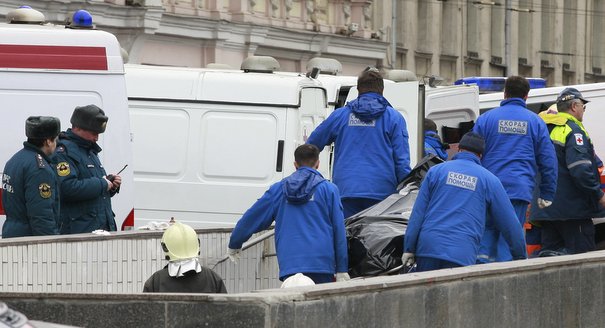
The March bombings in Moscow have shown that efforts by the Kremlin to quiet the North Caucasus have only made rebel leaders more desperate and more willing to resort to terrorism to achieve their goals.
Source: The Moscow Times

The country’s terrorists have made it clear that they are still as strong and capable as ever to strike at any time or place. The group’s main leader, Chechen rebel Doku Umarov, has been warning for years that jihad will spread to all of Russia. The suicide bombers and their supporters carried out Monday’s mission with their typical professionalism and precision. The media have reported the existence of two special schools in the Caucasus for training suicide bombers, and now those graduates have brought their “skills” to practice.
The terrorist attack had the standard theatrical flair. The first explosion took place at the Lubyanka metro station, almost directly beneath the Federal Security Service. That was a direct provocation, and the secret service will unquestionably retaliate with an iron fist.
It appears that a new generation of extremists has come of age, and they have chosen terrorism as their method of doing battle.
Monday’s attacks were probably motivated by revenge for recent operations conducted by Russian special forces that killed several key figures in the militant Islamic movement. These included chief ideologue and theologian Said Buryatsky, as well as Anzor Astemirov (also known as Emir Saifulla), leader of radical militants in the Kabardino-Balkaria region.
The metro bombings show that the violent and highly unstable situation in the North Caucasus has spread to Moscow and other parts of the country. This instability will not be solved by the Kremlin’s harsh “anti-terrorist special operations” that it claims have “exterminated” so many terrorists. On the contrary, further “exterminations” will probably make a bad situation only worse. The stakes are high. If Moscow experiences even the slightest success in subduing the extremist movement, rebel leaders could lose their authority among rank-and-file radical militants.
The Kremlin hopes that the ambitious plans of Alexander Khloponin, presidential envoy to the newly formed North Caucasus Federal District, to improve social and economic conditions in the region will undermine and weaken the radical movement in the region. The rebel leaders, sensing a threat to their authority, are driven even further toward terrorism. The result is a vicious circle: The more the Kremlin tries to exert influence on the North Caucasus — either through economic assistance or anti-terrorist operations — the more radical the separatists will become.
Monday’s attack differs from those that took place in the 2000s. Then, the terrorists pursued specific goals — to gain recognition from the federal authorities and to force Moscow to negotiate with them. But it became clear after the Beslan School No. 1 massacre that no negotiations are possible with terrorists. Abdul-Halim Saidullayev, who briefly took the place of Shamil Basayev, the Chechen militant leader who was killed in 2006, once admitted that it was impossible to achieve their goals using that form of terrorism.
Before Monday’s attack and the November bombing of the Nevsky Express train, many Russians thought that terrorism had been largely subdued in the country. Unfortunately, this is not the case. Today’s extremists are not pursuing specific goals with their attacks. Now they are simply demonstrating their power and are pursuing terror for terror’s sake.
The Moscow bombings are bound to create frustration not only with the work of the secret service, but also with political leaders in the Caucasus who have repeatedly claimed that the extremists had been almost entirely eradicated. And if it is discovered that Chechen separatists were behind the double bombing, as preliminary reports suggest, it will be a blow to Chechen President Ramzan Kadyrov, who has received so much support from the Kremlin precisely because of his supposed ability to defeat the radical movement in his republic.
Another important aspect of Russia’s recurring problem with terrorism is whether Russia is capable of protecting the Sochi Games from a terrorist attack. Many extremist groups in the North Caucasus, and in particular the ethnic Circassians, are opposed to holding the Olympics there. They claim that some of the Olympic complexes are being built over the bones of their compatriots who died during their deportation from Russia in the 19th century.
It remains unclear whether Monday’s terrorist attack is an isolated incident or represents the opening salvo in a new round of terrorism. Only future events will provide the answer to that question.
Former Scholar in Residence, Religion, Society, and Security Program
Malashenko is a former chair of the Carnegie Moscow Center’s Religion, Society, and Security Program.
Recent Work
Alexey Malashenko
Alexey Malashenko

Are Germany’s economic, industrial, and political struggles becoming a liability for the EU’s ability to rise to the geopolitical moment?

Rym Momtaz, ed.

European Commission President Ursula von der Leyen is about to give her annual address on the state of the EU. Here’s what she won’t—but should—say.
Rym Momtaz

The EU’s responses to two recent incidents expose the gulf between European perceptions and capabilities. Unless the union can bridge that gap, it will never become a real geostrategic power.
Rym Momtaz

European states control several Overseas Countries and Territories around the world that carry strategic, economic, and environmental weight. As great powers challenge the rules-based order, defending them is a geopolitical imperative for Europe.

Marc Pierini

In supporting Europe’s far-right, MAGA and Russia both want the same thing: a weaker EU. Europe must defend itself without abandoning the openness these forces exploit.

Armida van Rij