Morocco's Economic Model Succeeds Where Others Fail
Morocco has made impressive headway reducing poverty over the last decade. It remains far from a perfect model, but policy makers in other Arab countries can learn from its success.
Morocco's Economic Model Succeeds Where Others FaiMorocco has made impressive headway reducing poverty over the last decade. It remains far from a perfect model, but the approval the country has received is justified and other Arab countries should learn from its success. Today, less than nine per cent of Moroccans are considered “poor”, compared to 16.2 per cent a decade ago.
This is a remarkable achievement for a country of 32 million people that lacks significant natural resources. The success rests on seven factors: a slowdown in demographic growth, intensive and targeted infrastructure investment, an effective tax system, strategic use of privatisation revenues, a strong microcredit sector, generous remittances and dynamic involvement from civil society organisations.
Between 1980 and 2010, fertility in Morocco dropped from six to 2.4 children per adult woman, which is a much larger decline than in Egypt or Syria for instance. This drop has relieved pressure on public spending, allowed more money for infrastructure and has led to a GDP per capita increase of 3.6 per cent over the last decade, as compared to 2.8 and 1.6 per cent for Egypt and Syria, respectively.
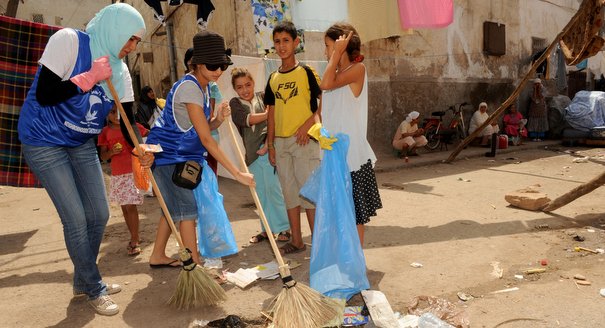
The state invested in basic infrastructure programmes for rural zones. Expansion of drinking water and electricity networks has improved well-being, even in poor communities.
During field research in Morocco last month, it was easy to see how these improvements had changed lives. Fatna, a 22-year-old mother, said that before the village water tower was built, she had to walk more than two kilometres to find water, three to four times a day. Since water became available at home, life is much more pleasant.
Rural electrification has allowed greater access to information and created opportunities for individuals and small businesses. Naima, a 43-year-old woman, told how access to electricity had changed her life for the better. She can now prepare and preserve food in the refrigerator, freeing her daughter to study in the evening. For Mohammad, a 35- year-old farmer, electricity means safety. Before electricity came to his home, he says: “We were an easy target for cattle robbers in the winter when the nights are long.”
Rural roads have created opportunities for transport of people and goods. They have given markets greater access to agricultural produce, allowed people to commute to work, and better access to health and education for rural populations.
Public investments in infrastructure would have not been possible without stable fiscal resources. Morocco began to reform its tax system in the 1980s by rationalising exemptions and reinforcing tax administration. Tax revenues now account for 24 per cent of GDP, compared to 15 and 11 per cent in Egypt and Syria, respectively. Additionally, Moroccan authorities created a special fund to which half of any privatisation revenues have been automatically channeled. By 2009, the fund had accumulated more than $4 billion (Dh14.7 billion) and contributed to the financing of more than $27 billion worth of public investments.
Small loans extended by microcredit associations are another device that served to cut poverty. In the Arab world, Morocco is the leader in microcredit with 59 per cent of total regional loans granted. Microcredit loans help people to escape from poverty by providing start-up money for small business or consolidating existing ones. As Adam Smith, the author of The Wealth of Nations, wrote: “Money makes money, when you have got a little it is often easy to get more. The great difficulty is to get that little.” The number of microcredit beneficiaries has increased to 1.3 million. Unlike banking credit, which is limited to urban zones, microcredit benefits people in small, isolated villages.
Moroccans working abroad also play a prominent role in cutting poverty rates by remitting money to their parents and relatives. On average, each Moroccan emigrant sends the equivalent $100 to his family each month. Increasingly, migration overseas of one or more family members represents a key household strategy for escaping poverty. At a macroeconomic level, remittances represent eight per cent of GDP in Morocco, compared to five per cent in Egypt and less than three per cent in Syria.
Finally, active involvement by local civil society organisations contributed to the country’s poverty decline. At first, the state tolerated NGOs since they focused on providing services and not confrontational politics. The partnership between NGOs and state and local councils, to provide electricity and water and to improve literacy rates, strengthened their position by building relationships with the government. Then an amendment to the legal framework governing such associations in 2002 allowed Morocco’s NGOs to take direct advantage of foreign funding sources.
In the last decade, about 1.7 million Moroccans moved out of poverty. The challenge today for Morocco is to sustain the trend and prevent those who escape poverty from sliding backwards. Achieving these goals requires that a higher priority be given to fighting illiteracy, more redistributive fiscal policies and adequate incentives for informal entrepreneurs to join the formal economy.
For policy makers in other parts of the Arab world, there is much to be learnt from the Moroccan experience: serious progress on poverty can be made even in countries with large populations and without massive natural resource wealth.
Carnegie does not take institutional positions on public policy issues; the views represented herein are those of the author(s) and do not necessarily reflect the views of Carnegie, its staff, or its trustees.
A summer of escalation in the Black Sea has hurt Ukraine economically and is exacerbating world food security. A truce is needed—as is a broader reframing of Europe’s Ukraine strategy.
As geopolitical rivalry weaponizes global supply chains, the EU’s true vulnerability lies in emerging-risk imports. For these goods, suppliers are growing more concentrated, substitution more difficult, and political risk is looming.
The EU is putting together a new security strategy to meet today’s myriad challenges. But for any proposal to be effective, the union needs to grapple with its identity and ambitions.
The EU’s new migration policy is not suited to today’s realities. With climate change increasingly becoming a driver of displacement, Europe needs to rethink its deterrence-focused approach.
Between the United States’ market-driven approach and China's state-led industrial strategy, Europe is reckoning with how it can remain competitive in the global economy. But is Europe in danger of becoming a U.S. or China colony?