

Commentary
The new U.S.–Denmark–Greenland agreement will help Washington exert political, economic, and financial dominance under the guise of security. Yet, it acknowledged Copenhagen’s and Nuuk’s sovereignty on the island.
Marc Pierini
{
  "authors": [
    "Dmitri Trenin",
    "Andrei Trenin"
  ],
  "type": "legacyinthemedia",
  "centerAffiliationAll": "",
  "centers": [
    "Carnegie Endowment for International Peace",
    "Carnegie Europe",
    "Carnegie Russia Eurasia Center"
  ],
  "collections": [],
  "englishNewsletterAll": "",
  "nonEnglishNewsletterAll": "",
  "primaryCenter": "Carnegie Russia Eurasia Center",
  "programAffiliation": "",
  "programs": [],
  "projects": [
    "Eurasia in Transition"
  ],
  "regions": [
    "Central Asia",
    "Caucasus",
    "Russia",
    "Asia"
  ],
  "topics": [
    "Foreign Policy"
  ]
}
Source: Getty
If Russia wants to be a principal security provider and peace guarantor in the CIS space, it will need to refocus its strategy away from resisting NATO's drive and U.S. deployments and toward conflict prevention and conflict resolution.
Source: Radio Free Europe/Radio Liberty

First, Russia undertakes to guarantee Armenia's territorial integrity in its entirety, and not just its borders with Turkey and Iran, as before. This pledge is already contained in the current Russian military doctrine, which calls an attack on any member of the Moscow-led Collective Security Treaty Organization (CSTO) an attack on all. Azerbaijan, which talks about using all means necessary to restore control over Nagorno-Karabakh, is being put on notice: war against Armenia is not an option.
Second, Russia is signaling it is not about to leave anytime soon. The treaty with Armenia has been extended through 2044. This is becoming a trend: earlier this year, Ukraine agreed to host the Russian Black Sea Fleet through 2042. Russian strategists are beginning again to think in the long term. Some analysts believe this trend will continue in Moldova. From Moscow's perspective, however, it is crucial to consolidate a military presence in Kyrgyzstan and Tajikistan, Central Asia's two fragile states sharing the potentially explosive Ferghana Valley and situated too close for comfort to Afghanistan.
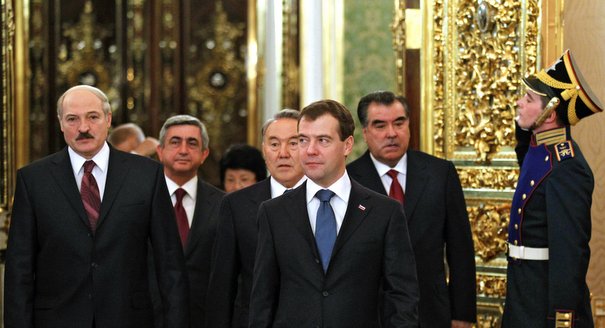
Thus, Russia is busy creating a security system around its perimeter. All his differences with Moscow notwithstanding, Belarusian President Alyaksandr Lukashenka has recently dropped his objections to chairing the CSTO. Two years after the war with Georgia, Russia has become entrenched militarily in Abkhazia and South Ossetia. It has also intensified contacts with Ukraine and Moldova, neither of which belongs to the CSTO. And next month, Medvedev is due in Baku.
The Russian leadership is obviously capitalizing on the pause in the NATO enlargement process. Both Ukraine and Georgia, mostly through their own actions, are much farther away from acceding to the Atlantic alliance than they were in 2008. The Obama administration, unlike its Republican predecessor, has little interest in combating Russian influence in the former Soviet republics. For the United States, the reset in U.S.-Russian relations holds out the promise of strategic cooperation on the issues of utmost importance to Washington, such as Afghanistan and Iran. Moscow's own drive toward technological modernization prioritizes relations with North America and the European Union.
True to the new trend, the leading powers of the West have expressed little concern over the strengthening of Moscow's strategic position in its immediate neighborhood. Partly this was due to the voluntary nature of the new agreements. The cash-strapped Ukrainians have agreed to the extension of the Sevastopol lease in exchange for a substantial subsidy; the Armenians have just won an unambiguous Russian security guarantee for their strategically isolated state.
Partly the reason for acquiescence has been the convergence of interest: the United States shares Russia's concern over the stability of Kyrgyzstan and its neighbors. Where Washington disagrees with Moscow, as on Georgia, the disagreement has been securely fenced off.
It is also important that the long lull in NATO's eastern enlargement has resulted from the changes in the candidate countries themselves -- and not from any deal with Moscow. Ukraine has seen a change of government and, consequently, a strategic reassessment; and Georgia resorted to force against its breakaway province, provoking a war with Russia. What is no less important is the sense of strategic overstretch that was discernible even before the global crisis both in the United States and in the European Union. Neither NATO nor the EU will begin moving east again for a long time.
Which means that, in the foreseeable future, Russia may have fewer impediments than ever to play a role it has always coveted, that of a principal security provider and peace guarantor in the space once covered by the Soviet Union. If the Russians are serious about exercising that role, they will have to adapt their policies and mend their ways. Above all, they will need to refocus their strategy from an essentially negative one -- resisting NATO's drive and U.S. deployments -- to a positive one: conflict prevention and conflict resolution.
Conflict prevention would necessitate a thorough reform of the CSTO away from a club of Russia's friends into an effective security tool, first of all in Central Asia. The region looks increasingly fragile, both from within and in view of the developments next door, particularly in Afghanistan. A NATO-like political structure, plus a modern integrated security toolbox and a much better analytical capacity, would help turn the toy copy of the Warsaw Pact into a functioning regional mechanism adequate to the new challenges. The reformed CSTO would not need to bother looking beyond Central Asia: bilateral treaties, like the Russo-Armenian one, would suffice.
Conflict resolution would require determined efforts to bring the post-Soviet conflicts to a close, two decades after the beak-up of the USSR. The Transdniestrian one appears easiest to resolve, but it still demands some heavy lifting in Tiraspol and Chisinau, as well as close coordination with Kyiv and good-faith cooperation with the European Union and the United States. To ease the Abkhaz and Ossetian situations, Russia would need, already now, to start opening up to the Georgian people and, eventually, to the government in Tbilisi -- probably after President Mikheil Saakashvili bows out at the end of his second term.
It is the Karabakh issue that looks the most difficult and dangerous one by far.
By expanding its guarantees to Armenia and extending the treaty's term, Moscow has given a warning to Baku to drop war as an instrument of policy. Now it needs to make another step, by producing incentives for both Armenia and Azerbaijan to reach a peace deal. A decade ago, at Key West, Florida, the deal was almost done, but it fell through because, unlike their leaders, the two countries' elites were not yet ready to embrace it.
Now, with the support of the Minsk group and its U.S. and French co-chairs, as well as the regional power Turkey, Russia needs to take the lead in bringing the sides to a final settlement. Over time, that will be the ultimate proof of its security-building capacity.
Dmitri Trenin is director of the Carnegie Moscow Center. His son, Andrei, is an independent security and energy analyst.
This article originally appeared on the Radio Free Europe/Radio Liberty site.
Former Director, Carnegie Moscow Center
Trenin was director of the Carnegie Moscow Center from 2008 to early 2022.
Andrei Trenin
Carnegie does not take institutional positions on public policy issues; the views represented herein are those of the author(s) and do not necessarily reflect the views of Carnegie, its staff, or its trustees.

The new U.S.–Denmark–Greenland agreement will help Washington exert political, economic, and financial dominance under the guise of security. Yet, it acknowledged Copenhagen’s and Nuuk’s sovereignty on the island.

Marc Pierini

A summer of escalation in the Black Sea has hurt Ukraine economically and is exacerbating world food security. A truce is needed—as is a broader reframing of Europe’s Ukraine strategy.

Thomas de Waal

Are Germany’s economic, industrial, and political struggles becoming a liability for the EU’s ability to rise to the geopolitical moment?

Rym Momtaz, ed.

European Commission President Ursula von der Leyen is about to give her annual address on the state of the EU. Here’s what she won’t—but should—say.
Rym Momtaz

The aftermath of the Ceuta crisis shows Europe has drawn the wrong lessons. Rather than doubling down on failed migration policies, the EU needs to address the underlying roots of such episodes.

Richard Youngs