

Research
- +5
Alper Coşkun, Fatih Ceylan, Tacan İldem, …
{
  "authors": [
    "Sinan Ülgen"
  ],
  "type": "legacyinthemedia",
  "centerAffiliationAll": "",
  "centers": [
    "Carnegie Endowment for International Peace",
    "Carnegie Europe",
    "Malcolm H. Kerr Carnegie Middle East Center",
    "Carnegie Russia Eurasia Center"
  ],
  "collections": [
    "Turkey’s Transformation"
  ],
  "englishNewsletterAll": "",
  "nonEnglishNewsletterAll": "",
  "primaryCenter": "Carnegie Europe",
  "programAffiliation": "",
  "programs": [],
  "projects": [
    "Eurasia in Transition"
  ],
  "regions": [
    "Middle East",
    "Europe",
    "Türkiye",
    "Levant"
  ],
  "topics": [
    "Political Reform",
    "Democracy"
  ]
}
Source: Getty
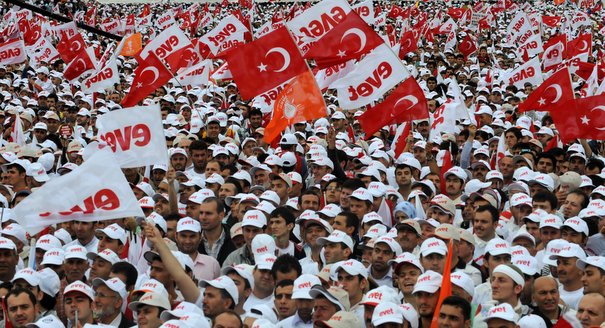
Turks are preparing to vote on a set of proposed constitutional amendments that risk undermining the independence of the judiciary and eroding one of the necessary checks on the power of the executive branch.
Source: The Financial Times

Its leader, Prime Minister Recep Tayyip Erdogan, has spearheaded the “Yes” campaign for Sunday’s vote, even warning Turkey’s business leaders that “those who remain impartial shall be sidelined”. He contends that the granting of union rights for civil servants, the right of individual recourse to the Constitutional Court and the establishment of an independent ombudsman amount to a radical overhaul of Turkish democracy.
But the opposition asserts that the core objective of the package is to allow the government to exert more control over the judiciary. By changing the set-up of the Constitutional Court and the Supreme Board of Judges and Prosecutors, the opposition argues the AKP aims to bring the judiciary under its control, thus extending its dominance over almost all state institutions.
This fear reflects a major and structural shortcoming of Turkish democracy: the lack of a strong and reliable system of checks and balances on political power. In Turkey, the military had in the past assumed this role. That is how the army was essentially able, with popular support, to oust unpopular governments. The age of this undemocratic leeway enjoyed by the armed forces has now come to an end. As the army’s power wanes, however, the need to strengthen the democratic alternatives for providing a counterweight to executive power is ever more pressing.
In parliamentary systems where the executive already controls the legislature, this is essentially ensured by an independent judiciary and a free media. The AKP’s record on protecting media freedoms and pluralism is poor. Not only has it striven to nourish an unabashedly pro-government media, it has also induced remaining media groups to tone down their criticism as witnessed by the politically motivated $2.5bn dollar tax fine imposed against the Dogan group.
As for the judiciary, the AKP contends that the amendments will break the outdated tradition of allowing the judiciary to interpret the law in a way that favours the state over the individual. In other words, for the AKP the problem with the judiciary is over its impartiality rather than its independence.
The proposed treatment, however, is at odds with this diagnosis. The amendments do not enshrine measures that may be relevant for addressing this shortcoming: there are no new rules for ensuring lawyers, judges or prosecutors become versed in the liberal tradition of legal practice. Instead, the amendments introduce procedural changes to the appointments of supreme justices allowing more to be appointed by the president and the legislative branch from state institutions controlled by the executive branch. An independent but ideological judiciary may thus be transformed into a dependent and possibly equally ideological entity. The independence is further undermined by allowing the minister of justice to remain at the helm of the supreme board of judges and prosecutors, which has the overall responsibility for the supervision of the judiciary.
Turkish leaders are fond of presenting the country as a unique model combining modernity, democracy and Islam. The attractiveness of this model, which underpins the country’s growing regional influence, depends on the sustainability of these credentials. A genuine democracy however needs rules and institutions to limit the government’s freedom of action. Devoid of such a crucial system of checks and balances, Turkish democracy runs the risk of being taken hostage by elected but authoritarian leaders. This would constitute a significant setback for a democracy that has laboured for years to replace the cult of a strong and unimpeded leader by a shared belief in institutions and the rule of law.
Such a development would not only distance Turkey from its traditional partners in the west and give new ammunition to the Turkey-sceptics in the EU but would also significantly undermine the burgeoning soft power of Ankara.

Senior Fellow, Carnegie Europe
Sinan Ülgen is a senior fellow at Carnegie Europe in Brussels, where his research focuses on Turkish foreign policy, transatlantic relations, international trade, economic security, and digital policy.
Recent Work
Alper Coşkun, Fatih Ceylan, Tacan İldem, …
Carnegie does not take institutional positions on public policy issues; the views represented herein are those of the author(s) and do not necessarily reflect the views of Carnegie, its staff, or its trustees.

An overwhelming victory by a far-right-wing party in a small state in eastern Germany will have major repercussions for Chancellor Friedrich Merz’s coalition.

Judy Dempsey

Canadian Prime Minister Mark Carney has twice inspired praise for standing up to U.S. President Donald Trump: at the 2026 World Economic Forum in Davos and on Canada-U.S. trade negotiations. Is Carney showing a third way better than the EU has in dealing with the Trump administration?

Rym Momtaz, ed.

The EU’s responses to two recent incidents expose the gulf between European perceptions and capabilities. Unless the union can bridge that gap, it will never become a real geostrategic power.
Rym Momtaz

European states control several Overseas Countries and Territories around the world that carry strategic, economic, and environmental weight. As great powers challenge the rules-based order, defending them is a geopolitical imperative for Europe.

Marc Pierini

In supporting Europe’s far-right, MAGA and Russia both want the same thing: a weaker EU. Europe must defend itself without abandoning the openness these forces exploit.

Armida van Rij