• Research
  • Strategic Europe
  • About
  • Experts
Carnegie Europe logoCarnegie lettermark logo
EUUkraine
  • Donate
{
  "authors": [
    "Paul Salem"
  ],
  "type": "legacyinthemedia",
  "centerAffiliationAll": "",
  "centers": [
    "Carnegie Endowment for International Peace",
    "Malcolm H. Kerr Carnegie Middle East Center"
  ],
  "collections": [],
  "englishNewsletterAll": "",
  "nonEnglishNewsletterAll": "",
  "primaryCenter": "Malcolm H. Kerr Carnegie Middle East Center",
  "programAffiliation": "",
  "programs": [],
  "projects": [],
  "regions": [
    "Levant",
    "Lebanon",
    "Middle East"
  ],
  "topics": [
    "Security"
  ]
}
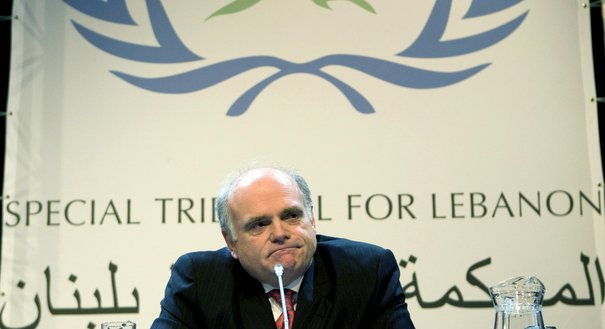
Source: Getty

In The Media
Malcolm H. Kerr Carnegie Middle East Center

Tensions Over Tribunal Threaten Country's Delicate Sectarian Balance

The possibility that the Special Tribunal for Lebanon might indict members of Hizbollah in its investigation into the assassination of former Prime Minister Rafik Hariri has increased tensions and could result in the collapse of Lebanon’s fragile political balance.

Link Copied
By Paul Salem
Published on Oct 1, 2010

Source: Los Angeles Times

Tensions Over Tribunal Threaten Country's Delicate
The tensions over the special tribunal for Lebanon are threatening to push Lebanon to collapse. Support for the tribunal was a point of consensus in the national dialogue meetings of 2006 and was part of the official mission statements of two successive governments. Now that the indictments apparently might come out blaming members of Hezbollah, that party is demanding that the prime minister and his government stop all cooperation with the tribunal.
 
Hezbollah charges that the tribunal is neither professional nor neutral, and that it has been used by the U.S., the West and Israel, first to pressure Syria, and now to isolate and undermine Hezbollah. Officials of Hezbollah, Syria and other Syrian allies in Lebanon have warned that unless the prime minister changes his position, the tribunal and indictments will lead to civil war. 
 
Prime Minister Saad Hariri has held firm, stating that the tribunal adjudicating his father’s assassination, and that of many others, was not a subject for negotiation. Walid Jumblatt, Hariri’s former ally, now says that he “wished the [tribunal] had never been set up,” and is trying, with house Speaker Nabih Berri, to find a negotiated resolution to this confrontation. But it is hard to find any middle ground between accepting or rejecting the tribunal and its indictments.
 
It's now clear that the Saudi-Syrian summit in Beirut in late July brought temporary calm, but did not arrive at a resolution of the tribunal issue. Syria has maintained good relations with Prime Minister Hariri but has not intervened directly in this case, leaving Hezbollah to lead the charge and encouraging its other allies in Lebanon to raise the pressure. Syria wants Lebanon to cut its ties with the tribunal but does not want to take the blame for forcing the issue.
 
Syrian-Saudi relations have worsened since Syria went along with Iran’s choice for prime minister in Iraq, Nouri al-Malki; this worsening might be part of the reason for rising tensions in Lebanon.
 
Without any security defenses, Hariri might be calculating that Hezbollah, as well as Syria and Iran, would not want to risk sectarian Sunni-Shiite civil war; or that at least such a move by Hezbollah would be very costly for it and would seriously affect its image in the Arab and Muslim world. Hariri has succeeded in making the issue of the tribunal a Sunni red line in Lebanon, with several other Sunni leaders falling in line behind his position.
 
Hariri is also aware that although Hezbollah and its allies can bring down his government, they want the tribunal concession from him — because he is the son of the deceased. In addition, it will be very hard to find a credible Sunni leader to take his place at the head of a new government and openly grant Hezbollah what it wants over this highly charged issue.
 
Hezbollah might stay its hand until after Iranian president Ahmadinejad’s visit to Lebanon  Oct. 13-15. That visit in itself will raise tensions with Israel, as well as with the U.S., Saudi Arabia, Egypt and other Arab Sunni powers. The internal escalation will probably start after that date. Hezbollah has a wide array of military and political options to use against Hariri; but if Hariri refuses to concede, even if militarily and politically besieged, the country could enter an extended period of paralysis and open-ended tension that would further undermine the institutions of the state and erode the lingering consensus on the Taif Agreement.
 
The depth of division in Lebanon has reached a critical point as accord has been lost over key issues such as the principle of state sovereignty, the authority of the constitution and rule of law, the authority of national institutions, the power-sharing formula, and foreign and defense policies. At the tail end of a drawn-out crisis, Hezbollah might insist on revisiting the Taif Agreement, and revising the power-sharing formula in the country in its community’s favor.
 
Hezbollah is in a very tight position: facing potential international indictments, war with Israel or isolation if the peace process moves forward. It has a historic and overwhelming dominance in Lebanon, and it sees how its sister community in Iraq has institutionalized its ascendancy there. It is possible that facing such severe challenges, Hezbollah might opt to press its advantage and claim a more central role for its community in the government.
 
None of this is inevitable. But because there seems to be no middle ground regarding the tribunal, and because it touches on such sensitive issues for both Sunni and Shiite communities, it might usher in not only a period of crisis, but a meltdown of the post-Taif state. Perhaps a compromise can still be found; but as things stand today, the country is headed for a drawn-out standoff whose outcome might go well beyond the issue of the tribunal and current government."

About the Author

Paul Salem

Senior Fellow at the Middle East Institute

Paul Salem is a senior fellow at the Middle East Institute.

    Recent Work

  • Paper
    Iraq’s Tangled Foreign Interests and Relations

      Paul Salem

  • Article
    Bracing for Impact in Syria

      Paul Salem

Paul Salem
Senior Fellow at the Middle East Institute
Paul Salem
SecurityLevantLebanonMiddle East

Carnegie does not take institutional positions on public policy issues; the views represented herein are those of the author(s) and do not necessarily reflect the views of Carnegie, its staff, or its trustees.

More Work from Carnegie Europe

  • Commentary
    Strategic Europe
    Russia’s Imperial Retreat Is Europe’s Strategic Opportunity

    The war in Ukraine is costing Russia its leverage overseas. Across the South Caucasus and Middle East, this presents an opportunity for Europe to pick up the pieces and claim its own sphere of influence.

      William Dixon, Maksym Beznosiuk

  • Commentary
    Strategic Europe
    Europe and the Arab Gulf Must Come Together

    The war in Iran proves the United States is now a destabilizing actor for Europe and the Arab Gulf. From protect their economies and energy supplies to safeguarding their territorial integrity, both regions have much to gain from forming a new kind of partnership together.

      • Rym Momtaz

      Rym Momtaz

  • Commentary
    Strategic Europe
    Taking the Pulse: Is France’s New Nuclear Doctrine Ambitious Enough?

    French President Emmanuel Macron has unveiled his country’s new nuclear doctrine. Are the changes he has made enough to reassure France’s European partners in the current geopolitical context?

      • Rym Momtaz

      Rym Momtaz, ed.

  • Commentary
    The Iran War’s Dangerous Fallout for Europe

    The drone strike on the British air base in Akrotiri brings Europe’s proximity to the conflict in Iran into sharp relief. In the fog of war, old tensions in the Eastern Mediterranean risk being reignited, and regional stakeholders must avoid escalation.

      Marc Pierini

  • Commentary
    Strategic Europe
    Europe on Iran: Gone with the Wind

    Europe’s reaction to the war in Iran has been disunited and meek, a far cry from its previously leading role in diplomacy with Tehran. To avoid being condemned to the sidelines while escalation continues, Brussels needs to stand up for international law.

      Pierre Vimont

Get more news and analysis from
Carnegie Europe
Carnegie Europe logo, white
Rue du Congrès, 151000 Brussels, Belgium
  • Research
  • Strategic Europe
  • About
  • Experts
  • Projects
  • Events
  • Contact
  • Careers
  • Privacy
  • For Media
  • Gender Equality Plan
Get more news and analysis from
Carnegie Europe
© 2026 Carnegie Endowment for International Peace. All rights reserved.