

Paper
Ashley J. Tellis
{
  "authors": [
    "Ashley J. Tellis"
  ],
  "type": "legacyinthemedia",
  "centerAffiliationAll": "dc",
  "centers": [
    "Carnegie Endowment for International Peace",
    "Carnegie Russia Eurasia Center"
  ],
  "collections": [],
  "englishNewsletterAll": "ctw",
  "nonEnglishNewsletterAll": "",
  "primaryCenter": "Carnegie Endowment for International Peace",
  "programAffiliation": "SAP",
  "programs": [
    "South Asia"
  ],
  "projects": [],
  "regions": [
    "South Asia",
    "India"
  ],
  "topics": [
    "Security",
    "Military",
    "Foreign Policy"
  ]
}
Source: Getty
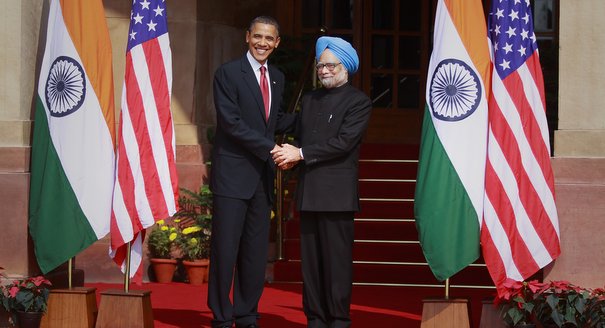
A strong U.S.-Indian partnership is in both countries’ strategic interest and both must make an effort to strengthen the relationship and foster India's continuing economic and political rise.
Source: Project Syndicate

In coming decades, a strong bilateral partnership will prove vital in managing the rise of China and promoting an Asian balance of power that is favorable to India, the United States, and Asia as a whole. India’s success as a democracy also strengthens freedom globally and protects broader American interests.
Yet, as many observers have noted, US-India relations have recently become listless and marked by drift. Both countries are to blame. Obama has understandably focused on competing priorities, including the troubled US economy and ongoing wars abroad. India’s government has been similarly occupied with domestic political struggles and the challenge of sustaining economic growth amid rising pressure for redistribution. Moreover, Indian officials must still nurture the small, albeit growing, constituency that supports a rapidly transformed relationship with the US.
This trip provides a great opportunity for both sides to reinvigorate a critical relationship.
For its part, the Obama administration should take a number of steps to reaffirm its support for India’s rise, its democratic achievements, and its struggle for security. Notably, the US should reaffirm its support for a larger Indian role in international organizations and help integrate India into the global non-proliferation regime.
In this context, the Obama administration should endorse India’s quest for a permanent seat on the United Nations Security Council. Obama should also support India’s membership in key non-proliferation organizations like the Nuclear Suppliers Group and the Missile Technology Control Regime.
India, too, must do its part. It can begin by creating greater opportunities for US firms – including from the nuclear industry – to invest in India’s economic success. It can expand defense cooperation beyond purchases of American-made military equipment by deepening its diplomatic engagement with the US to help find solutions to the difficult problems stemming from Afghanistan, Pakistan, and Iran. In short, India’s government should look for ways to sustain America’s interest in India during difficult times.
Both countries should consolidate their cooperation in other areas already agreed upon: agriculture, education, health care, energy, and science and technology. Obama’s trip offers an opportunity for taking stock, expanding initiatives that have matured, and announcing new projects that will provide global benefits.
The latter include developing an international food security initiative, cooperating to increase vocational training in fragile states, expanding clean-energy research, investing in global disease-detection systems, and collaborating to explore shale-gas extraction. In addition, the US and India should create innovation partnerships, which would not only yield direct returns to both countries, but would also demonstrate how a strong bilateral relationship can improve the international system.
The US and India should expand cooperation on other multilateral issues as well. The global economic crisis and new fears of US protectionism have motivated India to rethink its attitude toward the Doha Development Round. If Obama can weather domestic resistance to new international trade negotiations and modify America’s current position on sectoral tariff reduction by developing countries, the US and India will have an opportunity to break the impasse that has stymied the Doha Round’s successful conclusion.
Ultimately, a strong US-Indian partnership is in both countries’ strategic interest. Their societies are already intertwined – and will be even more so in the future – by various personal, economic, and social links. Moreover, Obama should resist the urge to approach the bilateral relationship purely in transactional terms, but instead should seek to strengthen India’s long-term capacity to be a productive partner with the US.
In short, Obama ought not to ask, “What will India do for us?”, but rather, “Is a strong, democratic and independent India in America’s national interest?” If the answer to this question is yes – as it should be – then the US should focus on how it can help India’s power continue to grow.
By reaffirming the US commitment to aid India’s rise, and by emphasizing America’s fellowship with India, Obama can help bring the two countries together on the basis of shared interests, and move their relationship forward significantly. That effort must start now.
Former Senior Fellow
Ashley J. Tellis was a senior fellow at the Carnegie Endowment for International Peace.
Recent Work
Ashley J. Tellis
Ashley J. Tellis
Carnegie does not take institutional positions on public policy issues; the views represented herein are those of the author(s) and do not necessarily reflect the views of Carnegie, its staff, or its trustees.

Funding Ukraine remains a priority for European leaders. As Russia’s war of aggression heads into another winter, two feasible options to mobilize support for Kyiv should be fast-tracked.


Vladyslav Rashkovan, Gregory P. Wilson

While the EU and European governments are embracing the much-lauded middle-power moment, this entails three difficult conundrums.

Richard Youngs

Europe is facing rising populism internally as well as external pressures from Russia, China, Turkey, and the United States.

Dimitar Bechev

Much has been said of the changes Brussels is trying to make to the EU enlargement process. Here’s why gradual integration might—or might not—be the answer.
Dimitar Bechev

The European Commissioner for Trade is headed to China. But after President Xi’s bridge-building visit to Washington, can a more isolated EU overcome Beijing’s stranglehold on critical raw materials? Who will blink first?

Rym Momtaz, ed.