

Commentary
Dmitri Trenin
{
  "authors": [
    "Dmitri Trenin"
  ],
  "type": "legacyinthemedia",
  "centerAffiliationAll": "",
  "centers": [
    "Carnegie Endowment for International Peace",
    "Carnegie Europe",
    "Carnegie Russia Eurasia Center"
  ],
  "collections": [],
  "englishNewsletterAll": "",
  "nonEnglishNewsletterAll": "",
  "primaryCenter": "Carnegie Russia Eurasia Center",
  "programAffiliation": "",
  "programs": [],
  "projects": [
    "U.S.-Russia Bilateral Presidential Commission"
  ],
  "regions": [
    "North America",
    "United States",
    "Caucasus",
    "Russia"
  ],
  "topics": [
    "Foreign Policy",
    "Political Reform",
    "Security",
    "Military",
    "Nuclear Policy"
  ]
}
Source: Getty
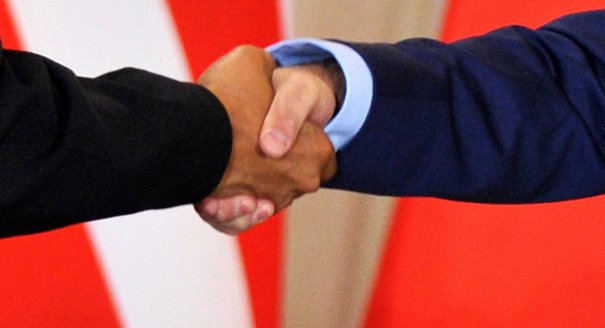
A failure by the U.S. Senate to ratify New START before the end of the year may cause Moscow to doubt the U.S. commitment to improving ties with Russia and could put the reset in bilateral relations on hold.
Source: Foreign Policy

If this looks bad from Washington, it looks worse from Moscow. Kyl isn't just imperiling Obama's arms-reduction ambitions -- he's also diminishing the American president's credibility abroad. And in the eyes of Russia's leaders, he's casting into doubt the United States' commitment to fixing its relationship with Russia.
To the Kremlin, New START's apparent demise may well mean the end of an arms-control agenda that seemed on the verge of resuscitation by Obama after suffering clinical death at the hands of George W. Bush. Arms-control agreements gave Russia a sense of security in the post-Cold War era, when the former superpower was struggling to define itself in the shadow of a militarily superior United States. The agreements allowed Russian leaders to claim strategic equality with the United States, holding on to a small measure of great-power status. That came to an end in 2002, when Bush pulled out of the 30-year-old Anti-Ballistic Missile Treaty.
That the Bush-era policy of zero arms control is suddenly poised to make a comeback is definitely bad news -- not just for arms control, but for the entire U.S.-Russia relationship. Both President Dmitry Medvedev (overtly) and Prime Minister Vladimir Putin (covertly) have invested a great deal in a new relationship with the United States and, in the run-up to NATO's Lisbon summit this weekend, hoped for a similar "reset" with that organization. Now the hard-liners in Russia who argued that Obama's charm offensive was but a brief interlude in an otherwise hegemonic U.S. foreign policy will see their views vindicated by the START debacle. Those who doubt the wisdom of cooperation with the United States and NATO on missile defense will speak with more confidence. Russian strategists will see U.S. missile defense efforts in more confrontational terms. Instead of thinking about coordinating defenses with the United States, they will resume thinking about how to defend Russia from the United States. "The future of the reset process which implies the development of a partnership on security issues depends on the ratification of the treaty in one way or another," Mikhail Margelov, chairman of the Federation Council of Russia's international affairs committee, told the Interfax news agency.
The Kremlin, however, knows enough about U.S. politics to know that Obama isn't the problem. As long as he's in the White House, Russian leaders will consider the reset halted, but not reversed. New START, after all, was a symbol of the reset, not the heart of it. For Moscow, Obama's most important -- and welcome -- decision to date has been to end his predecessor's efforts to roll back Russian influence in the former Soviet Union. NATO enlargement to Ukraine and Georgia has been put on hold. Arming Georgia has largely stopped. And Obama has scrapped Bush's Russia-centric missile-defense plans, with their radar and interceptor installations in the Czech Republic and Poland, in favor of a system designed to thwart potential threats from Iran. It was the unilateral and unconditional removal of these three irritants by Obama that gave the new U.S. president credibility in Moscow's eyes. As long as these issues are not revisited, the new cooperative relationship between Russia and the United States has every chance of continuing, albeit with new, more stringent limits.
Conversely, a material change in Washington's approach to any one of these points of contention would end the U.S.-Russia strategic cooperation -- a cooperation that is much more substantial and important than the United States' Russia hawks realize. Russia has allowed U.S. and NATO military transit through its territory and airspace, maintaining a vital northern supply route to Afghanistan. Moscow pleasantly surprised U.S. officials in September by not just supporting a new U.N. Security Council sanctions resolution on Iran, but annulling its sale of an air defense system to the country -- a decision that was controversial domestically in Russia. Moscow is unlikely to retaliate for New START's collapse by reversing itself on these goodwill gestures, but further cooperation will come at a higher price.
For now, the Russian leadership is keeping its cool. It does not want to appear panicky, so as to maintain the appearance that Washington needs the treaty as much as Moscow. U.S. politics being fluid, the foreign ministry has expressed a hope that New START may yet be ratified. It is not a given that Obama will be a one-term president, and as long as he is in the White House he remains a partner, even if his political stock has gone down.
Still, there is no denying that the next couple of years will be a difficult time in U.S.-Russia relations, even if they aren't a throwback to the late Bush years. The change in the House of Representatives' Foreign Affairs Committee from Democrat Howard Berman to the hawkish Republican Ileana Ros-Lehtinen will be very noticeable. There will certainly be more criticism on the Hill of Russian domestic practices, and probably fewer congressional contacts with the Russian Duma.
For now, Russia -- along with other countries watching the nuclear-treaty negotiations from the sidelines -- has learned a valuable lesson about U.S. domestic politics. Partisanship in Washington has reached a new level, infecting not just longstanding domestic-policy disputes, but also foreign policy and national security issues. There was nothing anti-Russian in Kyl's move -- it was purely anti-Obama. To that end, he succeeded: The United States' allies and enemies abroad will probably pay more attention to the foreign-policy players in Congress and hold the president in somewhat lesser esteem.
Former Director, Carnegie Moscow Center
Trenin was director of the Carnegie Moscow Center from 2008 to early 2022.
Recent Work
Dmitri Trenin
Dmitri Trenin
Carnegie does not take institutional positions on public policy issues; the views represented herein are those of the author(s) and do not necessarily reflect the views of Carnegie, its staff, or its trustees.

With its public finances in shambles, the far right polling at 35 percent ahead of the 2027 presidential election, and a growing protest movement, is France’s crisis a threat to the EU’s geopolitical awakening?

Rym Momtaz, ed.

Ahead of a tough winter for Ukraine, Donald Trump’s swing back toward Russia bodes ill. But instead of panicking, Kyiv’s European allies are focusing on action.
Rym Momtaz

Funding Ukraine remains a priority for European leaders. As Russia’s war of aggression heads into another winter, two feasible options to mobilize support for Kyiv should be fast-tracked.


Vladyslav Rashkovan, Gregory P. Wilson

While the EU and European governments are embracing the much-lauded middle-power moment, this entails three difficult conundrums.

Richard Youngs

Europe is facing rising populism internally as well as external pressures from Russia, China, Turkey, and the United States.

Dimitar Bechev