

Paper
Ibrahim Saif, Ahmed Ghoneim
{
  "authors": [
    "Ibrahim Saif"
  ],
  "type": "legacyinthemedia",
  "centerAffiliationAll": "",
  "centers": [
    "Carnegie Endowment for International Peace",
    "Malcolm H. Kerr Carnegie Middle East Center"
  ],
  "collections": [],
  "englishNewsletterAll": "",
  "nonEnglishNewsletterAll": "",
  "primaryCenter": "Malcolm H. Kerr Carnegie Middle East Center",
  "programAffiliation": "",
  "programs": [],
  "projects": [],
  "regions": [
    "Gulf",
    "Levant",
    "Maghreb"
  ],
  "topics": [
    "Political Reform",
    "Economy"
  ]
}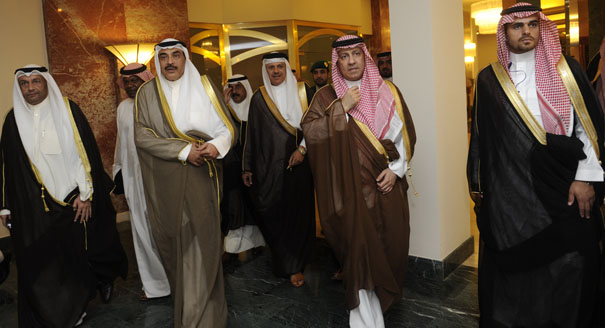
Source: Getty
Jordan and Morocco's prospective membership in the Gulf Cooperation Council could ease political and socio-economic tensions in the two monarchies, therefore reinforcing the Gulf's economic and strategic interests and security.
Source: National

In Jordan's case, the unanimous agreement by the six GCC states - Saudi Arabia, Bahrain, Kuwait, Oman, Qatar, and the United Arab Emirates - to call on Amman to enter membership negotiations was preceded by a number of meetings and visits by Jordanian officials to Gulf states. Jordan's King Abdullah II travelled to Qatar to improve bilateral relations that have been unstable for many years due to differences over Iran as well as relations with non-state actors, such as Lebanon's Hizbollah and the Palestinian Hamas movement. Until recently, Qatar had banned the issuance of work visas or important investment contracts to Jordanians.
Jordan's prime minister, Maarouf Bakhit, also recently delivered a royal message to Kuwait's emir, containing economic requests linked to increasing energy prices and Jordan's financial crisis.
The announcement of these invitations comes amid recent political developments in the kingdoms of Jordan and Morocco and in the Gulf states. Some observers consider the outreach to Jordan and Morocco a departure from the GCC's previous position, given that other states such as Yemen and Iraq - which are geographically closer - had sought to join the GCC but did not receive a positive response. Yemen was turned aside because of its small economy, while Saddam Hussein's regime and the disregard he showed for the regional bloc hurt Iraq's interests.
Jordan's difficult economic conditions, however, have provided a wide space for political mobilisation. The monarchy has responded to demands for change by adopting a more liberal tune regarding political reform. King Abdullah has formed commissions to examine the constitution and the powers entrusted to the king, and opened forums for national dialogue to study electoral and party laws.
As Jordan's economic crisis deepens and the state loses its ability to meet growing demands from public and private-sector workers and the unemployed, political demands are becoming increasingly strident - a factor that threatens the regime's stability. A partnership with such a rich regional bloc could ease the country's current economic pressures.
Given these developments, the GCC's acceptance of Jordan's request and its invitation to Morocco could help both countries delay answering growing political demands. Membership, if it occurs, implies the potential for improved economic conditions, greater financial stability and additional job opportunities - addressing the foremost challenges facing the two kingdoms.
Already, both Morocco and Jordan have seen calls for new forms of governance - based on stronger legislative institutions and limits on the king's absolute powers - that aim to create a "constitutional monarchy". Furthermore, there have been demands from opposition parties in both countries for an end to the role of unconstitutional institutions and committees, and for limits on the role of security agencies to ensure they stay out of political affairs.
The GCC's announcement can also be read in light of the security role that Jordan could play for the Gulf states in confronting Iran's growing influence and its appetite to interfere in the Gulf. This was apparent during the recent events in Bahrain, when the Gulf states' Peninsula Shield forces intervened to stop protests. While this military intervention so far has helped Bahrain achieve stability, the addition of Jordan's well-trained military force would be beneficial in contributing to similar missions in the future. Adding Morocco's contribution would further harden the GCC's position relative to Iran.
All of these factors explain the timing of the Gulf announcement. It is not the first time the subject of GCC expansion has been raised by both the member countries and those aspiring to join this wealthy club; what is new is the positive response to such suggestions and the states that have been invited. As for membership conditions, they will not exceed the traditional forms of cooperation between Arab states. While trade and movement of capital, commodities and individuals already occur on the basis of regulatory agreements, these could be expanded and institutionalised to give the newly acceded countries advantages over non-members, such as Lebanon and Egypt, which already compete in the GCC market.
The GCC has been reluctant to admit new states in the past because of its desire to remain a closed club, open only to those members who share many commonalities. The GCC's members also were divided on whether to expand the regional bloc. But it appears that domestic and regional conditions now require new forms of cooperation among some of the region's states.
The financial consequences of admitting new members to the GCC will certainly not overburden the Gulf states' financial surplus, as Jordan and Morocco total only 10 per cent of the GCC's gross domestic product. In return, the GCC needs security assistance to maintain stability, even if only temporarily.
Even with benefits for both sides, admission of Jordan and Morocco to the GCC is likely to proceed gradually, as doubts exist about its consequences, especially given the cultural differences between the Levant and Morocco and the more conservative Gulf. However, such fears are tempered by the fact that some of the Gulf states have coexisted successfully with different cultures in past decades. The formula of providing security to the GCC in return for economic assistance to Jordan and Morocco marks a new era of cooperation in a region that is experiencing many firsts this year.

Former Senior Associate, Middle East Center
Saif is an economist specializing in the political economy of the Middle East. His research focuses on international trade and structural adjustment programs in developing countries, with emphasis on Jordan and the Middle East.
Recent Work
Ibrahim Saif, Ahmed Ghoneim
Ibrahim Saif, Muhammad Abu Rumman
Carnegie does not take institutional positions on public policy issues; the views represented herein are those of the author(s) and do not necessarily reflect the views of Carnegie, its staff, or its trustees.

A summer of escalation in the Black Sea has hurt Ukraine economically and is exacerbating world food security. A truce is needed—as is a broader reframing of Europe’s Ukraine strategy.

Thomas de Waal

As the EU confronts profound challenges, several leaders have called for fundamental reform to the union’s model—but only modest, superficial changes have resulted. What if Europe really could be reimagined from zero today: What should such a redesigned European order look like?

Richard Youngs, ed.

When the U.S.-Iran memorandum of understanding was announced, the UK, France, Germany, and Italy declared their readiness to help demine the Strait of Hormuz and lift nuclear sanctions on Tehran. But does Europe need new tools to recover a diplomatic role?

Rym Momtaz, ed.

As geopolitical rivalry weaponizes global supply chains, the EU’s true vulnerability lies in emerging-risk imports. For these goods, suppliers are growing more concentrated, substitution more difficult, and political risk is looming.

Sinan Ülgen

The EU is putting together a new security strategy to meet today’s myriad challenges. But for any proposal to be effective, the union needs to grapple with its identity and ambitions.

Pierre Vimont