

In The Media
Lahcen Achy
{
  "authors": [
    "Lahcen Achy"
  ],
  "type": "legacyinthemedia",
  "centerAffiliationAll": "",
  "centers": [
    "Carnegie Endowment for International Peace",
    "Malcolm H. Kerr Carnegie Middle East Center"
  ],
  "collections": [],
  "englishNewsletterAll": "",
  "nonEnglishNewsletterAll": "",
  "primaryCenter": "Malcolm H. Kerr Carnegie Middle East Center",
  "programAffiliation": "",
  "programs": [],
  "projects": [],
  "regions": [
    "Maghreb"
  ],
  "topics": [
    "Political Reform",
    "Security",
    "Economy"
  ]
}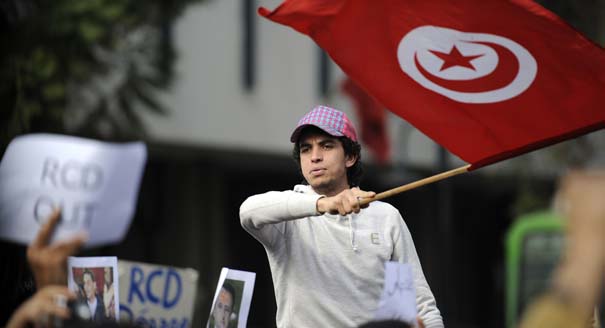
Source: Getty
As Tunisia moves away from its former regime, the country's policymakers need to seize this opportunity to review the foundations of the country's economic strategy and take steps to overcome its key challenges.
Source: National

Tunisia, however, was a complex case with a delicate authoritarian bargain between the regime and society. For a long time, the regime was able to provide economic and social gains and secure its legitimacy and political stability in return.
But the authoritarian bargain failed with the growing inability of the economy to create jobs for educated labour, the proliferation of unprotected and poorly paid jobs in the informal sector, and rising income inequality and regional disparities. Gradually, the losers from the status quo began to outnumber the winners - and this eroded the regime's legitimacy.
As Tunisia moves away from its former regime, policymakers need to seize the historic opportunity to review the foundations of the country's economic strategy and overcome its key challenges.
Striking a delicate balance between efficiency and social justice in economic policy and between a favourable investment climate and transparent incentive schemes will no doubt be tricky. The elected government - future members of the country's constituent assembly are currently campaigning - should come up with a consistent package of policies relying on credible discourse, concrete goals and a timetable to achieve them.
A sustainable process of job creation needs a strong and competitive private sector. In high-growth countries, private investment typically exceeds 25 per cent of GDP. But investment struggles to reach 15 per cent in Tunisia. The state still controls a great deal of the economy and also permeates the private sector through a complex web of cross-ownership. And the state is present not only in network industries - such as telecommunications, energy, transport, and banking - but also in other sectors such as fertilisers, mining, construction materials and so forth.
Policymakers, therefore, need to pinpoint the factors that impede private domestic and foreign investment and implement reforms in four key areas.
First, Tunisia needs to review investment restrictions, with the goal of increasing the participation of private domestic and foreign investors. Entry into many services, such as trading activities, are reserved for enterprises with Tunisians holding majority interests. For several other service activities, foreign investment requires prior agreement from Tunisia's Investment Commission if foreign ownership exceeds 50 per cent. The inner circle of the ousted president, Zine El Abidine Ben Ali, used these provisions to make themselves inescapable partners for foreign operators, which deterred private investment.
Second, the weakness of the Tunisian financial system handicaps growth because it raises the cost of capital and leads to inefficient resource allocation. The government maintains control over the three largest public banks and the banking sector continues to suffer from limited competition and excessive levels of nonperforming loans.
Third, authorities need to review incentives provided under the investment code and design more effective and transparent sets of supportive measures for investment and exports. Every year, the government gives up between 50 per cent and 60 per cent of the corporate taxes that are owed in the form of tax incentives. Yet, these incentives have been ineffective in promoting private investment and creating jobs. Mr Ben Ali's regime primarily used the system of incentives to buttress its legitimacy and strengthen its political and administrative control over the private sector.
Fourth, dealing a blow to the culture of corruption is essential to both the social and economic future of Tunisia. But corruption is a systemic issue that may not have fled Tunisia with Mr Ben Ali. Fighting corruption will entail cracking down on bribes, tax fraud and evasion and the allocation of social services for political purposes.
Although the media and public opinion focused exclusively on high-profile corruption among members of Mr Ben Ali's family who were abusing their positions, the issue of corruption and nepotism in Tunisia transcends the regime's inner circle and trickles down to large segments of the society.
The exchange of support for favours such as access to social services was widespread during the Mr Ben Ali regime. This practice, led by the ruling party's elite, was spread across all segments of society and came to define Tunisia's culture of patronage.
Policymakers and other stakeholders need to implement a comprehensive anti-corruption strategy. It needs to target not only those who abuse their positions but also private individuals and organisations that did so. Public awareness campaigns that explain the harmful effects of corruption on economic growth, investment and competition are necessary but insufficient. Raising awareness needs to come with adequate enforcement to be effective.
Tunisia's government will not have much room to manoeuvre and increase public investment in the years ahead with a large part of the budget absorbed by nondiscretionary spending in order to keep both public deficit and debt under control. The private sector is therefore essential for Tunisia's economic health. The elected government must promote private sector development by removing inefficient regulations and fighting corruption.
Instead of rents for patronage, the government needs to offer appropriate incentives based on economic efficiency and social justice.

Former Nonresident Senior Associate, Middle East Center
Achy is an economist with expertise in development, institutional economics, trade, and labor and a focus on the Middle East and North Africa.
Recent Work
Lahcen Achy
Lahcen Achy
Carnegie does not take institutional positions on public policy issues; the views represented herein are those of the author(s) and do not necessarily reflect the views of Carnegie, its staff, or its trustees.

European states control several Overseas Countries and Territories around the world that carry strategic, economic, and environmental weight. As great powers challenge the rules-based order, defending them is a geopolitical imperative for Europe.

Marc Pierini

Mounting economic strain and battlefield losses will not necessarily make the Kremlin less dangerous. They could instead push Moscow toward a more aggressive hybrid campaign designed to test NATO’s Eastern flank, exploit allied hesitation, and fracture European resolve.

Maksym Beznosiuk

Over the past ten years, NATO has held almost as many summits as it did during the entirety of the Cold War. Are they still useful, or is it time to stop holding annual meetings?

Rym Momtaz, ed.

As the EU confronts profound challenges, several leaders have called for fundamental reform to the union’s model—but only modest, superficial changes have resulted. What if Europe really could be reimagined from zero today: What should such a redesigned European order look like?

Richard Youngs, ed.

As Russia's war on Ukraine drags on, NATO is expanding its footprint in the Black Sea. Turkey, Romania, and Bulgaria are upgrading their fleets and deepening trilateral cooperation.

Dimitar Bechev