• Research
  • Strategic Europe
  • About
  • Experts
Carnegie Europe logoCarnegie lettermark logo
EUUkraine
  • Donate
{
  "authors": [
    "Marwan Muasher"
  ],
  "type": "legacyinthemedia",
  "centerAffiliationAll": "dc",
  "centers": [
    "Carnegie Endowment for International Peace",
    "Malcolm H. Kerr Carnegie Middle East Center"
  ],
  "collections": [
    "Arab Awakening"
  ],
  "englishNewsletterAll": "menaTransitions",
  "nonEnglishNewsletterAll": "",
  "primaryCenter": "Carnegie Endowment for International Peace",
  "programAffiliation": "MEP",
  "programs": [
    "Middle East"
  ],
  "projects": [],
  "regions": [
    "North Africa",
    "Tunisia",
    "Egypt",
    "Gulf",
    "Levant",
    "Maghreb"
  ],
  "topics": [
    "Political Reform"
  ]
}
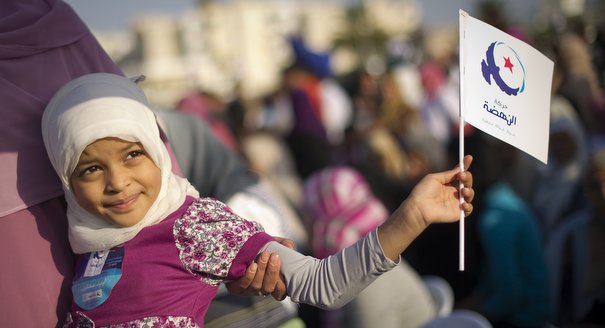
Source: Getty

In The Media

The Overblown Islamist Threat

Countries in transition have no choice but to open up their political system. Excluding and marginalizing Islamists out of fear will only strengthen their popular appeal.

Link Copied
By Marwan Muasher
Published on Nov 2, 2011

Source: New York Times

The Overblown Islamist ThreatTunisia’s election last month, in which the Islamist party Ennahda claimed more than 40 percent of the seats in the national assembly, reinforced the conventional wisdom that Islamists will be the biggest beneficiaries of the Arab Spring.

Held down for years by autocratic regimes, so the argument goes, Islamists will be able to exploit their popularity in new elections and ultimately gain control. This raises fears among secular leaders in the region and in Western capitals.
 
The West wants to pretend that Islamist parties don’t really exist. This won’t work. Political Islam will not go away because the West ignores it; Islamist parties will, however, become more moderate if they are included in government.
 
Islamists are unlikely to take over new governments in the Arab world, and seeking to prevent Islamist parties from participating in governance would actually be counterproductive for several reasons.
 
First, Islamists are not stupid. Arab countries face daunting challenges and whoever governs them will need to tackle tremendous political and economic problems. Islamists don’t want to be blamed for the mess. In Tunisia, Ennahda has made it clear that it’s uninterested in ruling the country alone.
 
Second, Islamists are not as popular as Western pundits and policy makers think. Political Islam benefited from closed authoritarian systems throughout the Arab world because there was no alternative; they were the only viable political opposition. Although Islamists in Egypt and Jordan enjoy no more than 15 to 20 percent of the popular vote, they are seen to have much wider influence on the street.
 
Regimes couldn’t totally crack down on Islamists given the power of the mosques, so people unhappy with the status quo tended to cast protest votes in favor of Islamist parties. Now there are other options and new political parties will take some of the opposition votes away from Islamists.
 
Third, the vast majority of protesters are not seeking to replace autocratic regimes with religious theocracies. Arabs — especially the young people and secular liberals who poured into the streets earlier this year — are not going to be satisfied with hard-line ideological regimes. Islam as a solution is not enough for them; people want jobs and better lives and will demand results.
 
Moderate Arab countries like Jordan have included Islamists in governments in the past. When Islamists were brought into the Jordanian government in 1990, they tried to introduce segregation between fathers and their daughters at school events. This backfired and citizens simply refused to go along with it. Jordan’s Islamists quickly backed down and dropped the demand. Political inclusion, it turned out, had a moderating effect on Islamists.
 
Islamists have proved to be no better or worse than any other party in government. The best way to deal with Islamist parties, therefore, is to include them in government and hold them accountable.
 
In Tunisia, Ennahda has already said that it will respect personal rights and that the veil is a woman’s choice. Ennahda understands that it can’t ignore the secular part of the electorate. If the party wants to be as successful in Tunisia’s next election after a new constitution has been written, it knows it needs to present moderate views.
 
Over the next few years, other parties will have a chance to develop in Tunisia and Islamists are likely to get a lower percentage of the vote next time around. They will start winning votes in relation to their actual strength on the ground. While they may be part of leading coalitions in various countries, they are unlikely to gain power outright in any country.
 
In order to ensure peaceful political competition between Islamists and other political parties, the new Arab democracies need to enshrine two principles in their new constitutions: pluralism and a peaceful political landscape that is free of armed groups like Hamas and Hezbollah. Pluralism would ensure that neither Islamists nor anyone else could come to power and then deny the right of political organization to others. And peaceful transfers of power are essential for any stable democracy. 
 
Countries in transition have no choice but to open up the political system. Excluding and marginalizing Islamists out of fear will only strengthen their appeal.

About the Author

Marwan Muasher

Vice President for Studies

Marwan Muasher is vice president for studies at Carnegie, where he oversees research in Washington and Beirut on the Middle East. Muasher served as foreign minister (2002–2004) and deputy prime minister (2004–2005) of Jordan, and his career has spanned the areas of diplomacy, development, civil society, and communications.

    Recent Work

  • Commentary
    Bombing Campaigns Do Not Bring About Democracy. Nor Does Regime Change Without a Plan.

      Marwan Muasher

  • Other
    Unpacking Trump’s National Security Strategy
      • Cecily Brewer
      • +18

      James M. Acton, Saskia Brechenmacher, Cecily Brewer, …

Marwan Muasher
Vice President for Studies
Marwan Muasher
Political ReformNorth AfricaTunisiaEgyptGulfLevantMaghreb

Carnegie does not take institutional positions on public policy issues; the views represented herein are those of the author(s) and do not necessarily reflect the views of Carnegie, its staff, or its trustees.

More Work from Carnegie Europe

  • Commentary
    Strategic Europe
    Europe and the Arab Gulf Must Come Together

    The war in Iran proves the United States is now a destabilizing actor for Europe and the Arab Gulf. From protect their economies and energy supplies to safeguarding their territorial integrity, both regions have much to gain from forming a new kind of partnership together.

      • Rym Momtaz

      Rym Momtaz

  • Commentary
    Strategic Europe
    The EU Needs a Third Way in Iran

    European reactions to the war in Iran have lost sight of wider political dynamics. The EU must position itself for the next phase of the crisis without giving up on its principles.

      Richard Youngs

  • Commentary
    Strategic Europe
    Europe on Iran: Gone with the Wind

    Europe’s reaction to the war in Iran has been disunited and meek, a far cry from its previously leading role in diplomacy with Tehran. To avoid being condemned to the sidelines while escalation continues, Brussels needs to stand up for international law.

      Pierre Vimont

  • Commentary
    Strategic Europe
    Can Europe Still Matter in Syria?

    Europe’s interests in Syria extend beyond migration management, yet the EU trails behind other players in the country’s post-Assad reconstruction. To boost its influence in Damascus, the union must upgrade its commitment to ensuring regional stability.

      Bianka Speidl, Hanga Horváth-Sántha

  • Commentary
    Strategic Europe
    Europolis, Where Europe Ends

    A prophetic Romanian novel about a town at the mouth of the Danube carries a warning: Europe decays when it stops looking outward. In a world of increasing insularity, the EU should heed its warning.

      Thomas de Waal

Get more news and analysis from
Carnegie Europe
Carnegie Europe logo, white
Rue du Congrès, 151000 Brussels, Belgium
  • Research
  • Strategic Europe
  • About
  • Experts
  • Projects
  • Events
  • Contact
  • Careers
  • Privacy
  • For Media
  • Gender Equality Plan
Get more news and analysis from
Carnegie Europe
© 2026 Carnegie Endowment for International Peace. All rights reserved.