

Article
Frederic Wehrey, Charles H. Johnson
{
  "authors": [
    "Frederic Wehrey"
  ],
  "type": "legacyinthemedia",
  "centerAffiliationAll": "dc",
  "centers": [
    "Carnegie Endowment for International Peace",
    "Malcolm H. Kerr Carnegie Middle East Center"
  ],
  "collections": [],
  "englishNewsletterAll": "menaTransitions",
  "nonEnglishNewsletterAll": "",
  "primaryCenter": "Carnegie Endowment for International Peace",
  "programAffiliation": "MEP",
  "programs": [
    "Middle East"
  ],
  "projects": [],
  "regions": [
    "Middle East",
    "Yemen",
    "Gulf"
  ],
  "topics": [
    "Political Reform",
    "Security",
    "Foreign Policy"
  ]
}
Source: Getty
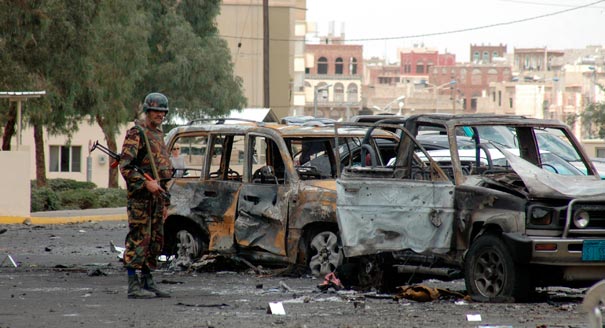
The struggle to root out al-Qaeda in the Arabian Peninsula will require extensive Yemeni and U.S. cooperation, but it is ultimately a problem that the Yemenis must solve.
Source: Fox News
In the continued fight against Al Qaeda in the Arabian Peninsula (AQAP), the Obama administration has relied on a two-track strategy of conducting drone strikes and working to build the capacity of the Yemeni government. Speaking with Fox News, Carnegie's Frederic Wehrey explained that this dual track approach “is the best option given the circumstances and the lessons we’ve learned from Iraq and Afghanistan." Wehrey discussed how AQAP, like other branches of al Qaeda, feeds off the local grievances in a country.
In response to a question regarding whether or not the administration should utilize a larger military campaign, Wehrey noted, “This is ultimately a Yemeni problem that will have to be addressed and solved by the Yemenis.” Indeed, there is mounting evidence that the drone strikes are exacerbating radicalization, he added. Ultimately, the struggle to root out AQAP is destined to be a long battle that will require extensive Yemeni and U.S. cooperation, Wehrey concluded.

Senior Fellow, Middle East Program
Frederic Wehrey is a senior fellow in the Middle East Program at the Carnegie Endowment for International Peace, where his research focuses on governance, conflict, and security in Libya, North Africa, and the Persian Gulf.
Recent Work
Frederic Wehrey, Charles H. Johnson
Frederic Wehrey, Charles H. Johnson
Carnegie does not take institutional positions on public policy issues; the views represented herein are those of the author(s) and do not necessarily reflect the views of Carnegie, its staff, or its trustees.

The EU can impose sanctions but struggles to enforce them without the United States. With Washington increasingly disinterested in backing European interests, the bloc must now fend for itself.


Nicu Popescu, Tiago Antunes

Russia is testing the waters of NATO’s mutual defense clause. What do strikes in Romanian territorial waters mean for the alliance’s posture toward Moscow?

Dimitar Bechev

With its public finances in shambles, the far right polling at 35 percent ahead of the 2027 presidential election, and a growing protest movement, is France’s crisis a threat to the EU’s geopolitical awakening?

Rym Momtaz, ed.

Ahead of a tough winter for Ukraine, Donald Trump’s swing back toward Russia bodes ill. But instead of panicking, Kyiv’s European allies are focusing on action.
Rym Momtaz

Funding Ukraine remains a priority for European leaders. As Russia’s war of aggression heads into another winter, two feasible options to mobilize support for Kyiv should be fast-tracked.


Vladyslav Rashkovan, Gregory P. Wilson