

Commentary
Uri Dadush
{
  "authors": [
    "Uri Dadush"
  ],
  "type": "legacyinthemedia",
  "centerAffiliationAll": "",
  "centers": [
    "Carnegie Endowment for International Peace"
  ],
  "collections": [],
  "englishNewsletterAll": "",
  "nonEnglishNewsletterAll": "",
  "primaryCenter": "Carnegie Endowment for International Peace",
  "programAffiliation": "",
  "programs": [],
  "projects": [],
  "regions": [
    "Western Europe",
    "Germany",
    "North America"
  ],
  "topics": [
    "Economy"
  ]
}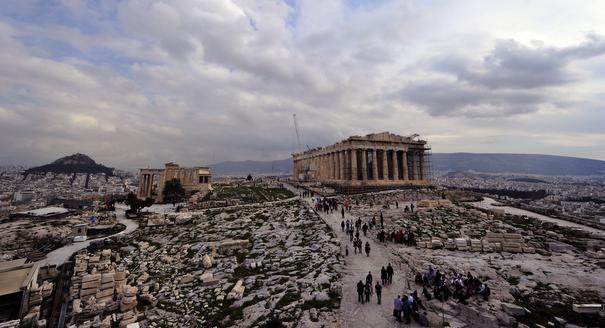
Source: Getty
As concerns rise over a potential exit by Greece and a possible bailout for Spain, the eurozone remains in a very difficult predicament, with few good options for moving forward.
Source: BBC World News

Speaking on BBC News, Carnegie's Uri Dadush noted both the importance of the eurozone to the global economy and the acute position its member countries find themselves in, as the euro debt crisis wears on. The eurozone is the largest trading bloc in the world—larger, as a single entity, than the United States. It could potentially withstand the departure of smaller economies, including Ireland, Portugal, and Greece (which financial markets have, to a large extent, written off already). But it would likely not remain intact if the fiscal and financial situation in Italy and Spain, among the five largest economies in the eurozone, deteriorated significantly. Dadush argued that troubled periphery countries in the eurozone have little choice but to muddle through austerity in the short and medium-term, as markets will not lend to them otherwise. The eurozone core, including Germany, and the European Central Bank, however, could do more—for example, accept somewhat higher inflation—to support the periphery’s transition.
Former Senior Associate, International Economics Program
Dadush was a senior associate at the Carnegie Endowment for International Peace. He focuses on trends in the global economy and is currently tracking developments in the eurozone crisis.
Recent Work
Uri Dadush
Uri Dadush
Carnegie does not take institutional positions on public policy issues; the views represented herein are those of the author(s) and do not necessarily reflect the views of Carnegie, its staff, or its trustees.

Radical-right parties are expected to do well in upcoming elections in four of the EU's biggest member states. If successful, they could prevent the union from addressing key challenges ahead.

Stefan Lehne

An overwhelming victory by a far-right-wing party in a small state in eastern Germany will have major repercussions for Chancellor Friedrich Merz’s coalition.

Judy Dempsey

In supporting Europe’s far-right, MAGA and Russia both want the same thing: a weaker EU. Europe must defend itself without abandoning the openness these forces exploit.

Armida van Rij

As we close out another season of Strategic Europe, it is worth taking stock of the deep shifts underway.

Rym Momtaz

As the EU confronts profound challenges, several leaders have called for fundamental reform to the union’s model—but only modest, superficial changes have resulted. What if Europe really could be reimagined from zero today: What should such a redesigned European order look like?

Richard Youngs, ed.