

Commentary
Michael Pettis
{
  "authors": [
    "Michael Pettis"
  ],
  "type": "legacyinthemedia",
  "centerAffiliationAll": "dc",
  "centers": [
    "Carnegie Endowment for International Peace",
    "Carnegie China"
  ],
  "collections": [],
  "englishNewsletterAll": "asia",
  "nonEnglishNewsletterAll": "",
  "primaryCenter": "Carnegie China",
  "programAffiliation": "AP",
  "programs": [
    "Asia"
  ],
  "projects": [],
  "regions": [
    "East Asia",
    "China"
  ],
  "topics": [
    "Economy"
  ]
}
Source: Getty
Rebalancing in China means by definition that the household consumption share of GDP must rise, and the only effective way to do this is by raising the household income share of GDP.
Source: Wall Street Journal

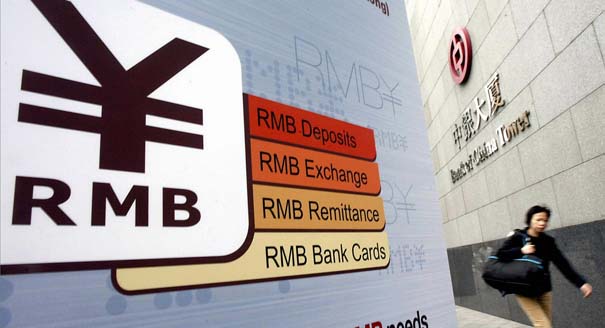
These worries are justified. Beijing urgently needs to rebalance its economy away from excessive reliance on investment toward more domestic consumption. Some Chinese policy makers evidently believe that by boosting China's competitiveness abroad, a weaker yuan will provide some relief from the sharp slowdown associated with rebalancing.
There is, however, a lot more to Chinese competitiveness than the exchange rate. In fact, three mechanisms explain the relatively low price of Chinese exports, all of which transfer income from Chinese households to subsidize Chinese producers.The currency regime is certainly one of them. An undervalued currency spurs exports by subsidizing costs for local manufacturers. These subsidies are effectively paid for by Chinese households in the form of artificially higher prices for imported goods.
The second mechanism does the same thing, but with a different set of winners and losers. Chinese workers' wages have grown more slowly than productivity for most of the past three decades, which means that until two years ago workers received a steadily declining share of what they produce. Manufacturers benefit because wages are effectively subsidized. The more labor-intensive production is, the greater the subsidy.
The third mechanism, and by far the most important, is artificially low interest rates. These reduce household income by reducing the return on household savings, and increase manufacturing competitiveness by lowering the cost of capital, with more capital-intensive producers benefitting the most.
All these subsidies goose economic growth, but they distribute the benefits in different ways—to local producers, employers, or borrowers. They also distribute the costs in different ways—to households as importers, as workers or as savers.
These three mechanisms cause the economy to grow faster at the expense of households. That's the root of China's unbalanced economy: household income has grown so much more slowly than the economy that household consumption over the past three decades has collapsed as a share of GDP.
Rebalancing in China means by definition that the household consumption share of GDP must rise, and the only effective way to do this is by raising the household income share of GDP. But for all the noises Washington and others make about revaluing the currency, this isn't the only way. There are two other mechanisms at Beijing's disposal.
Consider who exactly wins and loses with each mechanism. Yuan appreciation will disproportionately help urban households—for whom import costs tend to be important. And it will disproportionately hurt manufacturers to the extent that their production inputs—mainly labor, land, logistics and raw materials—are priced domestically.
Raising Chinese wages will help household income too. It will disproportionately help low-paid workers, while disproportionately hurting labor-intensive manufacturers who tend to be small and medium enterprises.
But the best way to rebalance is raising interest rates. Of all the three mechanisms, this is the most important one, since it strikes at the heart of the imbalances generated by China's investment-led growth model.
By skewing the financial system, Beijing has managed to distort the whole economy which is built on that system. If the government hikes the cost of capital, the winners will be every saver, whose higher income will then allow him to consume more. The losers are the large capital-intensive companies, usually state-owned enterprises, who for too long have treated the banks as ATMs.
This mechanism can change incentives for everyone. For the sake of more sustainable and equitable long-term growth, it is almost certainly better if Beijing raises interest rates. Higher interest rates will reduce the incentive to invest in economically dubious projects that benefit local elites, and will force a more efficient allocation of Chinese savings.
Which path of rebalancing China chooses in practice will reflect domestic priorities and political maneuvering, though the good news is they'll all broadly have the same impact. Each path is painful, and they all ensure that China's export costs will rise and its foreign competitiveness will go down. In return, its domestic market will become a bigger source of demand. The world should not, in other words, be overly concerned with what happens just to the exchange rate.
This article was originally published in the Wall Street Journal.

Nonresident Senior Fellow, Carnegie China
Michael Pettis is a nonresident senior fellow at the Carnegie Endowment for International Peace. An expert on China’s economy, Pettis is professor of finance at Peking University’s Guanghua School of Management, where he specializes in Chinese financial markets.
Recent Work
Michael Pettis
Michael Pettis

The hybrid warfare landscape is evolving rapidly, leaving policymakers without clear strategies. To better inform their work in addressing emerging challenges, governments must dig deeper into the underlying dynamics at play.


Raluca Csernatoni, Alicia Wanless

As geopolitical rivalry weaponizes global supply chains, the EU’s true vulnerability lies in emerging-risk imports. For these goods, suppliers are growing more concentrated, substitution more difficult, and political risk is looming.

Sinan Ülgen

The EU is putting together a new security strategy to meet today’s myriad challenges. But for any proposal to be effective, the union needs to grapple with its identity and ambitions.

Pierre Vimont

Amid uncertainty caused by the Iran war, the global drive for nonproliferation has stalled. With Europe diplomatically marginalized and countries reassessing their nuclear options, efforts to curb the spread of nuclear weapons risk becoming irrelevant.

Jane Darby Menton
Between the United States’ market-driven approach and China's state-led industrial strategy, Europe is reckoning with how it can remain competitive in the global economy. But is Europe in danger of becoming a U.S. or China colony?


Noah Barkin, Anu Bradford