

Commentary
Thomas de Waal
{
  "authors": [
    "Thomas de Waal"
  ],
  "type": "legacyinthemedia",
  "centerAffiliationAll": "dc",
  "centers": [
    "Carnegie Endowment for International Peace",
    "Carnegie Europe"
  ],
  "collections": [],
  "englishNewsletterAll": "ctw",
  "nonEnglishNewsletterAll": "",
  "primaryCenter": "Carnegie Europe",
  "programAffiliation": "russia",
  "programs": [
    "Russia and Eurasia"
  ],
  "projects": [],
  "regions": [
    "Caucasus",
    "Azerbaijan",
    "Armenia",
    "Georgia"
  ],
  "topics": [
    "Political Reform",
    "Security"
  ]
}
Source: Getty
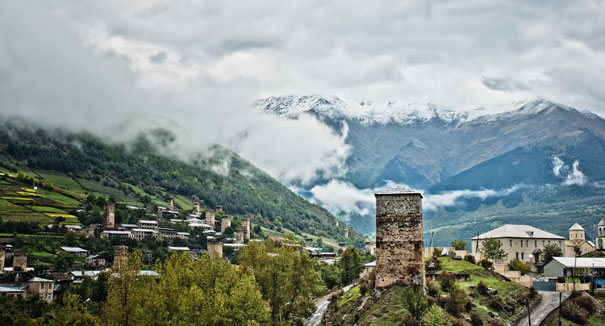
A cursory look at the history of the South Caucasus in the 20th century suggests that political animosity has prevented the South Caucasus region from successfully integrating.
Source: Europe-Asia Studies

THE PLACE THAT USED TO BE THE TRANSCAUCASUS and which is now called the South Caucasus presents a paradox in that it can be plausibly described both as a region and as not a region. The debate over this definition is not merely a theoretical one and raises fundamental questions about how the problems of the South Caucasus should be addressed. Is regional integration an inherently flawed strategy, or has it merely been wrongly applied, or has it faced obstacles that were too great? In answering these questions, it is instructive to look at the attempts to achieve overarching regional integration that were attempted in the last century—the shortlived Transcaucasian Federation and the looser Soviet Transcaucasian Federative Republic of 1922–1936, as well the integrationist processes of the Soviet period as a whole—and understand why they failed. A broader look at the repeating historical patterns suggests that exclusive national projects tend to overwhelm regional ones and that recurring problems of insecurity undermine integration projects.
Despite its history of disorder and disintegration, there is a strong case to be made that the South Caucasus does constitute a region and outside policy makers should treat it as such—although without trying to impose overly rigid limits on how the concept should be applied. This is not a universally shared view. Some argue that the concept of a South Caucasus region is merely a post-colonial legacy, a construction that has outlived its historic usefulness. Some scholars prefer to locate Armenia, Azerbaijan and Georgia within a wider context, by putting an emphasis, for example, on a ‘wider Black Sea region’ (Cornell et al. 2006). Most policy makers in foreign ministries tend to see their relationship with the region as three bilateral official relationships with Baku, Tbilisi and Yerevan, paying little attention either to the three de facto breakaway states of Abkhazia, South Ossetia and Nagorno-Karabakh or to the South Caucasus regional dimension. Yet I want to make the argument that, although the boundaries of the South Caucasus are blurred and its identities are varied, it does make sense to talk about it as a region and to encourage efforts for consensual regional integration...
This article was originally published in Europe-Asia Studies, vol. 64, No. 9.

Senior Fellow, Carnegie Europe
Thomas de Waal is a senior fellow at Carnegie Europe, specializing in Eastern Europe and the Caucasus.
Recent Work
Thomas de Waal
Thomas de Waal
Carnegie does not take institutional positions on public policy issues; the views represented herein are those of the author(s) and do not necessarily reflect the views of Carnegie, its staff, or its trustees.

Russia is testing the waters of NATO’s mutual defense clause. What do strikes in Romanian territorial waters mean for the alliance’s posture toward Moscow?

Dimitar Bechev

With its public finances in shambles, the far right polling at 35 percent ahead of the 2027 presidential election, and a growing protest movement, is France’s crisis a threat to the EU’s geopolitical awakening?

Rym Momtaz, ed.

Europe is facing rising populism internally as well as external pressures from Russia, China, Turkey, and the United States.
Dimitar Bechev

A notable degree of participative democracy has firmly arrived in Europe. But to have more far-reaching impact, democratic deliberation needs to move into a radically new phase.

Richard Youngs

Much has been said of the changes Brussels is trying to make to the EU enlargement process. Here’s why gradual integration might—or might not—be the answer.
Dimitar Bechev