

Commentary
Sarah Chayes
{
  "authors": [
    "Sarah Chayes"
  ],
  "type": "legacyinthemedia",
  "centerAffiliationAll": "dc",
  "centers": [
    "Carnegie Endowment for International Peace"
  ],
  "collections": [],
  "englishNewsletterAll": "ctw",
  "nonEnglishNewsletterAll": "",
  "primaryCenter": "Carnegie Endowment for International Peace",
  "programAffiliation": "SAP",
  "programs": [
    "South Asia"
  ],
  "projects": [],
  "regions": [
    "North America",
    "United States"
  ],
  "topics": [
    "Foreign Policy"
  ]
}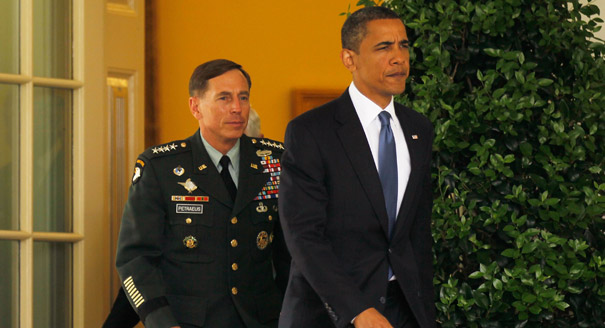
Source: Getty
The resignation of Petraeus as CIA director provides an opportunity to rebalance U.S. foreign policy in favor of non-military approaches.
Source: Los Angeles Times

The resignation of former Central Intelligence Agency Director David H. Petraeus after an extramarital affair came to light, together with expected high-level personnel changes at the State Department and other agencies, creates a singular opportunity to embark on the complex process of rebalancing U.S. foreign policy in favor of non-military approaches.
When he first came to office, Obama seemed suspicious of Petraeus, who made his reputation under President George W. Bush as the general who transformed the military's approach to the Iraq war. The suspicion was reflected in the fraught National Security Council debate over Afghanistan strategy in 2009. Yet since then, Obama, like so many others, seems to have been seduced by Petraeus. Not by the man but by what the man could offer him.Petraeus' unique political genius over the last decade has been to provide each of two contrasting presidents a military solution to his key national security problems that was tailored to his character. For Bush, obsessed with Iraq and with leaving a mark on the Middle East, Petraeus helped design a grandiose, troop-heavy approach.
With the change of administrations, Petraeus soon saw that Obama and his team were different — concerned about the costs of the inherited wars and about the risks of a runaway military. So while Petraeus continued to pay lip-service to counterinsurgency doctrine, he veered away from it in practice. His focus as commander of the troops in Afghanistan — and even more so at the CIA — was on a type of warfare better suited to this president: targeted, technologically advanced, secretive killing over which the president could exert control.
But such an approach, though cheaper in resources and American lives, is still flawed. It is still a military answer to problems that are deeply political in nature and rooted in a complex mix of history, regional and cultural particularism, and the effects of a protracted abuse of power by elites. By shifting to drones and special ops as the instruments of choice to combat militant extremism, the U.S. government remains consumed by the same old questions: How many men and women in uniform, equipped with what kind of hardware, need to employ which tactics to defeat the enemy?
What atrophied during the years that two U.S. administrations dwelt obsessively on these questions were all the other tools of U.S. foreign policy, including information-gathering and analysis, diplomacy and economic and legal leverage.
Perhaps the gravest consequence has been the knowledge deficit. Both wars were hampered by a devastating lack of situational understanding. In Afghanistan, where I lived and worked for more than eight years, I was stunned by how long it took U.S. officials to realize that tribes were key to Afghan social structure. U.S. officials resisted meeting with ordinary Afghans, dealing instead with members of a self-serving and unpopular government. So, for more than a decade, the U.S. government was operating almost blind.
The first way Obama can constructively harness Petraeus' downfall is to reorient the CIA toward its core function: intelligence-gathering. Of late, a body-count culture has prevailed at the CIA, exemplified by the secretive drone campaign. If 60 intelligence professionals are assigned to planning and monitoring each drone in the air, as has been reported, that's 60 who are not on the ground in country, interacting with locals, gaining an intuitive feel for the dynamics. Obama should resist the temptation to put another target-focused operator at the helm of the CIA.
Another main civilian component of U.S. power is its diplomacy. Obama should also use this moment of transition to think through what kind of State Department he really needs. The instruments of U.S. foreign policy are multiple, varied and subtle in their application. To avail itself of them, the government needs smart, adaptable, dynamic risk-takers, who think strategically and operate with autonomy. Such people must be attracted to government service and provided responsibilities commensurate with their talents.
But the other national security topic of the moment threatens to push Obama in the wrong direction. The death of Ambassador J. Christopher Stevens in Benghazi, Libya, has been politicized in deeply counterproductive ways. Members of Congress should bear that in mind as they continue examining the details of the attack.
Stevens was exactly the type of diplomat the U.S. government needs: someone with long experience in the region to which he was posted, an ambassador who engaged with people, gained insight into the environment and helped influence it. That kind of diplomacy is essential, but it carries risks. If it becomes politically untenable in Washington for an ambassador to die in the line of duty, then talented diplomats will be hobbled. And faced with a choked career path, the best will look elsewhere for rewarding work. Obama should appoint a secretary of State determined to counteract the tendency to retrench.
Perhaps the most important foreign policy challenge Obama faces in his second term is how to expand, restructure and reinforce the range of civilian instruments of U.S. power. That is a generational task, but one the current crisis has provided an unparalleled opportunity to tackle.
This article was originally published in the Los Angeles Times.
Former Senior Fellow, Democracy, Conflict, and Governance Program
Sarah Chayes is internationally recognized for her innovative thinking on corruption and its implications. Her work explores how severe corruption can help prompt such crises as terrorism, revolutions and their violent aftermaths, and environmental degradation.
Recent Work
Sarah Chayes
Carnegie does not take institutional positions on public policy issues; the views represented herein are those of the author(s) and do not necessarily reflect the views of Carnegie, its staff, or its trustees.
Following Ursula von der Leyen’s gaffe equating Turkey to Russia and China, relations with Ankara risk deteriorating even further. Without better, more consistent diplomatic messaging, how can the EU pretend to be a geopolitical power?

Sinan Ülgen
Closer EU-UK ties could help address urgent European concerns. But is the EU ready for rapprochement with the United Kingdom?

Rym Momtaz, ed.
Europe has been standing by while its Southern neighborhood is being redrawn by force. To establish a path to peace between Israel and Lebanon, it’s time for Europeans to get involved with hard power.
Rym Momtaz
In Ukraine, Gaza, and Iran, AI warfare has come to dominate, with barely any oversight or accountability. Europe must lead the charge on the responsible use of new military technologies.

Raluca Csernatoni
Montenegro and Albania are frontrunners for EU enlargement in the Western Balkans, but they can’t just sit back and wait. To meet their 2030 accession ambitions, they must make a strong positive case.


Dimitar Bechev, Iliriana Gjoni