

Commentary
Judy Dempsey
{
  "authors": [
    "Judy Dempsey"
  ],
  "type": "legacyinthemedia",
  "centerAffiliationAll": "dc",
  "centers": [
    "Carnegie Endowment for International Peace",
    "Carnegie Europe",
    "Carnegie Russia Eurasia Center"
  ],
  "collections": [
    "Europe’s Eastern Neighborhood"
  ],
  "englishNewsletterAll": "ctw",
  "nonEnglishNewsletterAll": "",
  "primaryCenter": "Carnegie Europe",
  "programAffiliation": "russia",
  "programs": [
    "Russia and Eurasia"
  ],
  "projects": [
    "Eurasia in Transition"
  ],
  "regions": [
    "Middle East",
    "Russia",
    "Europe",
    "Eastern Europe",
    "Bahrain",
    "Western Europe",
    "Belarus"
  ],
  "topics": [
    "EU",
    "Political Reform",
    "Democracy"
  ]
}
Source: Getty
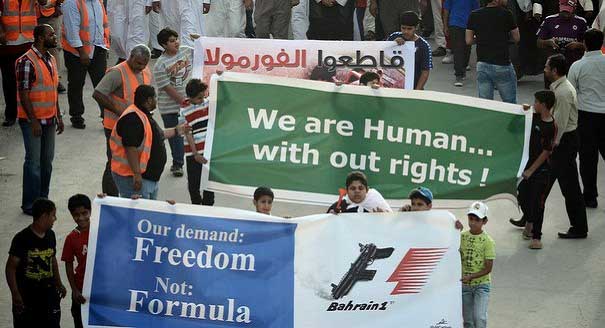
Despite the support by some political parties in Europe, human rights organizations have been unable to prevent high-profile events taking place in autocratic countries.
Source: New York Times
Earlier this month, President Vladimir V. Putin of Russia sacked a senior Russian Olympic Committee official over rising costs and a delay in the construction work for the 2014 Winter Olympics.
The cost of the games, to be held in the southern resort of Sochi, is expected to reach the equivalent of $50 billion. Mr. Putin said corruption had pushed up costs.
For human rights organizations, the issue is not cost or corruption. It is the principle of holding such a prestigious event in Russia as the Kremlin implements tough measures against nongovernmental organizations and clamps down on the opposition.
Why, ask human rights organizations, should Russia host such an event when even punk singers, such as some members of the Pussy Riot band, languish in prison? And why should neighboring Belarus be allowed to host the 2014 World Hockey Championships when the regime has imprisoned pro-democracy activists?Despite the support by some political parties in Europe, human rights organizations have been unable to prevent high-profile events taking place in autocratic countries.
Last April, the Grand Prix was held in Bahrain, the subject of my latest Letter from Europe.
This was despite the fact that the regime had already imprisoned hundreds and killed at least 50 people after the short-lived Arab Spring of February 2011, according to Human Rights Watch. To this day, pro-democracy activists are detained or constantly under surveillance.
It was the same in Azerbaijan, which hosted the Eurovision Song Contest in May 2012. Human rights organizations and some European politicians had called for the event to be held elsewhere because of Azerbaijan’s appalling human rights record. The event went ahead.
A few months later, the European Football Championships were held in Poland and Ukraine. Again, there were calls by pro-democracy activists but also German politicians, to boycott the matches in Ukraine because of the continuing imprisonment of the former prime minister, Yulia Timoshenko. The matches went ahead.
Some politicians argue that it is far better to allow these events to take place in these countries. They put the spotlight on conditions there. But once the event is over, the spotlight moves elsewhere.
Maybe it is time that the international sports federations and the Olympic Committee established democracy criteria for holding such events. They will, no doubt, immediately respond that this is introducing politics into sports. But was there ever a time when sports was innocent?
This article was originally published in the New York Times.

Nonresident Senior Fellow, Carnegie Europe
Judy Dempsey is a nonresident senior fellow at Carnegie Europe
Recent Work
Judy Dempsey
Judy Dempsey
Carnegie does not take institutional positions on public policy issues; the views represented herein are those of the author(s) and do not necessarily reflect the views of Carnegie, its staff, or its trustees.

Radical-right parties are expected to do well in upcoming elections in four of the EU's biggest member states. If successful, they could prevent the union from addressing key challenges ahead.

Stefan Lehne

The aftermath of the Ceuta crisis shows Europe has drawn the wrong lessons. Rather than doubling down on failed migration policies, the EU needs to address the underlying roots of such episodes.

Richard Youngs
An overwhelming victory by a far-right-wing party in a small state in eastern Germany will have major repercussions for Chancellor Friedrich Merz’s coalition.
Judy Dempsey

Canadian Prime Minister Mark Carney has twice inspired praise for standing up to U.S. President Donald Trump: at the 2026 World Economic Forum in Davos and on Canada-U.S. trade negotiations. Is Carney showing a third way better than the EU has in dealing with the Trump administration?

Rym Momtaz, ed.

The EU’s responses to two recent incidents expose the gulf between European perceptions and capabilities. Unless the union can bridge that gap, it will never become a real geostrategic power.
Rym Momtaz