

Article
C. Raja Mohan, Darshana M. Baruah
{
  "authors": [
    "C. Raja Mohan"
  ],
  "type": "legacyinthemedia",
  "centerAffiliationAll": "dc",
  "centers": [
    "Carnegie Endowment for International Peace",
    "Carnegie China",
    "Carnegie India"
  ],
  "collections": [
    "China’s Foreign Relations"
  ],
  "englishNewsletterAll": "ctw",
  "nonEnglishNewsletterAll": "",
  "primaryCenter": "Carnegie India",
  "programAffiliation": "SAP",
  "programs": [
    "South Asia"
  ],
  "projects": [],
  "regions": [
    "North America",
    "United States",
    "South Asia",
    "India",
    "East Asia",
    "China",
    "Japan"
  ],
  "topics": [
    "Security",
    "Military",
    "Foreign Policy"
  ]
}
Source: Getty
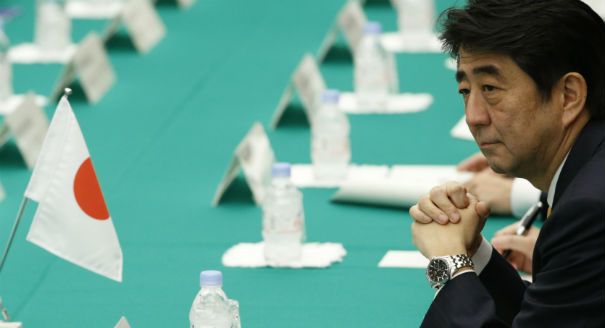
Japanese Prime Minister Shinzo Abe has promised to revitalize Japan's geopolitical significance, but that might mean alienating Tokyo's neighbors in the region.
Source: Indian Express
Defying American ambivalence and Chinese outrage, Japan Prime Minister Shinzo Abe declared in Washington last week that Japan will remain a first-rate power in the world. Addressing a Washington audience after he met U.S. President Barack Obama at the White House, Abe spoke in English, unusual for a Japanese premier, and asserted that "Japan is not, and will never be, a second-tier country."
After a series of weak PMs and persistent economic recession in the last few years, the widespread assumption in Washington and beyond has been that Japan is slowly but certainly fading out of the world's center stage. In the last few weeks he has been in power, Abe has sought to shake Japan, East Asia and the world out of the certitudes on Japan's inevitable decline. Making bold moves to revive the economy, standing up to Chinese pressure over the disputed islands that Beijing calls Diaoyu and Japan Senkaku, proposing an increase in defense spending and calling for far-reaching changes in Japan's peace constitution, Abe has generated shock waves."I make a pledge," Abe declared in Washington, "I will bring back a strong Japan, strong enough to do even more good for the betterment of the world." For a country that has never stopped offering apologies for its imperial conduct in World War II, the use of the phrase "Japan is back" has grated on Chinese nerves. Worse still, Abe made bold to accuse the Communist Party of China of mobilizing patriotism and stoking up territorial quarrels with neighbors to shore up its sagging domestic political legitimacy.
This was red rag to the Chinese bull, and a spokesman of the foreign office in Beijing declared that Abe's personal purpose was to "distort facts, attack and defame China and stir up confrontation between the two countries." Unfazed by the Chinese criticism, Abe said in Washington that he is not for confrontation with Beijing and is willing to engage China for mutual benefit. On the territorial dispute, though, Abe gave no quarter to Beijing. "No nation should make any miscalculation about the firmness of our resolve" to defend Japan's claim to the Senkakus.
While China is angry with Abe, it is apparently pleased with Obama's seeming reluctance to publicly back the Japanese premier against Beijing. Media commentary in China noted that Obama had turned down Abe's request to visit Washington in January. Beijing has also noted that John Kerry has not followed his predecessor Hillary Clinton's footsteps in making the first foreign trip as secretary of state to Asia. Kerry has chosen to go to Europe and the Middle East, adding to Chinese speculation that Washington is having second thoughts on the US pivot to Asia.
While the two leaders reaffirmed the centrality of the U.S.-Japan alliance, Chinese media noted, Obama carefully avoided any mention of China and refused to answer questions from Japanese reporters on the territorial dispute between Tokyo and Beijing in the East China Sea. Beijing is fully conscious of the debate in Washington where a large section of the foreign policy community has been wary of Japan's assertiveness under Abe. Many have suggested that the United States should not get dragged into a conflict between Japan and China and that Washington should not encourage Abe to confront China.
Chinese news agency Xinhua said what transpired in Washington was "contrary to Abe's great hope of showing off the 'robust' U.S.-Japan alliance and prodding the U.S. into taking Japan's side in its spiraling dispute with neighboring China over the Diaoyu Islands."
As the triangular dynamic between Washington, Beijing and Tokyo acquires a sharp edge, India appears to be falling out of the new power play in Asia. In his Washington speech, Abe did not mention India when he talked of his pet political project—building an alliance of Asian democracies. Nor did he cite the current trilateral dialogue between Japan, India, and the United States.
Among Japanese leaders, Abe has been the most vigorous champion of deepening the partnership with India. His return to power was widely expected to give a big boost to India-Japan relations. It is not easy to explain, then, the current drift in relations between New Delhi and Tokyo. One of the capitals, it would seem, has curbed strategic enthusiasm for the other.
Former Nonresident Senior Fellow, Carnegie India
A leading analyst of India’s foreign policy, Mohan is also an expert on South Asian security, great-power relations in Asia, and arms control.
Recent Work

C. Raja Mohan, Darshana M. Baruah


Alexander Gabuev, Paul Haenle, C. Raja Mohan, …
Carnegie does not take institutional positions on public policy issues; the views represented herein are those of the author(s) and do not necessarily reflect the views of Carnegie, its staff, or its trustees.
The closure of the Strait of Hormuz has triggered a global energy crisis, but Europe is stuck in reaction mode. Without more strategic foresight, the EU will remain dependent on fossil fuels and will never be truly secure.


Milo McBride, Pauline Gerard
Debate is heating up on how Turkey could be integrated into a common European defense framework. Commercial and industrial deals offer a better chance at alignment than sweeping political efforts.

Marc Pierini
After spending much of 2025 trying to placate Donald Trump, some European leaders are starting to change posture. But is even a hostile Washington still so important to Europe that the U.S. president’s outbursts are worth putting up with?

Rym Momtaz, ed.
European leaders have now not only lost faith in Donald Trump’s U.S. presidency, but also in America’s hegemony as a whole. But short-term challenges make an immediate divorce unwise.
Rym Momtaz
Countries face several hurdles in joining the EU, including the final stage of ratifying their accession treaties. Procedural reforms and substantive adjustments could help move the process forward.

Stefan Lehne