

Paper
Renée DiResta, Rachel Kleinfeld, Margot Treadwell
{
  "authors": [
    "Rachel Kleinfeld"
  ],
  "type": "legacyinthemedia",
  "centerAffiliationAll": "dc",
  "centers": [
    "Carnegie Endowment for International Peace"
  ],
  "collections": [
    "Arab Awakening"
  ],
  "englishNewsletterAll": "democracy",
  "nonEnglishNewsletterAll": "",
  "primaryCenter": "Carnegie Endowment for International Peace",
  "programAffiliation": "DCG",
  "programs": [
    "Democracy, Conflict, and Governance"
  ],
  "projects": [],
  "regions": [
    "North America",
    "United States",
    "Middle East",
    "Iran",
    "Syria"
  ],
  "topics": [
    "Political Reform",
    "Foreign Policy"
  ]
}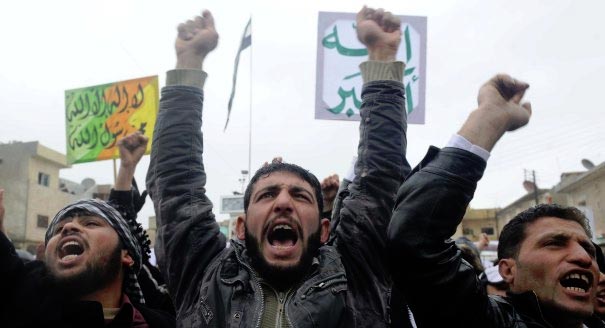
Source: Getty
The United States should arm carefully chosen Syrian rebel groups to expedite the fall of Syrian regime and prevent Iran from using the region as its main conduit for shipping weapons to terrorist groups that attack Israel and other U.S. allies.
Source: Wall Street Journal
Wars are ugly. They are deadly. They have unintended consequences and spillover effects. And yet, sometimes, putting a thumb on the scales of war is the lesser evil. Sometimes, dealing in arms is the right thing to do.
Arming the rebels of Syria is such a cause. But don't take my word for it. As Defense Secretary Leon Panetta and Gen. Martin Dempsey, chairman of the Joint Chiefs of Staff, revealed this month in Senate testimony, they backed a plan last year to arm carefully vetted Syrian rebels. The plan was also backed by then-Secretary of State Hillary Clinton and then-CIA Director David Petraeus. They were vetoed by a White House that sees itself as tough and realistic—but is instead being myopic.
Why arm Syrian rebels? Let's start with Iran. The faster Syrian dictator Bashar Assad falls, the faster Iran loses its closest ally in the region and its main conduit for shipping weapons to terrorist groups that attack Israel and other U.S. allies. A Syria without Assad will further isolate Iran and could help force it to the nuclear negotiating table.
Second, the war in Syria is destabilizing an already volatile region. Armed conflict has spilled into Iraq and Turkey. Refugees are creating tension in Jordan, Lebanon and other neighboring states. Syria's chemical weapons are hard to track—and the longer the civil war rages, the greater the risk that Assad will use them on his own people, or that they end up in the hands of terrorists.
Meanwhile, the rebels aren't waiting for Washington to decide. They are getting arms where they can—often from private individuals and Gulf countries that support the most radical Islamists within the rebel factions.
In other words, the longer we stand aside, the more power radical Sunni factions and rebel groups engaging in war crimes gain over more secular and nationalist groups. The latter are disgusted with our inaction. We will have few friends in Syria, a crucial country in a bad neighborhood, when this bloodletting—60,000 men, women and children killed so far—is over.
I respect the Obama administration's security credentials, and am glad that this White House heralds a tougher brand of liberalism, one that recognizes the necessity of national security and is comfortable with force.
But in this case, the realists are not realistic. The young people spearheading the Arab Spring are trying to decide what America stands for—whether it cares about their human rights and empowerment or is merely seeking cheap global oil and easy alliances. Inaction in Syria is not good for the U.S. in a region where more than 60% of the population is under age 30. America can lose this generation for the next 50 years if it is not on their side now.
Deciding how to intervene in Syria is by no means easy. In 2011 the U.S. and its NATO allies intervened in Libya, failed to secure weapons caches—and newly armed Islamists struck in Mali. Many of the insurgents in Syria are connected with radical Islamists, and the U.S. must be careful not to arm them (though they are growing stronger through our inaction). When Assad falls there will likely be bloody conflicts afterward between rebel and ethnic groups—bloodshed that may be exacerbated by our weapons.
To do the most good, we would need to arm carefully chosen groups. Luckily, we have had intelligence assets on the ground for nearly a year vetting such groups to determine the most worthwhile options.
We should choose arms that are of the most use militarily and the least in civilian killing. This should include antitank weaponry calibrated to pierce lower-grade Syrian armor, not higher-level Israeli, NATO, and U.S. tanks. And we should be willing to provide the additional military support to ensure that those arms are used well. Half-measures can be worse than no action at all.
Many will protest that this more robust option leaves the U.S. owning a conflict it does not want to own. I agree that we don't want to own this conflict. Yet in the eyes of the Arab street, America already does. Many in the region believe that by doing nothing, the strongest country in the world has cynically chosen the current outcome: Assad in power and civilians in body bags.
I'm glad to see a new breed of tough Democrat. But the Obama administration's "realism" is creating a ticking time bomb in a region that is already spinning ever so slowly out of control.
This piece was originally published in the Wall Street Journal.
Senior Fellow, Democracy, Conflict, and Governance Program
Rachel Kleinfeld is a senior fellow in Carnegie’s Democracy, Conflict, and Governance Program, where she focuses on issues of rule of law, security, and governance in democracies experiencing polarization, violence, and other governance problems.
Recent Work
Renée DiResta, Rachel Kleinfeld, Margot Treadwell
Political Violence Researchers, Rachel Kleinfeld, ed., Dalya Berkowitz, ed.
Carnegie does not take institutional positions on public policy issues; the views represented herein are those of the author(s) and do not necessarily reflect the views of Carnegie, its staff, or its trustees.

The EU can impose sanctions but struggles to enforce them without the United States. With Washington increasingly disinterested in backing European interests, the bloc must now fend for itself.


Nicu Popescu, Tiago Antunes

Russia is testing the waters of NATO’s mutual defense clause. What do strikes in Romanian territorial waters mean for the alliance’s posture toward Moscow?

Dimitar Bechev

With its public finances in shambles, the far right polling at 35 percent ahead of the 2027 presidential election, and a growing protest movement, is France’s crisis a threat to the EU’s geopolitical awakening?

Rym Momtaz, ed.

Ahead of a tough winter for Ukraine, Donald Trump’s swing back toward Russia bodes ill. But instead of panicking, Kyiv’s European allies are focusing on action.
Rym Momtaz

Funding Ukraine remains a priority for European leaders. As Russia’s war of aggression heads into another winter, two feasible options to mobilize support for Kyiv should be fast-tracked.


Vladyslav Rashkovan, Gregory P. Wilson