

Paper
Paul Salem
{
  "authors": [
    "Paul Salem"
  ],
  "type": "questionAnswer",
  "centerAffiliationAll": "",
  "centers": [
    "Carnegie Endowment for International Peace",
    "Malcolm H. Kerr Carnegie Middle East Center"
  ],
  "collections": [],
  "englishNewsletterAll": "",
  "nonEnglishNewsletterAll": "",
  "primaryCenter": "Malcolm H. Kerr Carnegie Middle East Center",
  "programAffiliation": "",
  "programs": [],
  "projects": [],
  "regions": [
    "Levant",
    "Lebanon",
    "Middle East"
  ],
  "topics": [
    "Political Reform"
  ]
}
Source: Getty
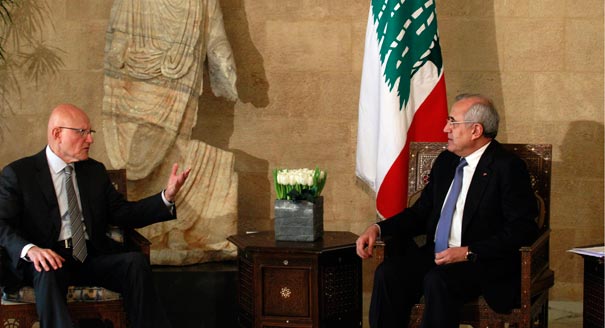
Consensus over Tammam Salam’s nomination has ensured temporary stability in Lebanon. Yet challenges for Salam in actually forming a new government and arriving at broad consensus over a new parliamentary election law remain.
In an apparent attempt to avoid a descent into instability and potential conflict, Lebanon’s political factions agreed to nominate prominent Sunni politician Tammam Salam to succeed Najib Mikati as prime minister. Mikati resigned in March following a political impasse that stemmed in part from a failure to agree on a new law for fast-approaching parliamentary elections.
In this Q&A, Paul Salem says that consensus over Salam’s nomination has ensured temporary stability in Lebanon. Yet challenges for Salam in actually forming a new government and arriving at broad consensus over a new election law remain.
The near-unanimous nomination of Salam is a positive development in a country that just two weeks ago was on the precipice of a serious political crisis.
The resignation of Prime Minister Najib Mikati and his government created a political vacuum. It spread fears of an imminent crisis that could impact political stability and might eventually have security consequences.
Both the main domestic parties in Lebanon and their foreign backers were aware enough of the danger of this situation to move quickly on encouraging the formation of a new government. I think all parties in Lebanon wanted to ensure some temporary stability.
Early suggestions of Salam’s appointment came with encouragement from Saudi Arabia, one of the main foreign backers of the anti-Assad March 14 opposition. The pro-Assad March 8 coalition—including Hezbollah, parliament speaker Nabih Berri’s Amal movement, and their Christian ally General Michel Aoun of the Free Patriotic Movement—quickly agreed to Salam’s nomination.
Mr. Salam is an independent figure and has a long political family history. While he is close to the position of the March 14 anti-Assad bloc, Salam is not officially a member of any party and hence has credibility as a centrist figure.
The appointment has led to a sense of public reassurance about the immediate future. Lebanon will now likely preserve its precarious stability for the next few months even though major issues remain, including drafting a new election law, appointing a new head of the internal security forces, and managing the spillover effects and refugee inflow from the Syrian civil war.
Salam faces a major challenge in trying to form a new government. He has announced that he aims to form a broad coalition government of national unity to include representatives from the main parties and coalitions, on the condition that these ministers not be candidates for elections. If he is not able to form such a broad political government—and indeed the main parties are at political loggerheads with one another—he might then try to form a more apolitical technocratic government.
If and when the government is formed, its main objective will be to hold parliamentary elections, which are supposed to be this June. For that to occur there needs to be success in the equally challenging task of agreeing to a new election law for the country’s parliament.
Disagreement over the parliamentary election law was one of the causes of collapse of the Mikati government. Yet there is still no serious sign of agreement on a new law.
If Salam is able to form a government, succeed in getting an election law passed, and oversee elections, Lebanon will then face the seating of a new parliament and the subsequent appointment of a new prime minister and government.
But if Salam manages to form a government but no election law is agreed upon, then his government might be longer lived. In the absence of elections, the current parliament might prolong its mandate for a year or more, and with it the life of this government.
Salam, however, has insisted that his government’s task is primarily to hold elections, and that he would not serve in an open-ended capacity if elections are not agreed upon.
Salam’s positions regarding Syria are known to be more sympathetic in general to the Syrian rebels.
In recent statements, he has expressed his support for democratic change in Syria, but he also stressed that ultimately it is the decision of the Syrian people. He did not indicate that the new government under his leadership will take a position dramatically different than that of his predecessor, which was one of official dissociation.
Salam has clearly stated that the questions of war and peace should be the prerogative of the state, that is not that of Hezbollah. But at the same time, he has not said that Hezbollah must be disarmed or otherwise dramatically weakened in any way.
Hezbollah’s rapid agreement to Salam’s nomination, who is no friend of the group, indicates that Hezbollah is being more accommodating, at least for the time being. Still, Hezbollah remains the most powerful force in Lebanon, making the group very difficult for Salam to ignore or oppose.
Hezbollah will likely participate in Salam’s government, but it is too early to tell in which ministries.
Salam will not be able to dramatically alter the status quo with Hezbollah. The forced coexistence between the Lebanese state and the group will persist.
It is looking quite unlikely that parliamentary elections will be held on time this June. Parliament has already pushed back the deadlines for nominating and registering candidates by a number of weeks. And there is still the thorny issue of agreeing on an election law.
In the best-case scenario, competing factions will agree on a new election law before June, and elections can be rescheduled for some date in the fall, thereby limiting the extension of the current parliament’s term.
In a more negative scenario, the June deadline might pass with no agreement on an election law but with the extension of the current parliament’s term. Although this outcome happened once before, it was during the Lebanese civil war, and a repeat would certainly signal a very unhealthy political situation.
The election-law formula that is gaining popularity is known as the “mixed system.” In this system, some seats in parliament are elected based on a majoritarian electoral system and others on a proportional electoral system. Variations of this type of system are in use in Germany and 50 other countries around the world. It was first proposed in Lebanon by the National Commission on Electoral Law Reform, also known as the Boutros Commission, in 2006.
The proposal has been put on the table by a number of political parties and is gaining some momentum. Still, there is no guarantee whatsoever that before June, the main factions will agree on this law and to holding elections.
Senior Fellow at the Middle East Institute
Paul Salem is a senior fellow at the Middle East Institute.
Recent Work
Paul Salem
Paul Salem
Carnegie does not take institutional positions on public policy issues; the views represented herein are those of the author(s) and do not necessarily reflect the views of Carnegie, its staff, or its trustees.

A notable degree of participative democracy has firmly arrived in Europe. But to have more far-reaching impact, democratic deliberation needs to move into a radically new phase.

Richard Youngs

Before the next wave of EU enlargement takes place, the union needs to grapple with thorny questions of how power is distributed among its members.


Emil Sondaj Hansen, Ditte Brasso Sørensen

As the EU confronts profound challenges, several leaders have called for fundamental reform to the union’s model—but only modest, superficial changes have resulted. What if Europe really could be reimagined from zero today: What should such a redesigned European order look like?
Richard Youngs, ed.

The EU’s new migration policy is not suited to today’s realities. With climate change increasingly becoming a driver of displacement, Europe needs to rethink its deterrence-focused approach.

Shana Tabak
Europe seems to have accepted its sidelining in the Middle East. The EU must reassert its support for the international rules-based order and step up engagement.

Rym Momtaz