

Article
C. Raja Mohan, Darshana M. Baruah
{
  "authors": [
    "C. Raja Mohan"
  ],
  "type": "legacyinthemedia",
  "centerAffiliationAll": "dc",
  "centers": [
    "Carnegie Endowment for International Peace",
    "Carnegie India",
    "Carnegie Russia Eurasia Center"
  ],
  "collections": [],
  "englishNewsletterAll": "ctw",
  "nonEnglishNewsletterAll": "",
  "primaryCenter": "Carnegie India",
  "programAffiliation": "SAP",
  "programs": [
    "South Asia"
  ],
  "projects": [
    "Eurasia in Transition"
  ],
  "regions": [
    "South Asia",
    "India",
    "East Asia",
    "Japan"
  ],
  "topics": [
    "Economy",
    "Trade",
    "Security",
    "Foreign Policy"
  ]
}
Source: Getty
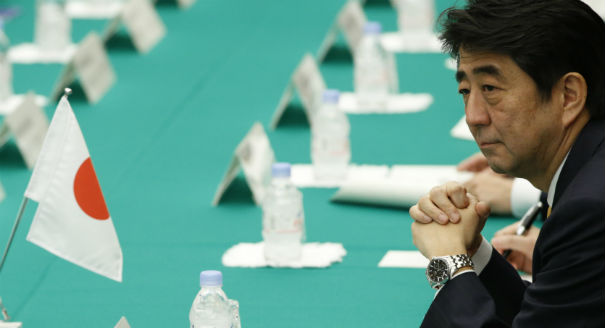
Manmohan Singh could stand to learn from Shinzo Abe's energetic outreach to foreign governments.
Source: Indian Express
After breaking many taboos on domestic economic policy, Japan's prime minister, Shinzo Abe, is now in diplomatic overdrive this week in very unlikely places—Russia, Saudi Arabia, the United Arab Emirates, and Turkey.
In the first few months since his surprising return to power in Japan, Abe has taken bold steps to revive the long-standing economy — easing monetary supply, spending big and promoting growth in a long stagnant economy. Abe's economic moves, which many consider risky, have helped the yen lose value, boost Japanese exports and raise the approval ratings for the prime minister. He has now turned to diplomatic adventures.
Over the weekend, Abe landed in Russia—the first visit by a Japanese PM to Moscow in 10 years—to impart some political momentum to one of Tokyo's weakest bilateral relationships in the world. After World War II, Russia and Japan did not sign a peace treaty and have long quarreled over four islands, called the Kuriles by Moscow and Northern Territories by Tokyo.As Japan's relations with China continue to deteriorate and Washington struggles to cope with Beijing's assertiveness, Abe is seeking some room for political manoeuvre for Tokyo by reaching out to Moscow. Moscow has strong ties with Beijing, but is nevertheless is concerned about the implications of China's rapid rise on the regional balance. Russian President Vladimir Putin is happy to test out the possibilities with Abe. Putin is playing hardball on territorial issues and Abe is teasing him with the prospect of Japanese collaboration to revive Russia's manufacturing sector and modernise its energy sector.
At the end of Abe's meeting with Putin on Monday, no breakthroughs were announced. But Abe and Putin declared that "it is abnormal that we don't have a peace treaty 67 years after the end of the World War II." The leaders also instructed their foreign ministers to accelerate the negotiations on drafting a peace treaty and find ways to resolve the dispute over the island territories.
Abe and Putin also want to build on the massive complementarity that has long demanded strong economic cooperation—the massive but underdeveloped hydrocarbon resources in Russia's Far East, and Japan's huge demand for energy imports. While the two sides have agreed to explore cooperation in the energy sector, big commercial deals will have to wait until mutually satisfactory terms are worked out. But Abe and Putin appeared to have broken the ice.
Energy security is at the top of Abe's mind as he travelled from Moscow to Riyadh. It's not been a destination that has drawn Japanese prime ministers in recent years, despite the fact that Saudi Arabia is the biggest source of Japanese oil imports.
The Japanese dependence on Saudi Arabia has intensified in recent years, as the US and Europe squeeze the oil sector of Iran, for long a major supplier of oil to Japan. Reaching out to Saudi Arabia has become an important political objective for Tokyo.
Abe and his advisors are concerned that Japan has kept too low a profile in the Middle East in recent years and ceded too much ground to Chinese companies in the expanding regional market. Abe wants to correct that.
One of Abe's biggest political challenges is to revive the Japanese nuclear energy sector that faces huge popular and political resistance after the 2011 disaster at Fukushima atomic power station. While progress at home is hard, Abe is promoting nuclear exports.
In Abu Dhabi, Abe is expected to sign a nuclear cooperation agreement with the UAE. In Ankara, Abe will lobby hard for a joint bid by Japanese and French companies (Mitsubishi and Areva) for a contract to build a nuclear power station at Sinop on Turkey's Black Sea coast. The only remaining competition for the contract, said to be worth more than $20 billion, is China's Guangdong Nuclear Power Holding.
As Delhi watches Tokyo's outreach to Russia and the Middle East, one can only hope some of Abe's audacity will rub off on Manmohan Singh, who plans to visit Tokyo at the end of this month. With Abe pushing Japan into a rare moment of creative diplomacy, Delhi must match Tokyo's new strategic imagination.
Former Nonresident Senior Fellow, Carnegie India
A leading analyst of India’s foreign policy, Mohan is also an expert on South Asian security, great-power relations in Asia, and arms control.
Recent Work

C. Raja Mohan, Darshana M. Baruah


Alexander Gabuev, Paul Haenle, C. Raja Mohan, …
Carnegie does not take institutional positions on public policy issues; the views represented herein are those of the author(s) and do not necessarily reflect the views of Carnegie, its staff, or its trustees.

Are Germany’s economic, industrial, and political struggles becoming a liability for the EU’s ability to rise to the geopolitical moment?

Rym Momtaz, ed.

European Commission President Ursula von der Leyen is about to give her annual address on the state of the EU. Here’s what she won’t—but should—say.
Rym Momtaz

The aftermath of the Ceuta crisis shows Europe has drawn the wrong lessons. Rather than doubling down on failed migration policies, the EU needs to address the underlying roots of such episodes.

Richard Youngs

Canadian Prime Minister Mark Carney has twice inspired praise for standing up to U.S. President Donald Trump: at the 2026 World Economic Forum in Davos and on Canada-U.S. trade negotiations. Is Carney showing a third way better than the EU has in dealing with the Trump administration?
Rym Momtaz, ed.

The EU’s responses to two recent incidents expose the gulf between European perceptions and capabilities. Unless the union can bridge that gap, it will never become a real geostrategic power.
Rym Momtaz