

Other
Michael D. Swaine
{
  "authors": [
    "Michael D. Swaine"
  ],
  "type": "legacyinthemedia",
  "centerAffiliationAll": "dc",
  "centers": [
    "Carnegie Endowment for International Peace",
    "Carnegie China"
  ],
  "collections": [
    "China’s Foreign Relations"
  ],
  "englishNewsletterAll": "asia",
  "nonEnglishNewsletterAll": "",
  "primaryCenter": "Carnegie Endowment for International Peace",
  "programAffiliation": "AP",
  "programs": [
    "Asia"
  ],
  "projects": [],
  "regions": [
    "East Asia",
    "China",
    "Japan"
  ],
  "topics": [
    "Security",
    "Arms Control",
    "Foreign Policy"
  ]
}
Source: Getty
An examination of various Chinese sources suggests that virtually all statements constitute clear and consistent expressions of China’s sovereign claims to the islands as well as a complete repudiation of Japan’s claims.
Source: China Leadership Monitor
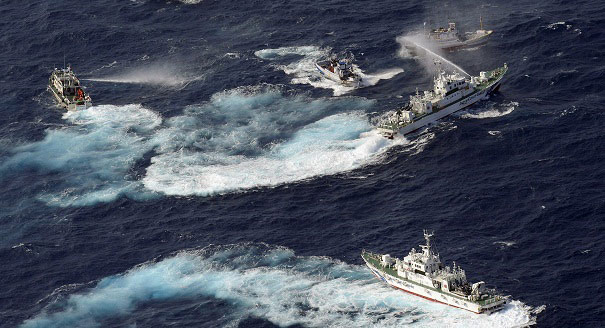
As indicated in earlier CLMs, China’s behavior and rhetoric toward Japan regarding a range of controversial events occurring in the East China Sea—from resource claims to naval transits and island territories— constitutes a major component of an arguably escalating pattern of assertiveness between Beijing and several of its maritime neighbors. Among these altercations, Beijing’s increasingly acrimonious confrontations with Tokyo over five small islands northeast of Taiwan (called the Diaoyu Islands by China and the Senkaku Islands by Japan and hereafter referred to as the S/D islands) are arguably the most dangerous.
Although tensions over these islands and their surrounding waters have existed since at least the 1970s, they have erupted into a series of sometimes sharp and dangerous interactions between Beijing and Tokyo only in the past two to three years, beginning with a crisis precipitated by the ramming of a Japanese coast guard ship by a Chinese fishing trawler in the vicinity of the S/D islands in September 2010.
The most recent—and thus far most intense—imbroglio between the two nations was largely precipitated by Tokyo’s purchase of three of the five main islands on September 10, 2012, a move apparently made to prevent an ultra-nationalist right-wing Japanese politician from acquiring them (see timeline below). This action resulted in large-scale, numerous, and sometimes violent, demonstrations in China (and to a lesser extent in Japan) in late 2012; an ongoing pattern of potentially dangerous interactions between Chinese and Japanese air and naval vessels jostling for position in or near the islands’ territorial air space and waters; and some particularly heated rhetoric, especially on the Chinese side.This dispute is particularly significant among Beijing’s altercations with its maritime neighbors because of the uniquely volatile combination of elements involved. These include, most notably: a) China’s current efforts to challenge directly Japan’s longstanding administrative authority over the islands through a fairly regular pattern of incursions into nearby spaces by a variety of mainly civilian government aircraft and ships; b) the relatively high numbers—and in some cases, level of capability—of the government vessels participating on both sides; and c) the intensity of elite and public emotions involved, especially in China. These and other factors significantly increase the likelihood of a serious crisis occurring, and perhaps escalating out of control, as a result of either a miscalculation and subsequent escalatory reaction by either side or a deliberate attempt by one or both sides to gain a lasting advantage during the ongoing crisis. Even if one accepts that the current Sino-Japanese confrontation over the S/D islands began with Tokyo’s September 2012 purchase decision, it is evident that the current crisis is sustained primarily by Beijing’s ongoing attempts to create a new “status quo” with regard to administrative authority over the islands, and Tokyo’s resistance to such efforts.
Hence, in order to assess the likely evolution of the crisis, and any path toward its possible future resolution, it is particularly important to understand Chinese views—both official and unofficial—toward the S/D islands dispute in general and the current imbroglio in particular.
This CLM seeks to contribute to this effort by examining unclassified and publicly available data in these areas. As with several past CLMs, three categories of leadership and elite sources are examined—authoritative, quasi-authoritative, and nonauthoritative— to identify, compare, and assess both mainstream and non-mainstream views and possible leadership positions on a variety of relevant issues, from the background context and specific catalysts and drivers of the crisis, to assessments of Japanese responsibility and possible paths toward some sort of resolution or more stable modus vivendi, the role of the United States, and the larger importance of the issue to Chinese policies and strategies toward Japan, the United States and the Asia-Pacific region. The methodology employed includes both a quantitatively-based comparison of word usage across media and over time, as well as a qualitative assessment of articles and statements appearing in party, government, and military sources.
The first section presents a brief overview of the use of certain relevant terms in the two major Chinese government-controlled newspapers (People’s Daily and Liberation Army Daily) during the past two years. This is followed by a description and assessment of the authoritative, quasi-authoritative, and non-authoritative Chinese statements regarding the above issues. A timeline of the major events in the current crisis is appended at the end.
In examining the above issues, we attempt to answer several questions, including first: Can one discern any critical differences between the Chinese leadership and outside Chinese elites regarding the understanding and handling of the dispute? Second: Can one identify differences between civilian and military views (both authoritative and nonauthoritative) toward the overall dispute and the current crisis in particular? And third: Will the new Chinese party and state leadership under Xi Jinping likely adopt a new or different approach to the dispute?
This article was originally published in the China Leadership Monitor.

Former Senior Fellow, Asia Program
Swaine was a senior fellow at the Carnegie Endowment for International Peace and one of the most prominent American analysts in Chinese security studies.
Recent Work
Michael D. Swaine
Michael D. Swaine
Carnegie does not take institutional positions on public policy issues; the views represented herein are those of the author(s) and do not necessarily reflect the views of Carnegie, its staff, or its trustees.

European Commission President Ursula von der Leyen is about to give her annual address on the state of the EU. Here’s what she won’t—but should—say.

Rym Momtaz

The aftermath of the Ceuta crisis shows Europe has drawn the wrong lessons. Rather than doubling down on failed migration policies, the EU needs to address the underlying roots of such episodes.

Richard Youngs

Canadian Prime Minister Mark Carney has twice inspired praise for standing up to U.S. President Donald Trump: at the 2026 World Economic Forum in Davos and on Canada-U.S. trade negotiations. Is Carney showing a third way better than the EU has in dealing with the Trump administration?
Rym Momtaz, ed.

The EU’s responses to two recent incidents expose the gulf between European perceptions and capabilities. Unless the union can bridge that gap, it will never become a real geostrategic power.
Rym Momtaz

European states control several Overseas Countries and Territories around the world that carry strategic, economic, and environmental weight. As great powers challenge the rules-based order, defending them is a geopolitical imperative for Europe.

Marc Pierini