

Article
C. Raja Mohan, Darshana M. Baruah
{
  "authors": [
    "C. Raja Mohan"
  ],
  "type": "legacyinthemedia",
  "centerAffiliationAll": "dc",
  "centers": [
    "Carnegie Endowment for International Peace",
    "Carnegie India"
  ],
  "collections": [],
  "englishNewsletterAll": "ctw",
  "nonEnglishNewsletterAll": "",
  "primaryCenter": "Carnegie India",
  "programAffiliation": "SAP",
  "programs": [
    "South Asia"
  ],
  "projects": [],
  "regions": [
    "South Asia",
    "India",
    "North America",
    "United States",
    "East Asia",
    "China"
  ],
  "topics": [
    "Technology",
    "Security",
    "Military",
    "Foreign Policy"
  ]
}
Source: Getty
The NSA’s newly-revealed espionage programs should prompt India to think about its own approach to cybersecurity.
Source: Indian Express
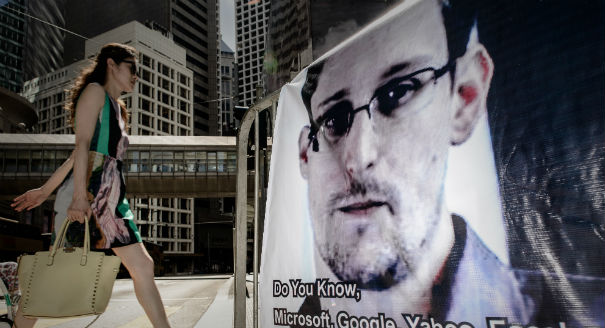
It is not often that China defends the rights of whistleblowers against the state and America finds itself defensive about internet freedom. That precisely is what Edward Snowden, the young American who has exposed the expansive cyber espionage activities of the National Security Agency in the United States against its own citizens and the rest of the world, has achieved.
Americans are calling Snowden a "traitor" and the Chinese media is heralding him as a "hero." Whether he is a Chinese spy or simply a "useful idiot" in Beijing's cyber war with Washington, Snowden has sharpened the terms of the debate on cyber issues within major nations and between them.The ever expanding flows of information in cyberspace and the determination of states to collect, process and exploit them has raised new questions about the traditional tension between liberty and security within nations. While finding a balance between the two imperatives in the information age is quite a challenge even in robust democracies, the Snowden affair has equal salience for great power relations, especially between Washington and Beijing. That in turn has a host of implications for lesser powers like India.
For quite some time now, the United States has made a big deal out of Chinese spying in the cyber domain. The charges included stealing secrets of the large American corporations and hacking into the US.. and Western defense establishments. Major U.S. media outlets like the New York Times and the Washington Post have had frontpage exclusives on Chinese cyber attacks on US entities. Beijing, in response, has been saying that it is not alone and that the United States has an even larger cyber espionage program against China. Snowden has now made the point for Beijing.
"Internet freedom" has been a major slogan for the United States as it charged China and Russia of using cyber control to pursue internal repression and limit personal freedoms. Beijing is now relishing the opportunity to accuse America of double standards, and underline the moral equivalence between the two powers.
While the Snowden affair is unlikely to end the ideological arguments on freedom and democracy between Washington and Beijing, it brings into focus a consequential power play in cyberspace between China and America. Washington and Beijing are investing massively in building their cyber capabilities, both defensive and offensive. Both recognize the centrality of cyberspace for future warfare—economic, political and military. For the moment at least, it is a no-holds-barred contestation.
At the informal California summit between Presidents Barack Obama and Xi Jinping earlier this month, there was much focus on cyber security issues. Reports on the summit said Obama pressed hard on the issue, but Xi was not defensive at all and pushed back. While they circle each other in cyberspace, Washington and Beijing might sit down, sooner than later, to work out an agreed set of rules for managing their conflict in the new domain. This process will be similar to the nuclear arms control negotiations in the Cold War between the US and the erstwhile Soviet Union that defined the terms of mutual deterrence and circumscribed the options for the rest of the world, including India.
Delhi's response to the Snowden affair has been low-key; rightly so. For moral posturing on cyber espionage is not going to get India too far. Spying is central to statecraft, since the earliest times. Nor was it ever limited to targeting adversaries; spying never excluded friends. Only the technological environment has changed.
There will be much that the Indian security establishment will have to do in coping with the new challenges arising from Sino-American confrontation and possible collaboration in cyberspace. India's ability to influence the new geopolitics of cyberspace will depend entirely on the capabilities it builds. While Delhi has apparently been getting its act together on cyber security in recent years, few are willing to wager that India is up to speed with America and China.
The UPA government needs to take Parliament and the public into confidence on how it plans to stay abreast of the global developments in cyber warfare. Mere statements that Delhi is doing what it needs to are not reassuring enough.
Former Nonresident Senior Fellow, Carnegie India
A leading analyst of India’s foreign policy, Mohan is also an expert on South Asian security, great-power relations in Asia, and arms control.
Recent Work

C. Raja Mohan, Darshana M. Baruah


Alexander Gabuev, Paul Haenle, C. Raja Mohan, …
Carnegie does not take institutional positions on public policy issues; the views represented herein are those of the author(s) and do not necessarily reflect the views of Carnegie, its staff, or its trustees.

With its public finances in shambles, the far right polling at 35 percent ahead of the 2027 presidential election, and a growing protest movement, is France’s crisis a threat to the EU’s geopolitical awakening?

Rym Momtaz, ed.

Ahead of a tough winter for Ukraine, Donald Trump’s swing back toward Russia bodes ill. But instead of panicking, Kyiv’s European allies are focusing on action.
Rym Momtaz

Funding Ukraine remains a priority for European leaders. As Russia’s war of aggression heads into another winter, two feasible options to mobilize support for Kyiv should be fast-tracked.


Vladyslav Rashkovan, Gregory P. Wilson

While the EU and European governments are embracing the much-lauded middle-power moment, this entails three difficult conundrums.

Richard Youngs

Europe is facing rising populism internally as well as external pressures from Russia, China, Turkey, and the United States.

Dimitar Bechev