

In The Media
Lilia Shevtsova
{
  "authors": [
    "Lilia Shevtsova"
  ],
  "type": "legacyinthemedia",
  "centerAffiliationAll": "",
  "centers": [
    "Carnegie Endowment for International Peace",
    "Carnegie China",
    "Carnegie Russia Eurasia Center"
  ],
  "collections": [],
  "englishNewsletterAll": "",
  "nonEnglishNewsletterAll": "",
  "primaryCenter": "Carnegie Russia Eurasia Center",
  "programAffiliation": "",
  "programs": [],
  "projects": [],
  "regions": [
    "North America",
    "United States"
  ],
  "topics": [
    "Security",
    "Foreign Policy"
  ]
}
Source: Getty
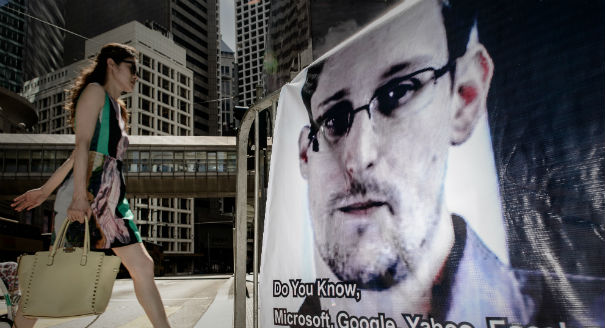
Snowden did not create the security-privacy dilemma, but he did illuminate a deeply rooted problem that Western leaders have long tried to obscure.
Source: Project Syndicate
A worldwide media frenzy has turned the plight of the rogue American intelligence analyst Edward Snowden into something resembling a John le Carré novel, full of suspense and intrigue. Whose spy is he? Who will grant him asylum? Will he be able to outmaneuver the National Security Agency as it attempts to force him to return to the United States to stand trial on charges of theft and espionage? And what will US President Barack Obama say to his Russian counterpart, Vladimir Putin, at their scheduled meeting in Moscow – where Snowden is currently taking refuge at Sheremetyevo Airport – this September?
The real espionage, however, lies not in Snowden’s decision to release NSA secrets, but in the surveillance programs that he exposed. The leaked information highlighted the West’s long-ignored failure to strike an informed balance between security and liberty. Current political and economic uncertainty has exacerbated the situation, driving policymakers to settle on simplistic solutions that, as Snowden made starkly apparent, can undermine the values that the West espouses.
This is not true only in the US and the United Kingdom, which happen to be entangled in the Snowden scandal. The reluctant responses by Germany and France to evidence that the NSA has been conducting unprecedented surveillance of their officials indicate that Europe’s governments may also be involved. Indeed, it now appears that America has shared its intelligence trove with Germany’s spy services when needed.So far, Obama’s handling of the Snowden affair shows that he places more stock in the logic of security than in adherence to principle. Coming from a president who won global sympathy – and a Nobel Peace Prize – for his moral stance, the claim that the NSA’s activities are justified because “that’s how intelligence services operate” is particularly disappointing.
A state that emphasizes security over civil rights and liberties is easily hijacked by security agencies. While America’s “war on terror” demands a stronger emphasis on security, the NSA’s activities expose an alarming willingness to violate the privacy of millions of individuals – including in allied countries, whose constitutions and sovereignty have also been breached.
Western leaders must now ask themselves whether the ends justify the means. With the all-powerful US training its sights on a young former analyst, the answer appears to be no. The current scandal’s impact on Obama’s image increasingly resembles the impact of the Watergate scandal on President Richard Nixon’s standing in the 1970’s – only now the events are playing themselves out on a global stage.
But Obama is not really the problem; at the heart of the issue is a model of liberal democracy that fails to respond to challenges that contradict the values it is supposed to uphold. In fact, Snowden’s warning that “any NSA analyst, at any time, can target anyone, from a federal judge to the president” suggests that NSA head Keith Alexander – dubbed “Emperor Alexander” – could already be more powerful than Obama.
Monitoring individuals’ private lives is not limited to the state and its security services. Major global telecommunication companies – such as Google, Microsoft, Facebook, and Skype – have assembled secret stockpiles of personal information about their users, which they share with the NSA.
Beyond the obvious violation of individuals’ privacy implied by such activities lies the danger that these firms will later make a deal with authoritarian regimes in Russia or China, where little, if any, effort is made to preserve even the illusion of privacy. Google already has some experience in turning over information to China’s security services. Against this background, it is impossible to know whether these companies are already spying on Western leaders, together with the NSA.
Snowden’s presence in Russia, even in the airport’s international transit zone, has given the US a pretext to declare that he is not a whistleblower, but a traitor. The fact that Snowden has now applied for temporary asylum in Russia has reinforced that interpretation. Ironically, by turning the affair into a spy thriller, Putin has helped the US to salvage its reputation – or at least to deflect some of the attention from the NSA’s surveillance programs.
The discussion about security, privacy, and freedom that the Snowden drama has sparked is long overdue. But the scandal has begotten many losers. Snowden has effectively given up his future. The US and Obama have lost their claim to the moral high ground. And liberal democracies’ apparent inability to protect their citizens from infringement of their individual rights has undermined their standing at home and abroad.
Russian society will also pay a price, with the NSA’s surveillance programs giving the Kremlin ammunition to defend the expansion of state control over the Internet and other aspects of citizens’ personal lives. Similarly, the scandal will likely inspire China to strengthen its Great Firewall further.
The ordeal’s only victor is Putin, who now has grounds to dismiss US criticism of his authoritarian rule. Indeed, at the slightest provocation, Putin will be able to point to America’s hypocrisy for spying on, say, European Union facilities as part of expanded surveillance programs supposedly within the scope of the war on terror, and for hunting Snowden after accusing Russia of unfairly prosecuting the whistleblower Sergei Magnitsky.
Snowden did not create the security-privacy dilemma, but he did illuminate a deeply rooted problem that Western leaders have long tried to obscure. One can only hope that his actions, and the resulting scandal, will compel Western leaders to reassess their approach to national security – and not simply lead them to try to conceal it better.

Former Senior Associate, Russian Domestic Politics and Political Institutions Program, Moscow Center
Shevtsova chaired the Russian Domestic Politics and Political Institutions Program at the Carnegie Moscow Center, dividing her time between Carnegie’s offices in Washington, DC, and Moscow. She had been with Carnegie since 1995.
Recent Work
Lilia Shevtsova
Lilia Shevtsova
Carnegie does not take institutional positions on public policy issues; the views represented herein are those of the author(s) and do not necessarily reflect the views of Carnegie, its staff, or its trustees.

Are Germany’s economic, industrial, and political struggles becoming a liability for the EU’s ability to rise to the geopolitical moment?

Rym Momtaz, ed.

European Commission President Ursula von der Leyen is about to give her annual address on the state of the EU. Here’s what she won’t—but should—say.
Rym Momtaz

Radical-right parties are expected to do well in upcoming elections in four of the EU's biggest member states. If successful, they could prevent the union from addressing key challenges ahead.

Stefan Lehne

The aftermath of the Ceuta crisis shows Europe has drawn the wrong lessons. Rather than doubling down on failed migration policies, the EU needs to address the underlying roots of such episodes.

Richard Youngs

Canadian Prime Minister Mark Carney has twice inspired praise for standing up to U.S. President Donald Trump: at the 2026 World Economic Forum in Davos and on Canada-U.S. trade negotiations. Is Carney showing a third way better than the EU has in dealing with the Trump administration?
Rym Momtaz, ed.