

Paper
Paul Salem
{
  "authors": [
    "Paul Salem"
  ],
  "type": "legacyinthemedia",
  "centerAffiliationAll": "",
  "centers": [
    "Carnegie Endowment for International Peace",
    "Malcolm H. Kerr Carnegie Middle East Center"
  ],
  "collections": [
    "Arab Awakening"
  ],
  "englishNewsletterAll": "",
  "nonEnglishNewsletterAll": "",
  "primaryCenter": "Malcolm H. Kerr Carnegie Middle East Center",
  "programAffiliation": "",
  "programs": [],
  "projects": [],
  "regions": [
    "Levant",
    "Syria",
    "Middle East"
  ],
  "topics": [
    "Political Reform",
    "Security"
  ]
}
Source: Getty
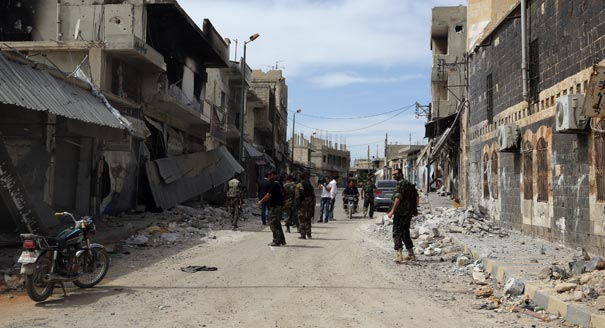
The bombardment in Homs is part of an effort by the Syrian regime and Hezbollah to try to secure a corridor that links the Damascus to the coast.
Source: Syria Deeply
It was expected. What the regime and Hezbollah are trying to do is secure that corridor that links the capital [Damascus] to the coast. Qusayr was major step, and securing the outskirts of Homs is of great strategic importance for that alliance. So it’s not a surprise that after they finished with Qusayr, the next target would be Homs — if they can get both [cities] it would be a sustainable situation for the regime for an indefinite period for months or even years, even if they can’t get Aleppo, if they can secure that core. It’s important for Hezbollah because it’s a buffer against Jabhat al-Nusra and other groups who might use it to get into Lebanon. It’s part of clear strategy.
They already have the capital, they have Qusayr, they have the coast and they’d like to consolidate it further. It would be better if they could get all of Homs. But they’re in a strong position anyway at this point.
Clearly what’s significant is that the regime from the beginning had superior air power is now learning how to do this kind of [strategic ground] warfare, and when it chooses to concentrate its forces, it can [beat] the rebels. The regime will have to choose its battles.
One possibility is that they could sit on their laurels and hold that, and it’s possible that the Russians and Iranians are OK or even supportive of this aggressive action up to a point. They might understand that taking Qusayr and Hezbollah might allow the regime and Hezbollah to have a sustainable situation that they could [maintain] for years. So after this we might not see major battles for major towns and cities, we could see a pause in a civil war that might go on for many years.
Alternatively, some have been saying that [the regime] will [go from] victory to victory and go from Homs to Aleppo. But they don’t have the capacity to stretch themselves thinner and thinner, and Hezbollah is not a large fighting force and doesn’t have the capacity to stray far from Lebanon.
The regime is not going to win back the whole country. The opposition is not going to beat the regime for the foreseeable future. The situation is going to go on for many years. There’s no winner around the corner and no political settlement around the corner, either. They’re not going to create a political breakthrough at Geneva II. The future for Syria for the next two years is an area controlled by the regime, Hezbollah and others; and an area, less stable, controlled by the opposition [and groups that support the opposition.]
It’s sustainable in the sense that if the regime can keep the capital and coastline, they’ll have opened supply lines to the coast and they’ll have [under their control] the airport, the government ministries and the central bank. They’ll have access to Lebanon with Hezbollah’s support. So they’re not isolated, they’re not cornered. The oil areas would be a big loss, but they’d have the other important areas. It’s also politically sustainable in that they’d be credible, they’d have capital, they’d have support among Alawites, among some of the Sunnis. And the opposition would be in the ‘other’ areas. They can hold [this situation] for a long time.
Senior Fellow at the Middle East Institute
Paul Salem is a senior fellow at the Middle East Institute.
Recent Work
Paul Salem
Paul Salem
Carnegie does not take institutional positions on public policy issues; the views represented herein are those of the author(s) and do not necessarily reflect the views of Carnegie, its staff, or its trustees.

Before the next wave of EU enlargement takes place, the union needs to grapple with thorny questions of how power is distributed among its members.


Emil Sondaj Hansen, Ditte Brasso Sørensen

The new U.S.–Denmark–Greenland agreement will help Washington exert political, economic, and financial dominance under the guise of security. Yet, it acknowledged Copenhagen’s and Nuuk’s sovereignty on the island.

Marc Pierini

A summer of escalation in the Black Sea has hurt Ukraine economically and is exacerbating world food security. A truce is needed—as is a broader reframing of Europe’s Ukraine strategy.

Thomas de Waal

Are Germany’s economic, industrial, and political struggles becoming a liability for the EU’s ability to rise to the geopolitical moment?

Rym Momtaz, ed.

European states control several Overseas Countries and Territories around the world that carry strategic, economic, and environmental weight. As great powers challenge the rules-based order, defending them is a geopolitical imperative for Europe.
Marc Pierini