

Commentary
Yezid Sayigh
{
  "authors": [
    "Yezid Sayigh"
  ],
  "type": "legacyinthemedia",
  "centerAffiliationAll": "dc",
  "centers": [
    "Carnegie Endowment for International Peace",
    "Malcolm H. Kerr Carnegie Middle East Center"
  ],
  "collections": [
    "Arab Awakening"
  ],
  "englishNewsletterAll": "menaTransitions",
  "nonEnglishNewsletterAll": "",
  "primaryCenter": "Malcolm H. Kerr Carnegie Middle East Center",
  "programAffiliation": "MEP",
  "programs": [
    "Middle East"
  ],
  "projects": [],
  "regions": [
    "Egypt",
    "North Africa"
  ],
  "topics": [
    "Political Reform",
    "Security",
    "Democracy",
    "Military"
  ]
}
Source: Getty
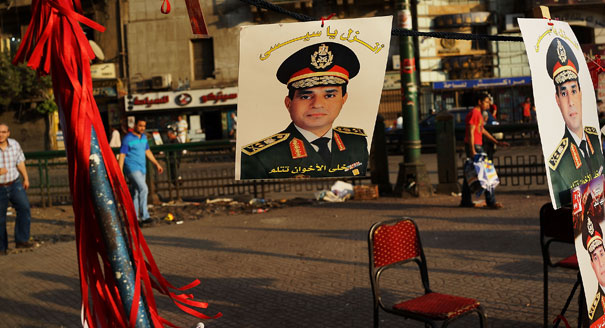
Egypt’s de facto ruler, General Abdel Fattah el-Sisi, seems to indicate a readiness to negotiate a way out of the country’s crisis, but only on his terms. Mubarak is gone, but his police state is coming back.
Source: Al-Hayat
The statement by Egypt’s de facto ruler, Defense Minister and Egyptian Armed Forces Commander General Abdel Fattah el-Sisi, that “there is room for everyone” in Egypt seems to indicate a readiness to negotiate a way out of the country’s bloody crisis. Addressing supporters of deposed president Mohamed Morsi and the Muslim Brotherhood to which he belonged on August 18, Sisi urged them to help “rebuild the democratic path” and “integrate in the political process.”
But clearly the general, who deposed Morsi on July 3 and who evidently believes his self-portrayal as the savior of Egypt, expects this to occur on his terms. The Morsi camp’s response to Sisi’s exhortations is irrelevant: the country’s real rulers have set it on a course leading to the revival of the police state that former president Hosni Mubarak built.
It is difficult to see the interim government that was formed on July 16 as anything but a civilian facade for the Egyptian Armed Forces command, and particularly for Sisi. If it is to prove otherwise, the interim government must launch a serious effort to reform the Ministry of Interior, which commands a security sector numbering between 1.5 and 1.7 million police officers, paramilitary forces, and plainclothes agents and informers. The security sector’s systemic human rights abuses were the focal point of the January 25, 2011, uprising that overthrew Mubarak. But neither the Supreme Council of the Armed Forces, which ruled Egypt from February 2011 to June 2012, nor the Morsi administration, which came to power the following year, undertook the task of reforming this gargantuan sector.Reforming the Egyptian security sector would have been difficult enough even when political conditions favored it. Now, it poses an even greater challenge as the country slips deeper into crisis. The interim government, and behind it the Egyptian Armed Forces command, relies on the Ministry of Interior to spearhead its drive against the Muslim Brotherhood and other Islamists, so reforming the ministry and the sector it commands will not be seen as a pressing priority. But the interim government risks falling hostage to the security sector, which is once again using indiscriminate and disproportionate force against largely unarmed protesters, confident of its undiminished impunity.
The consequences of these actions are apparent in a death toll of some 1,000 since the overthrow of Morsi and in the growing damage to Egyptian relations with the United States and the European Union. The security sector acts as if it has not only shaken off the sense of defeat and humiliation inflicted on it since the 2011 uprising but has indeed emerged from the transition as a winner and now seeks revenge. Over the past two years, officers repeatedly demanded more firearms, looser rules of engagement, and legal protection from prosecution, but their requests were denied. Now, they have a political blank check to use violence without accountability.
Failure to confront these practices will bankrupt the interim government morally, deepen the country’s already-bitter social and political divisions, and set the stage for the complete recidivism of a sector long characterized by its crude methods and petty corruption.
To give its talk of the democratic path and political integration credibility, the interim government should use what political capital it has to leverage the armed forces into backing reform of the Interior Ministry. The interim government is weak, but the military needs it to maintain a claim to political legitimacy both domestically and internationally, stabilize markets, and attract aid and investment. Should it wish to do so, the military is the one force in the country that can bring the Interior Ministry to heel.
The military command also has an interest in preventing further defections from the interim government following the embarrassing resignation of opposition leader Mohamed ElBaradei as interim vice president. Police violence is likely to deepen divisions, such as that between the interim prime minister and the interim deputy prime minister. While Prime Minister Hazem el-Beblawi has repeatedly rejected “reconciliation with those whose hands have been stained with blood and who turned weapons against the state and its institutions,” Deputy Prime Minister Ziad Bahaa el-Din seeks an end to the state of emergency declared on August 14 by the interim government after a bloody crackdown on protesters, assurances for the political participation of all parties, and protection of human rights.
Paradoxically, security sector reform may be the only policy sphere in which the interim government can make some headway. Its official priorities are to achieve financial stabilization and restore economic growth. While it can claim short-term success in the former thanks to pledges of $12 billion in aid and oil from several Gulf monarchies, the latter requires fundamental reforms of the state apparatus and state-owned commercial companies in which the military has extensive networks. The military will not allow this, but it has no love for the police and internal security agencies and could benefit politically from making a show of curbing them.
Yet this is not the direction in which Sisi is heading, a fact that was made obvious on August 13 when 25 new governors were sworn in by his appointee, interim president Adli Mansour. Morsi had already appointed thirteen new governors in June, but his appointments were simply disregarded.
Whereas Morsi’s appointees were all civilians, eighteen of the 25 governors appointed in August are retired generals, restoring the practice established by then president Gamal Abdel Nasser in the early 1960s and maintained by all his successors, including the Supreme Council of the Armed Forces. The interim authorities did not even attempt a semblance of reform or inclusion in selecting the new appointees: the seven new civilian governors are former members or supporters of Mubarak’s defunct National Democratic Party. No appointees were drawn from the interim government’s political allies such as the liberal al-Wafd and al-Dostour parties, the Social Democratic Party, or the Nasserist Democratic Party.
This suggests that the Egyptian Armed Forces command and the Ministry of Interior have not shed any part of their authoritarian mindset or coercive, anticivilian culture. This does not pose a particular problem for the ministry, which led the fight against the Muslim Brotherhood and jihadist Islamists for thirty years, so long as it is not scapegoated for the sins of the entire state apparatus that underpinned Mubarak’s rule, as it was in 2011. But it leaves Sisi, who has unmistakable presidential ambitions, with limited options, especially given the weakness of the political parties supporting the interim government.
This fact explains why the campaign against the Muslim Brotherhood is being conducted in the name of “fighting terrorism” rather than focusing on genuinely democratic reforms such as demilitarizing the security sector or preparing to transform local government, which is appointed in its entirety from top to bottom by the executive branch, into an elected structure. But suppressing a large social movement like the Muslim Brotherhood necessitates mass arrests—the desert camps that held as many as 20,000 political prisoners under Abdel Nasser in the 1950s or 30,000 under Mubarak in the 1990s could reopen—and may also lead to a “dirty war” of covert assassinations and disappearances. The inevitable retaliation, whether by the Brotherhood or more militant Islamists, will serve the interim authorities retroactively as validation of their fight against “terrorism.”
Egypt can avoid this outcome only if Sisi and the armed forces use their considerable clout to do so. But for now, it appears that the security sector has free rein and is doing the military’s bidding. Mubarak is gone, but his police state is coming back.
This article was originally published in Arabic in Al-Hayat.

Senior Fellow, Malcolm H. Kerr Carnegie Middle East Center
Yezid Sayigh is a senior fellow at the Malcolm H. Kerr Carnegie Middle East Center in Beirut, where he leads the program on Civil-Military Relations in Arab States (CMRAS). His work focuses on the comparative political and economic roles of Arab armed forces, the impact of war on states and societies, the politics of postconflict reconstruction and security sector transformation in Arab transitions, and authoritarian resurgence.
Recent Work
Yezid Sayigh
Yezid Sayigh
Carnegie does not take institutional positions on public policy issues; the views represented herein are those of the author(s) and do not necessarily reflect the views of Carnegie, its staff, or its trustees.

Mounting economic strain and battlefield losses will not necessarily make the Kremlin less dangerous. They could instead push Moscow toward a more aggressive hybrid campaign designed to test NATO’s Eastern flank, exploit allied hesitation, and fracture European resolve.

Maksym Beznosiuk

Over the past ten years, NATO has held almost as many summits as it did during the entirety of the Cold War. Are they still useful, or is it time to stop holding annual meetings?

Rym Momtaz, ed.

As the EU confronts profound challenges, several leaders have called for fundamental reform to the union’s model—but only modest, superficial changes have resulted. What if Europe really could be reimagined from zero today: What should such a redesigned European order look like?

Richard Youngs, ed.
As Russia's war on Ukraine drags on, NATO is expanding its footprint in the Black Sea. Turkey, Romania, and Bulgaria are upgrading their fleets and deepening trilateral cooperation.

Dimitar Bechev
Far-right leader Marine Le Pen can—and will—run in France’s next presidential election. What does the outcome of her appeal against a 2025 embezzlement conviction mean for the country’s political future?
Catherine Fieschi