

Commentary
Dmitri Trenin
{
  "authors": [
    "Dmitri Trenin"
  ],
  "type": "commentary",
  "centerAffiliationAll": "",
  "centers": [
    "Carnegie Endowment for International Peace",
    "Carnegie Russia Eurasia Center"
  ],
  "collections": [],
  "englishNewsletterAll": "",
  "nonEnglishNewsletterAll": "",
  "primaryCenter": "Carnegie Russia Eurasia Center",
  "programAffiliation": "",
  "programs": [],
  "projects": [],
  "regions": [
    "Eastern Europe",
    "Ukraine"
  ],
  "topics": [
    "Foreign Policy"
  ]
}
Source: Getty
For Vladimir Putin, seeing Ukraine moving away from Russia and leaning toward the EU is unnatural, even perverse.
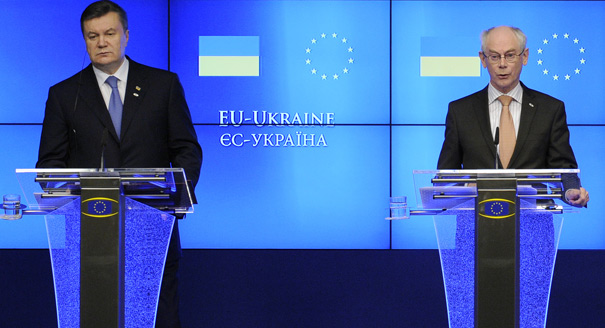
One of the more important events this week has been the decision by the Ukrainian government to sign the association and deep free trade agreements with the European Union. There was no surprise: it had been coming; yet, it marks an important milestone. Now, Kiev is on final for the Vilnius summit of the Eastern Partnership where its association with the EU is likely to be formally sealed.
Not everyone is applauding. There are people within Ukraine, some in the governing Regions Party, and some in the Communist Party, who oppose the country’s westward orientation. There are also opponents outside Ukraine. The Moscow rumor mill churned out a story this week that Vladislav Surkov, one-time éminence grise of Russian domestic politics, may be appointed Putin’s aide and be given the Ukraine portfolio.
Whether this turns out to be true or not is not so important: since he had lost his government post, Surkov was “appointed” by the rumormongers to a half-dozen positions, none of which has materialized. What really counts is that Vladimir Putin has resolved not to give up Ukraine without a good fight—and, for the time being, he does not expect to lose.
In Putin’s calculus, the EU association agreement has already aroused many unrealistic expectations in Ukraine, which will soon turn into disappointments. EU membership remains uncertain, and in any event is many years away, while the economic effect of the Russian response to Ukraine’s “departure” will be immediate. True, Commissioner Stefan Fule has indicated the EU would lower import tariffs to help Ukraine compensate for the loss of the Russian market, but it is unlikely to help much before Ukrainian products become competitive in Europe.
Thus, the Kremlin expects many more in Ukraine to have second thoughts about European integration and to revisit the Eurasian option. Surkov’s—or somebody else’s—job will be to organize this process and to coordinate it with Russia’s own policy toward Ukraine, ahead of the 2015 presidential elections there. It looks clever, but Operation Ukraine contains seeds of its own demise. In Russia, Ukrainians have a reputation of being pragmatic, but they also are reputed to be strong-headed and independent-minded. Putin and especially his eager associates in fact may be helping Ukraine to make its choice—the one he does not like.
The reason for this, ironically, lies in Putin’s own highly emotional, even romantic attitude toward the “cradle of Russian civilization.” A cooler-headed, entirely rational Russian politician might have concluded that trying to include Ukraine into a Moscow-led project was not worth it. Ukraine, a poorer country than Russia, would cost Moscow too much; a big nation, it would demand too much of a voice and even be able to block the whole Eurasian project; an independent-minded society, it would always look for a way out of Russia’s embrace. From this perspective, dealing with Ukraine as a foreign country would save money, avoid headache, and prevent ultimate disappointment.
Putin’s attitude is different. He seems to genuinely believe in the transcendental Orthodox unity of Eastern Slavs and has vowed to restore it. For him, seeing Ukraine moving away from Russia and leaning toward the EU is unnatural, even perverse. The campaign in Ukraine is beginning in earnest. It will not culminate at Vilnius; it will last as long as Ukraine remains outside the EU—which means a very long time indeed. As the campaign continues, the EU will be drawn ever more into the fray: Moscow will make the Europeans compete harder even where they are reluctant to do much. Ultimately, the Ukrainians themselves will have to decide, and at the end of the—very long—day, there will be no no man’s land in Europe.
Former Director, Carnegie Moscow Center
Trenin was director of the Carnegie Moscow Center from 2008 to early 2022.
Recent Work
Dmitri Trenin
Dmitri Trenin
Carnegie does not take institutional positions on public policy issues; the views represented herein are those of the author(s) and do not necessarily reflect the views of Carnegie, its staff, or its trustees.

Ahead of a tough winter for Ukraine, Donald Trump’s swing back toward Russia bodes ill. But instead of panicking, Kyiv’s European allies are focusing on action.

Rym Momtaz

Funding Ukraine remains a priority for European leaders. As Russia’s war of aggression heads into another winter, two feasible options to mobilize support for Kyiv should be fast-tracked.


Vladyslav Rashkovan, Gregory P. Wilson

While the EU and European governments are embracing the much-lauded middle-power moment, this entails three difficult conundrums.

Richard Youngs

Much has been said of the changes Brussels is trying to make to the EU enlargement process. Here’s why gradual integration might—or might not—be the answer.

Dimitar Bechev

The European Commissioner for Trade is headed to China. But after President Xi’s bridge-building visit to Washington, can a more isolated EU overcome Beijing’s stranglehold on critical raw materials? Who will blink first?
Rym Momtaz, ed.