

Commentary
Dmitri Trenin
{
  "authors": [
    "Dmitri Trenin"
  ],
  "type": "commentary",
  "centerAffiliationAll": "",
  "centers": [
    "Carnegie Endowment for International Peace",
    "Carnegie Russia Eurasia Center"
  ],
  "collections": [],
  "englishNewsletterAll": "",
  "nonEnglishNewsletterAll": "",
  "primaryCenter": "Carnegie Russia Eurasia Center",
  "programAffiliation": "",
  "programs": [],
  "projects": [
    "Eurasia in Transition"
  ],
  "regions": [
    "North America",
    "United States",
    "South Asia",
    "Afghanistan",
    "Central Asia",
    "Russia"
  ],
  "topics": [
    "Security",
    "Foreign Policy"
  ]
}
Source: Getty
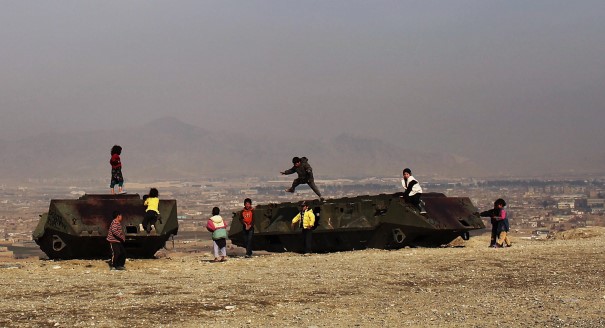
In the run-up to 2014, when the U.S./NATO combat forces due to leave Afghanistan, fears multiply that a major extremist threat is rising again for the neighborhood and beyond. Russia is right to focus on the southern flank as far as its most pressing security needs are concerned.
Twelve years ago this month, the United States, joined by Britain and supported by Russia, with overwhelming support from the entire international community, hit hard Al Qaeda in Afghanistan and dislodged the Taliban regime in Kabul. The U.S. intervention in Afghanistan saved Russia, Alexei Arbatov said last week. In the mid- and late 1990s, many in Russia feared the Taliban would push north, across Central Asia and all the way to the Volga. These fears were most probably exaggerated. The Taliban was then, and has remained, an essentially Afghan phenomenon. However, it harbored not only Al Qaeda, but a number of other extremists: Chechens, Uzbeks, Tajiks, and others. In 1999 and again in 2000, Afghanistan was the base for extremist groups' raids deep into Kyrgyzstan and Uzbekistan, which the local government forces were hard put to defend against.
In 2001, the United States for the first time established military presence in Central Asia. Many in the Russian politico-military leadership expressed concern. Not President Putin, who was then thinking in terms of a genuine anti-terrorist coalition. Twelve year later, the United States is finally heading back. With the U.S./NATO combat forces due to leave Afghanistan in 2014, Kyrgyzstan decided to terminate the U.S. lease of the Manas air base. Last week, the U.S. military began to redeploy from Manas to a Romanian air base near Constanta. Russia is about to claim another notable geopolitical achievement: soon, it will again be the only outside power with military forces in Central Asia.
Americans, however, seem to create problems for others both when they insert themselves into a region, and when they extricate themselves from it. In the run-up to 2014, when Kabul, rather than the U.S. and its allies, will be fully responsible for security in Afghanistan, fears multiply that a major extremist threat is rising again for the neighborhood and beyond, including Central Asia and even parts of Russia. These fears are largely misplaced. True, "Post-American" Afghanistan will hardly be at peace with itself, and its neighbors will feel it. However, it will be the neighbors—Pakistan and India, in the first place—who will probably vie for influence in Afghanistan, not the Afghans who will seek to subvert neighboring governments. Central Asia may be beset by a number of problems as it looks to political transition in its two biggest countries, Uzbekistan and Kazakhstan, but Afghanistan is not the source of most of them.
Russia is right to focus on the southern flank as far as its most pressing security needs are concerned. It is also right not to panic as U.S. forces leave Afghanistan. It needs to develop an adequate understanding of current Afghan realities, including the importance of the Pushtun factor and the nature and role of the Taliban. It needs to cooperate with Afghanistan's neighbors, but stay away from their competition. It absolutely needs to avoid any military involvement of its own in Afghanistan, and engage economically only when this makes sense in economic terms. It must focus squarely on drugs trafficking into Russia and on drugs production, but carry out this anti-drugs offensive from Russia's border south, gradually drug-cleansing Central Asia and building a drugs firewall, moving it farther and farther away from the Russian territory. America's imminent departure makes a strong case for Russia's leadership on anti-drugs measures in Central Asia.
Former Director, Carnegie Moscow Center
Trenin was director of the Carnegie Moscow Center from 2008 to early 2022.
Recent Work
Dmitri Trenin
Dmitri Trenin
Carnegie does not take institutional positions on public policy issues; the views represented herein are those of the author(s) and do not necessarily reflect the views of Carnegie, its staff, or its trustees.
Montenegro and Albania are frontrunners for EU enlargement in the Western Balkans, but they can’t just sit back and wait. To meet their 2030 accession ambitions, they must make a strong positive case.


Dimitar Bechev, Iliriana Gjoni
Donald Trump has repeatedly bashed NATO and European allies, threatening to annex Canada and Greenland and deploring their lack of enthusiasm for his war of choice in Iran. Is this latest round of abuse the final straw?

Rym Momtaz, ed.
Donald Trump’s repudiation of NATO goes against the Make America Great Again vision of a U.S.-centered foreign policy. If the goal is to preserve the alliance by boosting Europe’s commitments, leaning into France’s vision is the most America First way forward.
Rym Momtaz
The wars in Ukraine and the Middle East are existential threats to Europe as a peace project. Leaders and citizens alike must reaffirm their solidarity to face up to today’s multifaceted challenges.

Marc Pierini
The U.S.-sponsored TRIPP deal is driving the Armenia-Azerbaijan peace process forward. But foreign and domestic hurdles remain before connectivity and economic interdependence can open up the South Caucasus.


Thomas de Waal, Areg Kochinyan, Zaur Shiriyev