

Commentary
Alexey Malashenko
{
  "authors": [
    "Alexey Malashenko"
  ],
  "type": "commentary",
  "centerAffiliationAll": "",
  "centers": [
    "Carnegie Endowment for International Peace",
    "Carnegie Russia Eurasia Center"
  ],
  "collections": [],
  "englishNewsletterAll": "",
  "nonEnglishNewsletterAll": "",
  "primaryCenter": "Carnegie Russia Eurasia Center",
  "programAffiliation": "",
  "programs": [],
  "projects": [],
  "regions": [
    "Russia"
  ],
  "topics": [
    "Political Reform"
  ]
}
Source: Getty
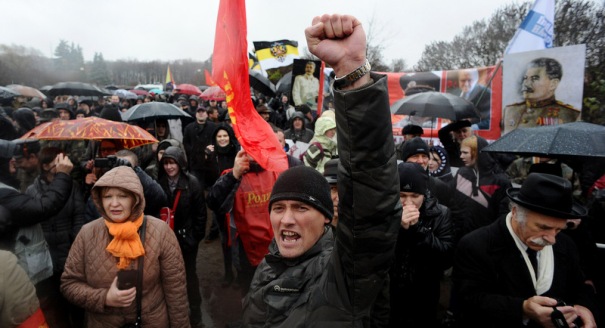
Russia does not have and will probably never have a specific event that can become a symbol of national consolidation. Still, something specific that consolidates everyone at once is necessary and the Kremlin wants people to nationally unite against the external enemies.
The Kremlin did not invent the Day of National Unity because life was all too rosy. Russia does not have and will probably never have a specific event that can become a symbol of national consolidation. The October Revolution celebration on November 7 is fading from memory; the anniversaries of the royal dynasty are forgotten; and Russia’s Independence Day is not particularly remembered. Celebrating the victory over Germany as a national holiday is kind of awkward.
So the non-committal national unity was invented and is being exploited by those who first and foremost treat national unity as a tool to consolidate their influence.
Can you imagine someone raising a glass to the national unity at a family celebration: “Happy Holiday, dear guests, happy national unity to you?” The holiday rings phony, just as the concepts of sovereign democracy and Russia’s special path of development.
The state of national unity is highlighted by ethnic tensions that constantly lead to interethnic clashes, xenophobia, and the slogans like “Stop feeding the Caucasus,” “Stop feeding Moscow,” and, of course, “Russia for Russians.” The debate on whether the Caucasus weddings, with their shootings and lezghinka dances, or the soccer fans are more to blame for the growing mutual discontent are pointless. All of the debate participants blame the state. In turn, the authorities take a deep breath and offer the celebration of national unity. Apparently, they fancy a common march by the Orthodox Church standard-bearers, soccer fans, Caucasus Salafites, Bolotnaya Square protesters, Navalny, and lezghinka dancers. So what? This motley crew gathering can essentially be interpreted as the Russian citizens’ national unity. After all, the national unity is actually valuable insofar as it manages to consolidate a host of different, at times incompatible groups and individuals on the national, or rather national and civic basis.
But which slogans can this unified national mass carry? What can consolidate it? Can it be corruption, low wages, horrible roads, or the persecution of nontraditional religions?
The Russian authorities have a clear vision, though: the national consolidation is only possible around it. The Kremlin long-term residents are its pillar and the bureaucratic entities like the United Russia (now also the People’s Front) is the glue that attaches the nation to this pillar. In other words, the ruling class equates the national unity and the regime, conjuring up the Soviet maxim, “People and the Party are Unified.”
However, such national and state unity appears fragile rather than eternally strong today. This unity, just as the above-mentioned holiday, is simply the game of unity and the manipulation of people’s conscience. Still, something specific that consolidates everyone at once is necessary. Here—as a gift from heavens—come the external enemies that threaten us from the West, the South, and (surreptitiously) from the East. It is against them, especially against the foe from the West, that all of us have to nationally unite. Thus, apart from everything else, the Day of National Unity can also be considered an important foreign policy instrument.
Former Scholar in Residence, Religion, Society, and Security Program
Malashenko is a former chair of the Carnegie Moscow Center’s Religion, Society, and Security Program.
Recent Work
Alexey Malashenko
Alexey Malashenko
Carnegie does not take institutional positions on public policy issues; the views represented herein are those of the author(s) and do not necessarily reflect the views of Carnegie, its staff, or its trustees.
European reactions to the war in Iran have lost sight of wider political dynamics. The EU must position itself for the next phase of the crisis without giving up on its principles.

Richard Youngs
Europe’s interests in Syria extend beyond migration management, yet the EU trails behind other players in the country’s post-Assad reconstruction. To boost its influence in Damascus, the union must upgrade its commitment to ensuring regional stability.

Bianka Speidl, Hanga Horváth-Sántha
A prophetic Romanian novel about a town at the mouth of the Danube carries a warning: Europe decays when it stops looking outward. In a world of increasing insularity, the EU should heed its warning.

Thomas de Waal
2026 has started in crisis, as the actions of unpredictable leaders shape an increasingly volatile global environment. To shift from crisis response to strategic foresight, what under-the-radar issues should the EU prepare for in the coming year?
Thomas de Waal
Europe is designing a new model of collective security that no longer relies on the United States. For this effort to succeed, solidarity between member states that have different threat perceptions is vital.

Erik Jones