

Commentary
Dmitri Trenin
{
  "authors": [
    "Dmitri Trenin"
  ],
  "type": "legacyinthemedia",
  "centerAffiliationAll": "",
  "centers": [
    "Carnegie Endowment for International Peace",
    "Carnegie Russia Eurasia Center"
  ],
  "collections": [],
  "englishNewsletterAll": "",
  "nonEnglishNewsletterAll": "",
  "primaryCenter": "Carnegie Russia Eurasia Center",
  "programAffiliation": "",
  "programs": [],
  "projects": [],
  "regions": [
    "Russia",
    "Eastern Europe",
    "Ukraine"
  ],
  "topics": [
    "Security",
    "Foreign Policy"
  ]
}
Source: Getty
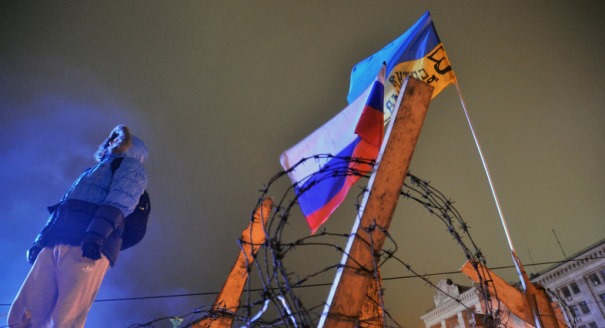
Moscow needs to play its hands wisely and avoid supporting the separatist movement in Ukraine, which could give Kyiv a pretext to send in troops to restore constitutional order.
Source: NPR’s Morning Edition
DAVID GREENE, HOST: And now let's turn to Ukraine's huge neighbor. Viktor Yanukovych lost the support of many Ukrainians, in part because he seemed to be turning away from Europe and towards Moscow. Russia's president Vladimir Putin had been working to strengthen his country's influence and economic ties in Ukraine, but now a trio of European foreign ministers helped to broker a change of government there. This East-West tussle over Ukraine's future has echoes of the Cold War, and a big question now is what Russia will do next. For some insight on that, we're joined from Moscow by Dmitri Trenin. He's director of the independent Carnegie Moscow Center. Dmitri, welcome back to the program.
DMITRI TRENIN: Glad to be on the program, Dave.GREENE: So, can you tell me what the Kremlin wants here? What are they hoping the resolution is when this all gets sorted out in the Ukraine?
TRENIN: Well, it's difficult to know what will happen in Ukraine. I think we are in unchartered waters there. I think that the situation is highly unstable where many things possible, from a loose confederacy to a civil war. Those would be, of course, very different scenarios. And there are many scenarios in between.
GREENE: You're describing a situation that - what strikes me, I mean, you say it could be a loose confederacy on one hand or a civil war on the other. It sounds like you're pretty convinced that somehow the Russian-speaking part of Ukraine in the east is not going to be very unified with the west.
TRENIN: Well, I'm very concerned, frankly, and I have been concerned for some time that the developments in Ukraine over the last three months were less unifying than divisive in terms of domestic Ukrainian politics.
GREENE: What does Russia do if there are parts of the east who come to Moscow and say, you know, send troops in? I mean, we want your support here in the east.
TRENIN: Well, that's a really hard part. You see Russian flags already, now, flying in various Crimean cities. And there are people who are calling for closer ties with Russia, and at some point they may start talking about secession. Now, this is a very, very difficult, dangerous but important moment for Moscow. Moscow, in my view, needs to play its hands wisely not supporting the separatism that could give a pretext to Kiev to send in troops to restore constitutional order.
GREENE: Why is it important for Moscow to stay out of it?
TRENIN: Well, because Moscow would be distracted from the things that are far more important to Russia than redrawing the map of Eastern Europe. Russia is in no need of new territories or new citizens. Rather, Russia's best bet in Ukraine would be a Ukraine that's more democratic, more modern but also more decentralized.
GREENE: Given the pressures that we're seeing, given, you know, people in eastern Ukraine who, as you say, are waving Russian flags, I mean, what are you expecting to see from the Russian government in the days and weeks ahead?
TRENIN: I think the Russian government is taking a pause, setting a pause button. The Russian government has recalled the ambassador from Kiev for consultations to Moscow. They are not congratulating the new Ukrainian leadership on taking power, nor are they supporting the ousted president, Yanukovych. I think that the Russians are doing what I think is best under the circumstances. They want to be as much in touch with the realities in Ukraine as possible. You can argue that this is the most important country to them now. But they are very economical at this point, with their actual involvement. So, you just, you watch more than you act at this point. I think that's the motto in Moscow.
GREENE: Dmitri Trenin is director of the Carnegie Moscow Center. Dmitri, thanks for joining us, as always.
TRENIN: Thank you very much for having me.
(SOUNDBITE OF MUSIC)
GREENE: It's MORNING EDITION from NPR News.
Former Director, Carnegie Moscow Center
Trenin was director of the Carnegie Moscow Center from 2008 to early 2022.
Recent Work
Dmitri Trenin
Dmitri Trenin
Carnegie does not take institutional positions on public policy issues; the views represented herein are those of the author(s) and do not necessarily reflect the views of Carnegie, its staff, or its trustees.

Russia is testing the waters of NATO’s mutual defense clause. What do strikes in Romanian territorial waters mean for the alliance’s posture toward Moscow?

Dimitar Bechev

With its public finances in shambles, the far right polling at 35 percent ahead of the 2027 presidential election, and a growing protest movement, is France’s crisis a threat to the EU’s geopolitical awakening?

Rym Momtaz, ed.

Ahead of a tough winter for Ukraine, Donald Trump’s swing back toward Russia bodes ill. But instead of panicking, Kyiv’s European allies are focusing on action.
Rym Momtaz

Funding Ukraine remains a priority for European leaders. As Russia’s war of aggression heads into another winter, two feasible options to mobilize support for Kyiv should be fast-tracked.


Vladyslav Rashkovan, Gregory P. Wilson

While the EU and European governments are embracing the much-lauded middle-power moment, this entails three difficult conundrums.

Richard Youngs