

Commentary
Sarah Chayes
{
  "authors": [
    "Sarah Chayes"
  ],
  "type": "legacyinthemedia",
  "centerAffiliationAll": "dc",
  "centers": [
    "Carnegie Endowment for International Peace"
  ],
  "collections": [
    "Anti-Corruption"
  ],
  "englishNewsletterAll": "ctw",
  "nonEnglishNewsletterAll": "",
  "primaryCenter": "Carnegie Endowment for International Peace",
  "programAffiliation": "SAP",
  "programs": [
    "South Asia"
  ],
  "projects": [],
  "regions": [
    "South Asia",
    "Afghanistan"
  ],
  "topics": [
    "Political Reform",
    "Security",
    "Military",
    "Foreign Policy"
  ]
}
Source: Getty
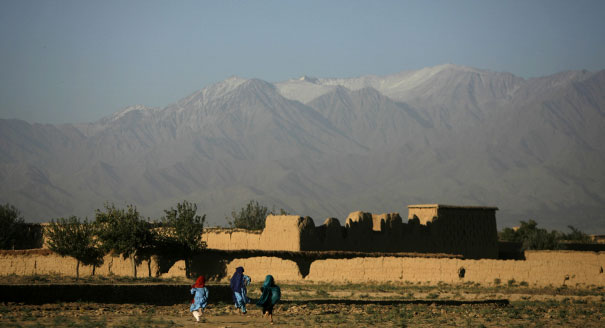
Over the past decade, corruption in Afghanistan has crystallized into a business of structured networks, with subordinates paying up the line for protection from repercussions.
Source: POLITICO Magazine
Human rights abuses, classically defined, are gory: nighttime disappearances, a corpse lodged in the weeds by the side of a canal, scars from electrical burns blotching bruised skin or bodies swinging above city streets from the crossbeams of cranes. The horror of such crimes is easy to decry. But what about government crime that may be less gruesome though possibly even more consequential? Acute, systemic corruption is such an offense. And that is exactly what the United States, in the name of democracy, has enabled over the past 13 years in Afghanistan.
To the east of the Afghan city of Kandahar, where I lived for most of the past decade, is a long bridge over the Tarnak River. A decomposing carcass of dangerously exposed sinews, shattered by war and neglect, that bridge was an obvious reconstruction project for the Afghan government to take on. But within weeks of each repair, new holes would spring open; drivers had to pick their way around them, or abandon the bridge altogether and hazard the rocky riverbed below. Then repairs would begin anew. Meanwhile, the contractors on the job, linked to the provincial governor, flaunted sudden wealth.A scan of recent reports by the U.S. government’s Special Inspector General for Afghanistan Reconstruction reveals dozens more cases out of the $63 billion the United States has spent on reconstruction there since 2002: an unfinished courthouse in the province of Parwan, millions of dollars in unaccountable fuel purchases by the Afghan National Security Forces, poorly constructed schools.
I once asked a weathered old man who cultivated grapes and a few pomegranate trees on the parched plain west of Kandahar what corruption meant. He answered: “When the governor of the district keeps all the reconstruction money for himself and his cronies and surrounds himself with armed thugs so no one can approach him to lodge a complaint, that’s corruption.” For him, it was no abstraction: When U.S. troops arrived in the man’s village during the 2009 surge, they blew up the thick-walled building his father had fashioned to dry grapes into prized raisins, lest Taliban militants shelter there. Afghan national army troops, under nominal U.S. supervision, stripped the building of its precious wooden beams and carried them off, presumably to sell.
This wasn’t an example of the system failing; it was an example of the system—sustained and secured by the United States—at work. Over the past decade, corruption in Afghanistan has crystallized into a business of structured networks, with subordinates paying a part of the take up the line, in return for protection from repercussions. Impunity has become the rule. President Hamid Karzai and other top Afghan officials have spent considerable energy guaranteeing it, releasing suspects from preventive detention, shutting down investigations or, in one case, even apparently facilitating the flight to England of a former minister under a travel ban. According to the U.N. Office on Drugs and Crime, Afghans were forced to pay nearly $4 billion in bribes in 2012. But that can only be a fraction of the overall cost of corruption in the country.
U.S. officials are not accused of actively participating in these abuses, or only rarely; I remember hearing of one or two cases of American contracting officers allegedly taking kickbacks. Yet the whole structure of the U.S. intervention has facilitated and enabled Afghanistan’s burgeoning corruption. The United States launched strikes and raids based on intelligence from corrupt Afghan officials or their cronies, acting in effect as the Afghans’ muscle. It also used corrupt officials as agents in ways that made Americans all but complicit in their actions, asking them to obtain materiel for U.S. troops, solve logistical problems or engage with the Afghan population on their behalf. It contracted with them for reconstruction and protection on roads. The mere presence of top U.S. officials by the sides of these Afghans threw an implicit blanket of protection over them and their corrupt networks.
Worse yet, the CIA has been paying millions of dollars a month to a collection of the most egregious offenders. Among them was Ahmed Wali Karzai, the younger half-brother of the president, who installed officials, stole land, facilitated drug trafficking, threatened to send U.S. forces against those who dared oppose him and generally was the bane of most Kandaharis’ existence—until he was shot and killed by a Kandahar police officer in 2011. Another was a border police official, reported to execute his rivals in the desert that marks the border with Pakistan, who stands accused of ballot-box stuffing during the 2009 presidential election. I never understood what the CIA thought it was buying, but the widely known payments to such notorious criminals badly damaged U.S. credibility. “People think you like the corruption, you want it to continue,” an Afghan development worker remarked last year, when the New York Times broke the story of direct bags-of-cash payments to Karzai himself.
This often inadvertent impact of U.S. policy—facilitating and exacerbating government corruption abroad—is of course a values issue. But it is also a security issue, and it extends well beyond Afghanistan. Every country that harbors an extremist insurgency today suffers from kleptocratic governance, including long-established U.S. allies like the Philippines and Thailand. Al Qaeda foundational literature stresses the corrupt capture of natural resources by Saudi Arabia and other Gulf monarchies, and the U.S. role in enabling and benefiting from it, as a rationale for violent actions against Americans. Every government that faced significant mass protests during the 2011 Arab uprisings perpetrated acute corruption on behalf of narrow cliques that included top government officials and their close relatives. Acutely corrupt governments in Latin America make alliances with transnational criminal superpowers, enabling their expansion.
There’s a huge economic cost to all this too, as “rent”-taking governments that violate their own regulations distort entire markets. Corruption acts as an accelerant of just about any other problem troubled countries have, from environmental degradation to humanitarian crises. Taking acute corruption into consideration is, in other words, a matter of principle, but also of vital U.S. national interest. That goes for Afghanistan, too, even as the United States prepares for its withdrawal. As another Kandahar-area elder put it to me in 2009, “You ask us, why don’t we fight the Taliban when they’re killing people? But how can we work with this government? It’s only there to fill its own pockets. If government administration in this country is not reformed, it doesn’t matter how many soldiers the Americans send, security will never improve.”
Former Senior Fellow, Democracy, Conflict, and Governance Program
Sarah Chayes is internationally recognized for her innovative thinking on corruption and its implications. Her work explores how severe corruption can help prompt such crises as terrorism, revolutions and their violent aftermaths, and environmental degradation.
Recent Work
Sarah Chayes
Carnegie does not take institutional positions on public policy issues; the views represented herein are those of the author(s) and do not necessarily reflect the views of Carnegie, its staff, or its trustees.

As we close out another season of Strategic Europe, it is worth taking stock of the deep shifts underway.

Rym Momtaz

The EU had to compromise to adopt a twenty-first sanctions package against Russia, exposing growing cracks in the union’s resolve. Is this latest, weaker round worth it to keep pressure on Moscow?
Rym Momtaz, ed.

Trump is distracted and Ukraine wants Europe to step up. The continent’s leaders must find their voice and assert it in talks with Russia.

Alissa de Carbonnel

Mounting economic strain and battlefield losses will not necessarily make the Kremlin less dangerous. They could instead push Moscow toward a more aggressive hybrid campaign designed to test NATO’s Eastern flank, exploit allied hesitation, and fracture European resolve.

Maksym Beznosiuk

Over the past ten years, NATO has held almost as many summits as it did during the entirety of the Cold War. Are they still useful, or is it time to stop holding annual meetings?
Rym Momtaz, ed.