

Commentary
Dmitri Trenin
{
  "authors": [
    "Dmitri Trenin"
  ],
  "type": "legacyinthemedia",
  "centerAffiliationAll": "",
  "centers": [
    "Carnegie Endowment for International Peace",
    "Carnegie Russia Eurasia Center"
  ],
  "collections": [],
  "englishNewsletterAll": "",
  "nonEnglishNewsletterAll": "",
  "primaryCenter": "Carnegie Russia Eurasia Center",
  "programAffiliation": "",
  "programs": [],
  "projects": [],
  "regions": [
    "Russia",
    "Eastern Europe",
    "Ukraine"
  ],
  "topics": [
    "Foreign Policy"
  ]
}
Source: Getty
Moscow has long been unhappy about some of the rules of the game set after the end of the Cold War, such as the West’s dominance, but now it feels strong and confident enough to challenge them.
Source: China Daily
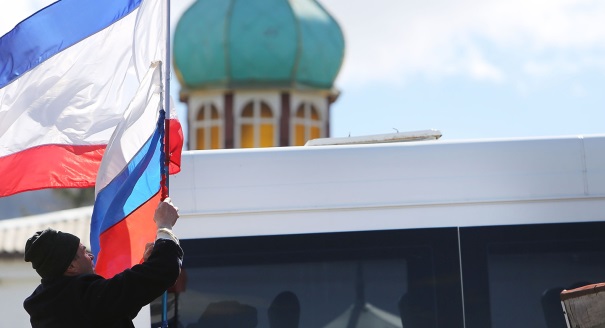
The referendum in Crimea, the evolving situation in Ukraine and Russia's proactive foreign policy will have a far-reaching impact on international relations. New facts have been established in Eastern Europe. Ukraine does not recognize the referendum and will not agree to Crimea becoming a part of Russia, nor will the United States and most members of the international community. But no country will attempt to physically challenge it.
Instability in Ukraine will continue, and the country's future shape, constitution and international affiliations are wide open at this point. Eastern and southern regions of Ukraine that are home to huge numbers of ethnic Russians will, supported by Russia, continue to demand more autonomy from Kiev. Ukraine's ailing economy will seek more financial support, which the West cannot ignore. The US and the European Union, on one hand, and Russia, on the other, will compete hard and long for the former Soviet republic.
The Baltic states, Poland, Romania and other Central and Eastern European countries, now embedded in the EU and NATO, will seek additional military and diplomatic protection from the US. They are likely to receive some notional US deployments to the region in the form of ballistic missile defense systems, air and sea patrols, and military exercises.Having made a bold step in Crimea, Russia will not run for cover from Western sanctions and take a defensive posture. Citing the situation of ethnic Russians in Ukraine, it has raised the larger issue of the post-Cold War settlement in Europe. Moscow will not seek to restore the Soviet Union, but it will try to consolidate the Eastern Slav/Orthodox countries, as well as areas inhabited by some Muslim Turkic peoples, into a new Eurasian compact - a competitor and an alternative to the EU, rather than its extension.
In particular, Russia will take an active stance on the Moldova/Transnistria situation, seeking to check Chisinau's drive toward the West or, at least and more realistically, to reintegrate Transnistria (for example, via Odessa) with the areas where ethnic Russians are in majority. If the plan succeeds, virtually the entire northern portion of the Black Sea coastline - from the Dniester River in the west to the Inguri River in the east with Sevastopol at the center - will again be in Russia's hands.
Of course, Russia will face open hostility from the US and its allies in Europe. There will be sanctions, and their associated costs. Russia will not hesitate to strike back wherever and however it can. And something like a new Cold War could follow.
This will be a serious test for Western policies, but even more so for the Russian Federation. A three-dimensional (economic, political and information/cultural) competition with a much stronger adversary will require Russia to mobilize all its available resources. It will also expose the flaws of Russia's present system. As a result, Russia could either re-emerge as a nation with a strong sense of patriotism, or it could break up again.
Future Western, particularly European sanctions can push Russia to seek compensation through strengthening economic ties with Asian countries. China is obviously the leading candidate, but Moscow hopes that others in the region, such as Japan, South Korea and Singapore, despite supporting the US verbally, will continue, and even expand, their trading links with Russia.
Politically, Moscow knows it will have to stand alone on the Crimea issue. It has been through this before, over South Ossetia and Abkhazia in 2008, and does not seem to mind much. Russian President Vladimir Putin believes he is doing the right thing, by helping Russians to come back to Russia, and this is what matters.
Moscow has certainly noted Beijing's sole abstention during the UN Security Council vote on the Crimea referendum. The Russians understand China's concern about the principles of territorial integrity and non-interference, but they also realize that Beijing is not comfortable with Washington's geopolitical interests in the region. This calls for continued close partnership, but not for a military alliance.
Essentially, the Russians believe that it is the interests of the various countries - the US, China, Russia and others - that inform their behaviors, and that it is the power relationships among the leading members of the international community which set the rules of the game. Moscow has long been unhappy about some of the rules set after the end of the Cold War, such as the West's dominance, but now it feels strong and confident enough to challenge them.
The post-Cold War is thus over, and it can now well be renamed the inter-cold war.
Former Director, Carnegie Moscow Center
Trenin was director of the Carnegie Moscow Center from 2008 to early 2022.
Recent Work
Dmitri Trenin
Dmitri Trenin
Carnegie does not take institutional positions on public policy issues; the views represented herein are those of the author(s) and do not necessarily reflect the views of Carnegie, its staff, or its trustees.

As we close out another season of Strategic Europe, it is worth taking stock of the deep shifts underway.

Rym Momtaz

The hybrid warfare landscape is evolving rapidly, leaving policymakers without clear strategies. To better inform their work in addressing emerging challenges, governments must dig deeper into the underlying dynamics at play.


Raluca Csernatoni, Alicia Wanless

The EU had to compromise to adopt a twenty-first sanctions package against Russia, exposing growing cracks in the union’s resolve. Is this latest, weaker round worth it to keep pressure on Moscow?
Rym Momtaz, ed.

Trump is distracted and Ukraine wants Europe to step up. The continent’s leaders must find their voice and assert it in talks with Russia.

Alissa de Carbonnel

Mounting economic strain and battlefield losses will not necessarily make the Kremlin less dangerous. They could instead push Moscow toward a more aggressive hybrid campaign designed to test NATO’s Eastern flank, exploit allied hesitation, and fracture European resolve.

Maksym Beznosiuk