

Commentary
Thomas de Waal
{
  "authors": [
    "Thomas de Waal"
  ],
  "type": "commentary",
  "centerAffiliationAll": "",
  "centers": [
    "Carnegie Endowment for International Peace",
    "Carnegie Europe",
    "Carnegie Russia Eurasia Center"
  ],
  "collections": [],
  "englishNewsletterAll": "",
  "nonEnglishNewsletterAll": "",
  "primaryCenter": "Carnegie Europe",
  "programAffiliation": "",
  "programs": [],
  "projects": [],
  "regions": [
    "Russia",
    "Eastern Europe",
    "Ukraine"
  ],
  "topics": [
    "Security",
    "Foreign Policy"
  ]
}
Source: Getty
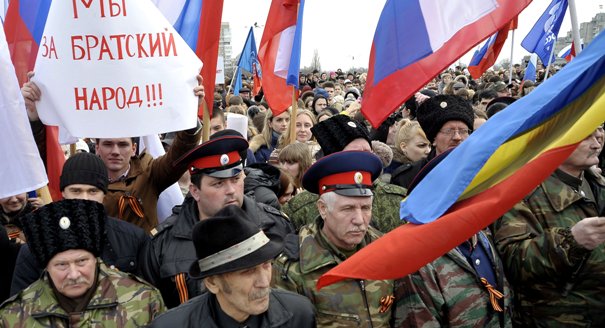
It is not clear whether “protection of compatriots” is a new foreign-policy goal Putin intends to apply elsewhere—or whether he is just using any weapon he can to undermine the new authorities in Kyiv. In any case, playing the “compatriot card” is a dangerous game.
Until last week, the issue of intervention on behalf of Russian "compatriots" in the former Soviet space was a dog that, thankfully, did not bark.
Since he became Russian president, Vladimir Putin has made sympathetic comments about the plight of Russians in the "Near Abroad." Indeed in 2005 he famously called the end of the Soviet Union "the greatest catastrophe of the century" precisely because it left millions of Russians on the wrong side of international borders.
It could have been different. One can only speculate what would have happened if Alexander Solzhenitsyn (Ronald Reagan's favorite Russian thinker, lest we forget), had gone into active politics in Russia.
In his famous 1990 pamphlet "Rebuilding Russia" Solzhenitsyn called for the creation of a new Slavic state that would incorporate Russia, Belarus and Ukraine and also, provocatively, the Russian-speaking parts of Northern Kazakhstan.
Fortunately, irredentist ethno-nationalism of the kind Solzhenitsyn advocated did not take hold in Russia in the 1990s. Russians, both inside and outside the borders of the new state, were not politically mobilized. Leaders of new states with large Russian-speaking populations, such as President of Kazakhstan Nursultan Nazarbayev, showed restraint. President Boris Yeltsin did not over-react, even when the Baltic States passed some discriminatory legislation.
Yeltsin got a lot of criticism for that stance at the time from the likes of maverick nationalist Vladimir Zhirinovsky and the small organization Congress of Russian Communities (in which Russian translates as the ethnic "russky" not the civic "rossiisky"). But the mainstream consensus held that ethnic Russians (sootechestvenniki) were not a political tool.
The tone changed under Putin. Two former leaders of the once-marginal Congress of Russian Communities, Dmitry Rogozin and Sergei Glazyev became leading members of the Moscow political establishment. Glazyev is now leading the ideological cavalry charge against the "Euro-maidan." Although the rhetoric escalated, not a lot changed. Lest we forget, ethnic Russians did suffer in some post-Soviet republics. Moscow politics dictated that in somewhere like Turkmenistan, where their cause was a real one, nothing was done.
Then last week the Kerch Straits between Russia and Crimea became the new Rubicon—and against the most implausible of candidates, brotherly Slavic Ukraine. The issue of alleged discrimination (or, in the overheated vocabulary of the post-Soviet space, "genocide") against Russian-speakers was cited as a justification for Russia's military intervention in Crimea, even after the new acting president of Ukraine had upheld the status of Russian as a regional language.
It's a frightening precedent—all the more so as sootechestvenniki is taken to cover the broader category of speakers of the Russian language, not holders of Russian passports. As Charles King of Georgetown University pointed out in a discussion I took part in this week, the term is so vague that Putin's "responsibility to protect" could go all the way to Brighton Beach.
So we need to understand whether "protection of compatriots" is a new foreign-policy goal Putin intends to apply elsewhere—or whether he is just using any weapon he can to undermine the new authorities in Kyiv.
The tone of Putin's press-conference on Tuesday suggested the latter option is more likely—that the Russian leader has not (yet at least) opted for outright annexation of Crimea or direct intervention in eastern Ukraine and is using Russian-speakers as tools he may drop later.
Even if that is the case (and it's far from proven), playing the "compatriot card" is still a dangerous game. Putin has stirred up a Russian-speaking hornet's nest. If the situation changes and the Russian president wants his protégés in Crimea to stand down, will they follow orders?

Senior Fellow, Carnegie Europe
Thomas de Waal is a senior fellow at Carnegie Europe, specializing in Eastern Europe and the Caucasus.
Recent Work
Thomas de Waal
Thomas de Waal
Carnegie does not take institutional positions on public policy issues; the views represented herein are those of the author(s) and do not necessarily reflect the views of Carnegie, its staff, or its trustees.

The EU can impose sanctions but struggles to enforce them without the United States. With Washington increasingly disinterested in backing European interests, the bloc must now fend for itself.


Nicu Popescu, Tiago Antunes

Russia is testing the waters of NATO’s mutual defense clause. What do strikes in Romanian territorial waters mean for the alliance’s posture toward Moscow?

Dimitar Bechev

With its public finances in shambles, the far right polling at 35 percent ahead of the 2027 presidential election, and a growing protest movement, is France’s crisis a threat to the EU’s geopolitical awakening?

Rym Momtaz, ed.

Ahead of a tough winter for Ukraine, Donald Trump’s swing back toward Russia bodes ill. But instead of panicking, Kyiv’s European allies are focusing on action.
Rym Momtaz

Funding Ukraine remains a priority for European leaders. As Russia’s war of aggression heads into another winter, two feasible options to mobilize support for Kyiv should be fast-tracked.


Vladyslav Rashkovan, Gregory P. Wilson