

Commentary
Balázs Jarábik
{
  "authors": [
    "Balázs Jarábik"
  ],
  "type": "legacyinthemedia",
  "centerAffiliationAll": "dc",
  "centers": [
    "Carnegie Endowment for International Peace",
    "Carnegie Russia Eurasia Center"
  ],
  "collections": [],
  "englishNewsletterAll": "ctw",
  "nonEnglishNewsletterAll": "",
  "primaryCenter": "Carnegie Endowment for International Peace",
  "programAffiliation": "russia",
  "programs": [
    "Russia and Eurasia"
  ],
  "projects": [],
  "regions": [
    "North America",
    "United States",
    "Russia",
    "Eastern Europe",
    "Ukraine",
    "Western Europe"
  ],
  "topics": [
    "Political Reform",
    "Democracy",
    "Security",
    "Foreign Policy"
  ]
}
Source: Getty
To understand the crisis in Ukraine, it is necessary to look at the region the way its residents see it. Contrary to the Western narrative of Russia aggression, the real story is much more complicated.
Source: POLITICO Magazine
The crisis in eastern Ukraine is far from over.
On Monday, the moderate mayor of Kharkiv, the country’s second-largest city, was shot while riding his bicycle. Pro-Russian separatists have seized another government building in the region, and some are holding hostage a group of European military observers. The United States, convinced the chaos is all being driven by Moscow, slapped new sanctions on top Russian officials Monday, and the Europeans will probably go along.
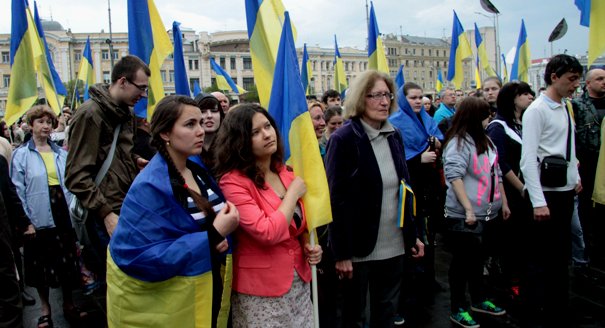
To understand what’s driving this crisis, though, it’s necessary to look at the region the way its residents see it, not just the way it appears to the outside world.The dominant Western narrative is all too familiar: It’s good guys vs. bad guys. Russian aggression against Ukraine and covert backing for separatist groups are the main sources of conflict, creating a very real danger that southeastern Ukraine may soon erupt into full-scale war or split off and join Russia. Throw in the kidnappings of journalists, targeted killings of local politicians and residents and renewed Ukrainian military operations against the separatists, and the whole region appears to be in flames—and it’s all Moscow’s doing. As U.S. Secretary of State John Kerry put it over the weekend, the Kremlin is behind the “distraction, deception and destabilization” in eastern Ukraine.
Unfortunately, the real story is much more complicated, and it has as much to do with the murky nature of Ukrainian politics as it does with Russia’s blatant meddling. On one level, the clashes in eastern Ukraine are just the latest battle between the country’s powerful and fractious oligarchs, for whom business interests—not the fate of Ukraine—are always priority number one.
The good news is that the separatists are actually quite isolated, according to recent accounts by the Organization for Security and Cooperation in Europe’s monitoring mission in eastern Ukraine. Even Kerry, despite his stern rhetoric, has indicated that fewer than 30 buildings have been occupied. And a recent poll conducted by the Kyiv International Institute of Sociology found that the majority of southeastern Ukraine’s residents do not favor joining Russia; 70 percent want to remain in Ukraine, and only 15 percent support secession; 60 percent do not approve of armed separatists seizing government buildings.
There is no doubt that Russia has been trying to destabilize Ukraine in the wake of the annexation of Crimea and that both sides could yet tumble into full-scale military conflict. But Russia is not the only factor shaping public opinion toward the central government in Kyiv, the Ukrainian capital.
From the outside, the Kyiv government is usually depicted as a band of selfless reformers. In fact, the differences in how it is perceived across the country are vast, with 78 percent of western Ukrainians but only 16 percent of easterners registering their approval in one recent poll.Easterners (and southerners, for that matter) see a cabinet dominated by former prime minister and current presidential candidate Yulia Timoshenko and her Fatherland political party, whose base of support is in the pro-European west of the country. Both the Party of Regions and Vitaly Klitchko’s UDAR party refused to join the government, leaving it dangerously low on eastern support.
The importance of looking beyond simplistic narratives also extends to politics at the regional level. When the Kyiv interim government appointed steel magnate and local oligarch Serhiy Taruta as governor of Donetsk, a major city close to the Russian border, he encountered strong local opposition, and the Donbas region, which includes Donetsk and Luhansk, soon became the main hotbed of separatist activity. Why? Many experts point to the influence of Ukraine’s richest businessman Rinat Akhmetov, who reportedly holds considerable sway over Donbas’s economic life, not to mention the activities of local law enforcement and municipal officials.
In Ukraine, political power almost always translates into control of property. The business elite of southeastern Ukraine is not prepared to surrender to a Kyiv government it sees as an instrument of Timoshenko (an old-school oligarch in her own right), and is likely using all means at its disposal, including the separatist card, to make its point.
The May 25 presidential election is the next big test, pitting Timoshenko against Petro Poroshenko, a prominent businessman who has held many senior posts in previous Ukrainian governments. A Timoshenko victory would spell trouble for the region’s business elite. Thus, the separatist unrest, which has put the actual viability of the elections in jeopardy, may be a hedging tactic by local oligarchs.
Ukrainian political insiders believe that Timoshenko’s control over the interim government in Kyiv has set off enough alarm bells that many oligarchs are pooling their resources and backing Poroshenko. (There is some evidence that Poroshenko and Klitchko traveled to Vienna in late March to hammer out a deal with Dmitro Firtash, a prominent Ukrainian oligarch who was recently indicted by U.S. law enforcement and is fighting extradition on racketeering charges.) After all, various Ukrainian oligarchs helped bankroll the Maidan movement, the protests that ousted President Viktor Yanukovych in February, because they were angry with the Yanukovych “family” for squeezing them out of lucrative businesses. They certainly do not want to see Timoshenko install herself as the top dog and make their lives miserable.
The unseemliness of Ukrainian politics certainly makes for strange bedfellows. In this instance, it has put some Ukrainian oligarchs on the same side as Vladimir Putin and against Timoshenko, who has long been rumored to be on good terms with the Russian president. Both the Kremlin and these oligarchs have an interest in undermining the current government in Kyiv. The Kremlin and the oligarchs may have their own distinct reasons for doing so, but both see the separatist card as a source of extra leverage.
Ironically, by relying on the separatists, the oligarchs could end up playing into Timoshenko’s hands. She is badly trailing Poroshenko in recent opinion polls. A postponed election would give her extra time to organize her campaign, while a compromised election would enable Russia to challenge the new president’s legitimacy and mount a comeback. Either way, Ukraine would be left with a dangerously weak government. (At the same time, the growing specter of Russian aggression could help her party in the next parliamentary elections.)
Confused?
Ukrainian politics, divided and replete with conspiracy theories and unfounded rumor, can be baffling to outside observers. Fiction is often more important than reality, as it drives the popular narrative. Yet there is an important lesson here: What is happening inside Ukraine is just as, if not more, important than what is happening on its border with Russia. We’d do well to understand it better.

Political analyst, former Slovak diplomat, and consultant specializing in Eastern Europe
Recent Work
Balázs Jarábik
Balázs Jarábik
Carnegie does not take institutional positions on public policy issues; the views represented herein are those of the author(s) and do not necessarily reflect the views of Carnegie, its staff, or its trustees.

The domestic impacts of how long it is taking to end the war in Ukraine have pushed the French electorate to the political extremes and compromised the country’s diplomatic capacity.

Rym Momtaz

Before the next wave of EU enlargement takes place, the union needs to grapple with thorny questions of how power is distributed among its members.


Emil Sondaj Hansen, Ditte Brasso Sørensen

The new U.S.–Denmark–Greenland agreement will help Washington exert political, economic, and financial dominance under the guise of security. Yet, it acknowledged Copenhagen’s and Nuuk’s sovereignty on the island.

Marc Pierini

A summer of escalation in the Black Sea has hurt Ukraine economically and is exacerbating world food security. A truce is needed—as is a broader reframing of Europe’s Ukraine strategy.

Thomas de Waal

Are Germany’s economic, industrial, and political struggles becoming a liability for the EU’s ability to rise to the geopolitical moment?
Rym Momtaz, ed.