

Commentary
Nathalie Tocci, Jan Techau
{
  "authors": [
    "Jan Techau"
  ],
  "type": "legacyinthemedia",
  "centerAffiliationAll": "dc",
  "centers": [
    "Carnegie Endowment for International Peace",
    "Carnegie Europe"
  ],
  "collections": [
    "Europe’s Eastern Neighborhood",
    "Transatlantic Cooperation"
  ],
  "englishNewsletterAll": "ctw",
  "nonEnglishNewsletterAll": "",
  "primaryCenter": "Carnegie Europe",
  "programAffiliation": "EP",
  "programs": [
    "Europe"
  ],
  "projects": [],
  "regions": [
    "Russia",
    "Europe",
    "Eastern Europe",
    "Ukraine",
    "Western Europe",
    "Iran"
  ],
  "topics": [
    "Foreign Policy",
    "Security"
  ]
}
Source: Getty
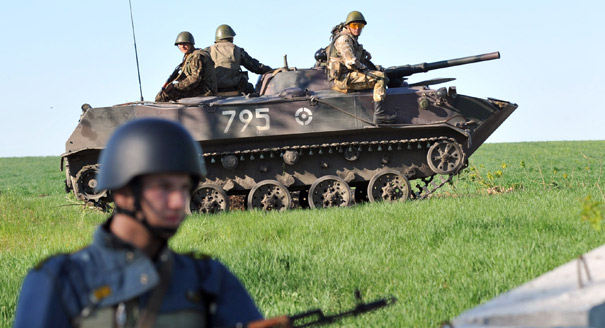
Russia has been conducting troop exercises on Ukraine’s border. But an invasion would not trigger a NATO military response—and probably not even strong economic sanctions.
Source: Deutsche Welle
My feeling is that NATO would condemn this very strongly. But if people expect NATO to protect eastern Ukraine militarily and defend it - I think they're mistaken. I don't think there's willingness on behalf of any NATO member state to commit NATO troops to defending eastern Ukraine. So we will not see military action. That's a pretty safe bet and that's what Mr. Putin knows.
It's very hard to say how this is being perceived in Moscow. The goal of the Russian policies at the moment is to regain political control over all of Ukraine - either very quickly or over the next one or two years. [Russia] has played things very systematically over the last few weeks. This is the one thing that Putin has to achieve, because under his watch Russia "lost" Ukraine, if you will. Now he needs to right that wrong from his perspective. That's the goal. Touching Article 5 territory is not his operational goal at this point so far.
I'm talking about political control - I'm not talking about occupying the entire country. I'm pretty convinced that it is not in Russian interests to have a military operation in all of Ukraine. But the ultimate goal is to regain political control over who governs the country. Russia thought it was safe with [former Ukrainian President] Yanukovych. They had banked on him to basically hold the fort and to stay in power even throughout the entire Maidan process.
They miscalculated. Yanukovych fled from office, and now they need to regain control. This is the strategic goal of Russia - to keep Ukraine as tightly associated as possible, to tie it into its sphere of influence. What they ultimately want is to have somebody in power who's Russia-friendly. That's not the case at the moment, and that's something they want to change.
The goal is that this new government, the current post-revolutionary government, cannot succeed. It must be undermined. It must be unable to consolidate the country. It must be unable to conduct a proper constitutional process in the next couple of months. And it must also fail - from the Russian perspective - to consolidate the economy.
The big question is whether Russia is playing this as a short-term game over the next few weeks - basically until the elections in Kyiv in late May - or whether we're looking at two years or so. I can't judge that. But the goal itself is pretty clear.
Russia has always been of the opinion - and this is on the record - that Ukraine is not a sovereign nation, that it is not even considered a country. Putin has said that repeatedly. And so the idea of Ukraine deciding its own political fate, which is what the Maidan revolution and the current political parties in Kyiv want, is completely a taboo for the Russian side.
That is not something the Americans want. The Americans have repeatedly said that their ultimate goal is that Ukraine can make a sovereign decision about its own political future. This is where the major conflict lies.
There are two elements in this: first of all, the Geneva talks - as it now turns out - were very clearly a time game for the Russian side. Russia immediately afterwards turned the provision of the Geneva agreement around and accused the government in Kyiv of having violated the agreement immediately. It was a very interesting and very smart game that Russia played in order to get some legitimacy for its own actions.
The second thing is the question of sanctions. Level 3 would include massive economic sanctions. My feeling is that the Europeans don't want to go there - partly because of German reservations, but not only. That may even be true in the case of an outright political invasion, which is in theory the trigger for level 3.
And then there's a second element to all of this: the division between the Americans and the Europeans. The Americans have now decided to play this tough, and to be very robust on Russia, and to not let this kind of Russian attack on the post-Cold War order in Europe stand. But the Europeans are not anywhere near that. The Europeans are playing it a lot softer, and are a lot more wedded to the diplomatic approach, with soft sanctions. What we therefore see is not only a division amongst the Europeans, but also a division between the Americans and the Europeans. And that doesn't bode well for a very united and forceful position vis-a-vis Russia.
That is completely open.
My feeling is that if the current situation persists - and we kind of anticipate that - time plays against Ukraine. And that would of course be a devastating blow to the entire European peace system after the Cold War, where it was clear that territorial integrity needed to be accepted and guaranteed. And now we're back to a system where force prevails, and where the country that is bold enough and forceful enough can redraw the map. And that is not a kind of Europe which looks terribly attractive for the future.
Director, Europe Team, Eurasia Group
Techau is director with Eurasia Group's Europe team, covering Germany and European security from Berlin. Previously, he was director of Carnegie Europe.
Recent Work

Nathalie Tocci, Jan Techau
Jan Techau
Carnegie does not take institutional positions on public policy issues; the views represented herein are those of the author(s) and do not necessarily reflect the views of Carnegie, its staff, or its trustees.

An overwhelming victory by a far-right-wing party in a small state in eastern Germany will have major repercussions for Chancellor Friedrich Merz’s coalition.

Judy Dempsey

Canadian Prime Minister Mark Carney has twice inspired praise for standing up to U.S. President Donald Trump: at the 2026 World Economic Forum in Davos and on Canada-U.S. trade negotiations. Is Carney showing a third way better than the EU has in dealing with the Trump administration?

Rym Momtaz, ed.

The EU’s responses to two recent incidents expose the gulf between European perceptions and capabilities. Unless the union can bridge that gap, it will never become a real geostrategic power.
Rym Momtaz

European states control several Overseas Countries and Territories around the world that carry strategic, economic, and environmental weight. As great powers challenge the rules-based order, defending them is a geopolitical imperative for Europe.

Marc Pierini

In supporting Europe’s far-right, MAGA and Russia both want the same thing: a weaker EU. Europe must defend itself without abandoning the openness these forces exploit.

Armida van Rij