

In The Media
Lilia Shevtsova
{
  "authors": [
    "Lilia Shevtsova"
  ],
  "type": "commentary",
  "centerAffiliationAll": "",
  "centers": [
    "Carnegie Endowment for International Peace",
    "Carnegie Russia Eurasia Center"
  ],
  "collections": [],
  "englishNewsletterAll": "",
  "nonEnglishNewsletterAll": "",
  "primaryCenter": "Carnegie Russia Eurasia Center",
  "programAffiliation": "",
  "programs": [],
  "projects": [
    "Eurasia in Transition"
  ],
  "regions": [
    "Central Asia",
    "Kazakhstan",
    "Russia",
    "Eastern Europe",
    "Belarus"
  ],
  "topics": [
    "Political Reform",
    "Security",
    "Foreign Policy"
  ]
}
Source: Getty
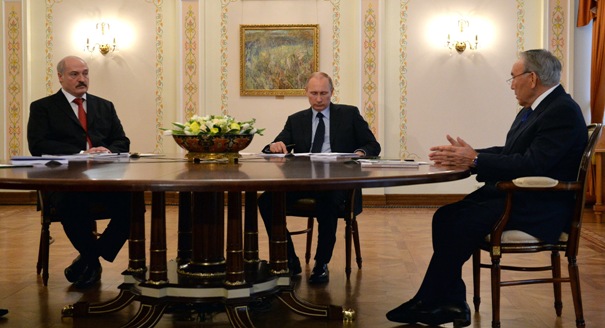
After the Russian annexation of Crimea, the Belarusian President Lukashenko starts creating a “besieged fortress” and mobilizing the Belarusians to defend their country from potential Russian aggression. Moreover, Kazakhstan’s President Nazarbayev may follow Lukashenko’s example. It is clear that the future Eurasian Union cannot be strong.
The Belarusian President Alexander Lukashenko has every right to claim the mantle of the deftest and most efficient tactician among the post-Soviet authoritarian leaders and dictators. For a while, it seemed that this title should belong to the Kazakh President Nursultan Nazarbayev. President Vladimir Putin definitely does not fit into this category. He is more skilled at working with a sledge-hammer. Were it not for all the nuclear weapons and natural gas that he commands, I cannot imagine how he would be capable of even simple foreign policy designs.
However, now Lukashenko openly refrained from supporting the Russian annexation of Crimea. Moreover, he took advantage of the annexation by borrowing Putin’s survival paradigm. He is creating a besieged fortress and mobilizing the Belarusians to fight for their independence! Look at what he said. “We are not aggressors; we do not want to go to war with anyone. But if someone starts with us, we must be ready to inflict unacceptable damage on this aggressor. It is a purely defense doctrine… We have to keep our armed forces on alert in order to avoid the sad fate of our Ukrainian brothers.”
In short, Lukashenko will be bracing himself for defending Belarus from potential Russian aggression. At the same time, he is not about to reject Moscow’s financial assistance. Besides, Lukashenko’s willingness to oppose the Kremlin’s aggressive designs is supported in Europe, which has long been trying to start dialogue with the continent’s “last dictator.” As for Moscow, it will have to open up its purse and buy off Lukashenko lest he expands on his plans to create “defenses” against Russia.
In any event, a paradoxical situation emerges: one of the Customs Union and future Eurasian Union members is going to defend itself against the leader and financial engine of this Union, that is Russia. So how strong can this union be?
It is quite possible that generally more restrained Nazarbayev will follow Lukashenko’s example and start creating his own “besieged fortress” model. After all, Kazakhstan must treat Putin’s doctrine of supporting Russian speakers abroad as a direct threat. In other words, the besieged fortress virus may prove to be contagious.
What we are witnessing today illustrates the Law of Unintended Consequences that Putin set in motion. In this case, instead of getting what he was looking for, Putin wound up with a somewhat unexpected situation.
Former Senior Associate, Russian Domestic Politics and Political Institutions Program, Moscow Center
Shevtsova chaired the Russian Domestic Politics and Political Institutions Program at the Carnegie Moscow Center, dividing her time between Carnegie’s offices in Washington, DC, and Moscow. She had been with Carnegie since 1995.
Recent Work
Lilia Shevtsova
Lilia Shevtsova
Carnegie does not take institutional positions on public policy issues; the views represented herein are those of the author(s) and do not necessarily reflect the views of Carnegie, its staff, or its trustees.

Are Germany’s economic, industrial, and political struggles becoming a liability for the EU’s ability to rise to the geopolitical moment?

Rym Momtaz, ed.

European Commission President Ursula von der Leyen is about to give her annual address on the state of the EU. Here’s what she won’t—but should—say.
Rym Momtaz

The aftermath of the Ceuta crisis shows Europe has drawn the wrong lessons. Rather than doubling down on failed migration policies, the EU needs to address the underlying roots of such episodes.

Richard Youngs

Canadian Prime Minister Mark Carney has twice inspired praise for standing up to U.S. President Donald Trump: at the 2026 World Economic Forum in Davos and on Canada-U.S. trade negotiations. Is Carney showing a third way better than the EU has in dealing with the Trump administration?
Rym Momtaz, ed.

The EU’s responses to two recent incidents expose the gulf between European perceptions and capabilities. Unless the union can bridge that gap, it will never become a real geostrategic power.
Rym Momtaz