

Commentary
Bayram Balci
{
  "authors": [
    "Bayram Balci"
  ],
  "type": "legacyinthemedia",
  "centerAffiliationAll": "dc",
  "centers": [
    "Carnegie Endowment for International Peace",
    "Malcolm H. Kerr Carnegie Middle East Center"
  ],
  "collections": [],
  "englishNewsletterAll": "menaTransitions",
  "nonEnglishNewsletterAll": "",
  "primaryCenter": "Carnegie Endowment for International Peace",
  "programAffiliation": "MEP",
  "programs": [
    "Middle East"
  ],
  "projects": [],
  "regions": [
    "Middle East",
    "Türkiye"
  ],
  "topics": [
    "Political Reform",
    "Democracy",
    "Religion"
  ]
}
Source: Getty
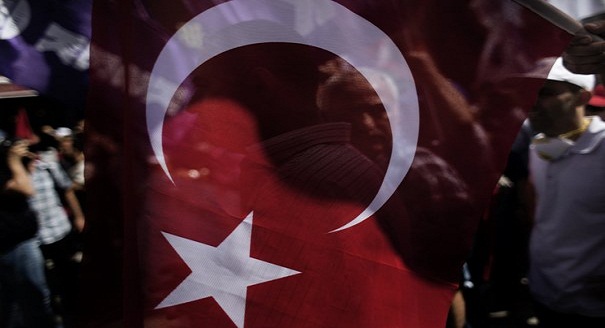
The political battle between the AKP and their former-ally turned competitor Fethullah Gülen has had severe consequences for Turkish democracy.
Source: World Policy Blog
Since December 17th, Turkey’s Prime Minister, Tayyip Erdoğan, has become ensnared by serious political crisis. Facing allegations of corruption and anti-democratic leadership, Erdoğan and his conservative Justice and Development Party (AKP) are now enemies of a former-ally turned competitor encroaching on Erdoğan’s power. A once strong coalition between Erdoğan’s (AKP) and Fethullah Gülen, an Islamic preacher and former ally to the prime minister, has shattered to pieces.
These two political and socio-religious forces, which have presided over the state in separate spheres for more than ten years, now continue to one-up each other in an ugly political battle. The fight has had severe consequences for Turkish democracy, where it seems the Turkish citizens are the ones losing. While Sunday’s countrywide elections signal a promising future for Erdoğan and the AKP, the political battle over Turkish rule is far from over.
Conscious of the threat Gülen poses to his power, Prime Minister Tayyip Erdoğan seems to be overriding the separation of powers and transforming the Turkish imperfect democracy into an autocracy. Putting intense constraints on the media and clearing government halls of his competitors, the leader is on the defensive. On the offensive is Gülen, who by publicly denouncing the Prime Minister and alleged government dishonesty, has emerged as a champion of anti-corruption. Though the Gülen movement gives the impression of being more democratic, a look into the movement’s internal functioning raises serious questions about this claim.The current Turkish government has been going through a difficult period for several months. Erdoğan is facing an unprecedented amount of political attacks and a growing sense of discontent among the population. Serious allegations of corruption have led him to reorganize his ministry—undermining the government’s integrity. In a fragile state, the Prime Minister is carefully watching his back for his former ally—the nebulous Fethullah Gülen who is accused of organizing a coup from the United States to bring him down.
To undermine the alleged U.S.-Gülen plot, Erdoğan has purged the police and justice departments where Gülen supporters had placed investigations. In addition to working against Gülen, Erdoğan’s moves work to stop the searches into his questionable practices. It’s politics at its best.
According to Erdoğan, Gülen supporters want nothing more than to overthrow him. On an authoritative path since his third term mandate in 2011, Erdoğan barely tasted the relative Turkish democracy of which he was a principal architect. Besides the purges and reassignments, he has been keeping the media in a strong-hold, banning Twitter and YouTube. Even worse, he has sought executive control over the judiciary department.
From this cloud of government corruption, Gülen has emerged a leader in the campaign attempting to fight Prime Minister’s authoritarian rule. But even his seemingly democratic movement cannot be be called wholly benevolent. Indeed, Gülen’s media outlet Zaman, or the English Today’s Zaman, continue to denounce breaches in democracy and corruption being muffled by government. Since the 1990s, the Gülen movement has worked in Turkey and abroad to support the emergence of a civil society, both conservative and Islamic, permitting real democratic progress. While accomplished through questionable infiltrations in the state, the denunciations served the state by rendering it more transparent. But despite his initiatives for democracy and less corruption in Turkey, there are reasons to doubt the democratic character and functioning of the Gülen movement.
Parallel to his initiatives for peace and dialogue between cultures and religions, runs mystery into the motives and workings of the movement. The internal functioning and hierarchy of the Gülen movement remain opaque, and Gülen himself is still the principal source of decision making for the movement. This political structure is far from democratic.
Meanwhile, the elusive and even obscure figure claims to combat corruption and authoritarianism, by infiltrating the government.While fighting corruption and authoritarianism is an honorable mission, how it is being carried out makes it un-democratic. The officials who have infiltrated the government are loyal to a mysterious religious leader’s community and not to the state (which is supposed to be run by a democratically elected government and not by a mysterious religious structure).
It is questionable whether these Gülen loyalists denounce corruption out of a passion for democracy, or in the name of their leader who is in a heated struggle for power with his former ally, the Turkish Prime Minister. It is curious that these functionaries have waited this long to denounce forces so prevalent in Turkish government. In their enthusiasm for Turkish democracy, why wait for the irreversible separation of Gülen and the Prime Minister to denounce Erdoğan’s undemocratic actions (a phenomenon that was nothing new in Turkish politics)? Finally, is the noble fight of procurers and police officers in the interest of democracy, or in self-interest?
In this tug-of-war between an ever authoritarian and corrupt government and a mysterious and omnipotent movement, we do not know where to turn. Nor do we know which of these two figures to call democratic. The Prime Minister is certainly not—the movement seems even less. And yet, although their actions in recent weeks can't be described as a struggle for democracy, Gülenists remain a social force that could contribute to social harmony in Turkey. For this, the movement must be faithful to the image it gives of itself—not as a religious movement becoming a political force, but as a social philosophy concerned with education, spirituality, and dialogue between different segments of society.
Because of the dominance of the army, the last decades can scarcely be called democratic for Turkey. Stuck between authoritarianism and a movement hungry for power, it is the Turkish people who are at risk of manipulation. The feud between the two former allies has sacrificed Turkish democracy - each force is off its original track, to serve the people. The AKP is interfering in the private affairs of the people, and the Gülen movement is stealthily interfering in policies. The return of each force to its initial sphere, Erdoğan to democracy and Gülen to social and religious arenas would restore valuable services to the Turkish democracy and stop a brewing political war.
Former Nonresident Scholar, Russia and Eurasia Program
Balci was a nonresident scholar in Carnegie’s Russia and Eurasia Program, where his research focuses on Turkey and Turkish foreign policy in Central Asia and the Caucasus.
Recent Work
Bayram Balci
Bayram Balci, Daniyar Kosnazarov
Carnegie does not take institutional positions on public policy issues; the views represented herein are those of the author(s) and do not necessarily reflect the views of Carnegie, its staff, or its trustees.

An overwhelming victory by a far-right-wing party in a small state in eastern Germany will have major repercussions for Chancellor Friedrich Merz’s coalition.

Judy Dempsey

In supporting Europe’s far-right, MAGA and Russia both want the same thing: a weaker EU. Europe must defend itself without abandoning the openness these forces exploit.

Armida van Rij
The hybrid warfare landscape is evolving rapidly, leaving policymakers without clear strategies. To better inform their work in addressing emerging challenges, governments must dig deeper into the underlying dynamics at play.


Raluca Csernatoni, Alicia Wanless

Over the past ten years, NATO has held almost as many summits as it did during the entirety of the Cold War. Are they still useful, or is it time to stop holding annual meetings?

Rym Momtaz, ed.

As the EU confronts profound challenges, several leaders have called for fundamental reform to the union’s model—but only modest, superficial changes have resulted. What if Europe really could be reimagined from zero today: What should such a redesigned European order look like?

Richard Youngs, ed.