

Commentary
Alexey Malashenko
{
  "authors": [
    "Alexey Malashenko"
  ],
  "type": "commentary",
  "centerAffiliationAll": "",
  "centers": [
    "Carnegie Endowment for International Peace",
    "Carnegie Russia Eurasia Center"
  ],
  "collections": [],
  "englishNewsletterAll": "",
  "nonEnglishNewsletterAll": "",
  "primaryCenter": "Carnegie Russia Eurasia Center",
  "programAffiliation": "",
  "programs": [],
  "projects": [
    "Eurasia in Transition"
  ],
  "regions": [
    "Central Asia",
    "Kazakhstan",
    "Caucasus",
    "Russia",
    "Armenia",
    "Eastern Europe",
    "Belarus"
  ],
  "topics": [
    "Economy",
    "Trade",
    "Foreign Policy"
  ]
}
Source: Getty
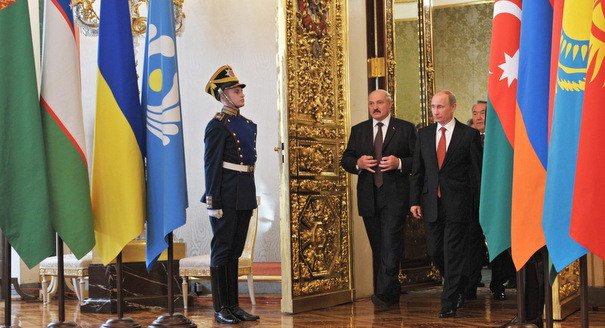
Belarus, Kazakhstan, and Russia signed a treaty on the creation of the Eurasian Economic Union (EAEU) on May 29. While Russia mainly hopes to increase its political clout, all three presidents realize how many difficulties they will have to overcome.
Belarus, Kazakhstan, and Russia signed a treaty on the creation of the Eurasian Economic Union (EAEU) on May 29, 2014. The event was quite expected, and the preparations for it had long been underway. The treaty will go into effect on January 1, 2015.
What are the EAEU members’ hopes and fears?
Russia mainly hopes to increase its political clout and make Kazakhstan and Belarus even more attached and dependent on it. Although the word “economic” figures prominently in the organization’s title, no one doubts the treaty’s political component, especially evident in light of the Ukraine crisis.
Politicizing the EAEU is exactly what Kazakhstan and Belarus fear. The fear is especially palpable in Kazakhstan, whose political class fears that the country may lose some of its sovereignty as a result of its closer ties with Russia. That is why the term “multi-vector foreign policy” is now being increasingly used in Kazakhstan as a reminder that the country is also oriented toward China, the United States, Europe and the Turkic-speaking world.
Creating the EAEU was Nursultan Nazarbayev’s initiative, so the idea is especially dear to the Kazakh President’s heart. It is hard to say how the concept will be approached after Nazarbayev leaves office. Some analysts believe that regardless of who the next Kazakh president will be, the ruling class will become more nationalistic (one can already observe some nationalistic trends today).
As for Belarus, its president Alexander Lukashenko, while being fully aware of his country’s complete economic dependency on Russia, does not wish for his country to become another region of the Russian Federation. He is trying to demonstrate his political independence, or at least autonomy, when the opportunity presents itself. For instance, Minsk did not recognize the independence of Abkhazia and South Ossetia in 2008, nor did it officially recognize Crimea as part of the Russian Federation. Moreover, Lukashenko is trying to independently develop the Belarus-Ukraine relationship. On top of that, the Belarusian leader blackmailed Moscow a bit right before the signing of the treaty. He threatened to abandon the treaty unless Russia compromised on customs tariffs. Russia caved in.
Incidentally, Belarusian EAEU membership implies a lower level of Russia-Belarus relations, since the countries had previously discussed the creation of a union state.
Kazakhstan and Belarus believe that the EAEU will bring them substantial economic gains in the industrial, agricultural, and finance sectors. Besides, the key energy sector stands to gain a lot from the treaty. However, no agreement in this sphere was actually reached. The creation of a common energy market was postponed until 2018, and a common oil market is slated to be created even later—in 2025. This in a way makes the process of EAEU creation unfinished, and its prospects uncertain. The problems of energy resources certainly belong to the political realm, which makes their resolution more complex and time-consuming.
Ukraine’s absence among the EAEU members is another factor making the new formation incomplete. Moscow had hoped that Ukraine would join the Union up until the start of the Maidan protests in Kiev. Kyrgyzstan’s and Armenia’s possible ascension will not make the EAEU significantly more influential politically and will contribute absolutely nothing to it economically. Besides, it is still unclear whether the EAEU will in fact make it to the Armenian doorstep, since President Serzh Sargsyan is expected to face difficulties introducing the project in his country.
Notably, the signing of the EAEU creation treaty did not cause mass elation in the capitals of its member states. All three presidents obviously realize how many difficulties they will have to overcome before the EAEU starts working. And will it ever work to its fullest?
Former Scholar in Residence, Religion, Society, and Security Program
Malashenko is a former chair of the Carnegie Moscow Center’s Religion, Society, and Security Program.
Recent Work
Alexey Malashenko
Alexey Malashenko
Carnegie does not take institutional positions on public policy issues; the views represented herein are those of the author(s) and do not necessarily reflect the views of Carnegie, its staff, or its trustees.

Are Germany’s economic, industrial, and political struggles becoming a liability for the EU’s ability to rise to the geopolitical moment?

Rym Momtaz, ed.

European Commission President Ursula von der Leyen is about to give her annual address on the state of the EU. Here’s what she won’t—but should—say.
Rym Momtaz

The aftermath of the Ceuta crisis shows Europe has drawn the wrong lessons. Rather than doubling down on failed migration policies, the EU needs to address the underlying roots of such episodes.

Richard Youngs

Canadian Prime Minister Mark Carney has twice inspired praise for standing up to U.S. President Donald Trump: at the 2026 World Economic Forum in Davos and on Canada-U.S. trade negotiations. Is Carney showing a third way better than the EU has in dealing with the Trump administration?
Rym Momtaz, ed.

The EU’s responses to two recent incidents expose the gulf between European perceptions and capabilities. Unless the union can bridge that gap, it will never become a real geostrategic power.
Rym Momtaz