

Paper
George Perkovich
{
  "authors": [
    "George Perkovich"
  ],
  "type": "legacyinthemedia",
  "centerAffiliationAll": "dc",
  "centers": [
    "Carnegie Endowment for International Peace",
    "Malcolm H. Kerr Carnegie Middle East Center"
  ],
  "collections": [
    "Iranian Proliferation",
    "U.S. Nuclear Policy"
  ],
  "englishNewsletterAll": "ctw",
  "nonEnglishNewsletterAll": "",
  "primaryCenter": "Carnegie Endowment for International Peace",
  "programAffiliation": "NPP",
  "programs": [
    "Nuclear Policy",
    "Middle East"
  ],
  "projects": [],
  "regions": [
    "North America",
    "United States",
    "Middle East",
    "Iran",
    "Russia"
  ],
  "topics": [
    "Security",
    "Nuclear Policy",
    "Foreign Policy"
  ]
}
Source: Getty
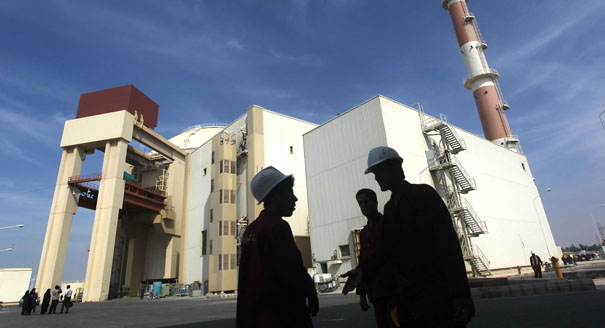
If Iran, the United States and the others could agree to pre-stock fuel for Bushehr and focus Iran’s enrichment program on research and development, it would be in everyone’s interest to extend the negotiations on this basis.
Source: Washington Post
Uranium enrichment is the stickiest sticking point in the nuclear negotiations with Iran now underway in Vienna. The United States and its five partners want Iran to scale back the number and output of the centrifuges it operates and deploys in reserve, thereby extending the time it would take to “break out” and construct a bomb. Iran says it could delay expanding its enrichment capacity for a few years but ultimately needs to scale up to produce replacement fuel for its Bushehr nuclear power reactor. Iranian negotiators maintain that they can’t rely on Russia to continue supplying the fuel or give up Iran’s centrifuge capability, given the high price that has been paid to acquire it — in sanctions and the assassination of its scientists.
It is difficult to find international nuclear experts who are convinced by the argument that Iran needs an industrial-scale enrichment program for Bushehr. Russia is fulfilling its contractual obligation to supply fuel through 2021 and wants to continue doing so thereafter, and Iran does not possess the intellectual property necessary to design and produce the fuel this reactor requires. If Iran did introduce self-made fuel into the reactor, its Russian warranties would no longer apply. While it is understandable that a proud country such as Iran would want to operate independently, no other country at such an early stage of nuclear development has been self-sufficient in this area.
The key to resolving this impasse is to prove that Iran can rely on Russian-made fuel to operate Bushehr without interruption, which would enable Iranian leaders to discontinue premature and uneconomical industrial-scale enrichment. To this end, Russia and the other negotiating states should offer to send, on a rolling basis and starting as soon as possible, several years’ worth of Bushehr fuel to Iran. Such fuel, if kept under constant safeguards by the International Atomic Energy Agency, would not feasibly enable a breakout.With fuel stockpiled, Iranian technicians could focus on research and development to produce more efficient centrifuges to make fuel for future, indigenously built Iranian power plants. Iran’s leaders could proclaim that they cleverly traded first-generation centrifuges to obtain their four main goals: to secure the “right” to enrich; to secure fuel for Bushehr; to create the basis for an advanced Iranian nuclear power program; and to relieve sanctions. If Iran’s leaders said no to a deal along those lines, the Iranian public and the rest of the world would conclude that something other than peaceful requirements was at issue.
Iran has already agreed that “under no circumstances will [it] ever seek or develop any nuclear weapons.” Shifting from an unnecessary, impractical, premature industrial-scale enrichment program to a research-and-development program whose scale and pace coincide with demonstrated civilian needs would help validate this commitment. Based on the experience of other countries with peaceful nuclear programs, Iran would need at least 15 years to design, site, build and operate a modern nuclear power plant that conforms to international safety, security and liability guidelines. The comprehensive deal being negotiated in Vienna would be fully implemented by then, and Iran would be regarded as a “normal” non-nuclear-weapon state.
Of course, even a research-and-development enrichment program is too much for some in the West who insist that Iran should have no nuclear capability at all. But that genie is out of the bottle. Iran is too advanced and too invested in maintaining hard-won expertise to accept what it — and other developing countries — would perceive as a neocolonial demand.
U.S. and Israeli security concerns could be met by an Iranian centrifuge program that proceeds apace with indigenous power plant construction and is located at a single declared facility, with no premature accumulation of enriched uranium and with attendant verification arrangements. Compared to plausible alternatives, a research-and-development program along these lines would diminish the prospects that Iran could either break out from declared facilities and dash for a bomb or “sneak out” and produce a bomb at undeclared facilities.
Time may not allow for agreement on these and other outstanding issues before the July 20 deadline. But if Iran, the United States and the others could agree to pre-stock fuel for Bushehr and focus Iran’s enrichment program on research and development, it would be in everyone’s interest to extend the negotiations on this basis. The alternative — a breakdown in diplomacy and resumption of destabilizing nuclear activity in Iran — could be a tragedy of global dimensions.
This article was originally published in the Washington Post.

Japan Chair for a World Without Nuclear Weapons, Senior Fellow
George Perkovich is the Japan Chair for a World Without Nuclear Weapons and a senior fellow in the Carnegie Endowment for International Peace’s Nuclear Policy Program. He works primarily on nuclear deterrence, nonproliferation, and disarmament issues, and is leading a study on nuclear signaling in the 21st century.
Recent Work
George Perkovich
George Perkovich
Carnegie does not take institutional positions on public policy issues; the views represented herein are those of the author(s) and do not necessarily reflect the views of Carnegie, its staff, or its trustees.
As we close out another season of Strategic Europe, it is worth taking stock of the deep shifts underway.

Rym Momtaz

The hybrid warfare landscape is evolving rapidly, leaving policymakers without clear strategies. To better inform their work in addressing emerging challenges, governments must dig deeper into the underlying dynamics at play.


Raluca Csernatoni, Alicia Wanless
The EU had to compromise to adopt a twenty-first sanctions package against Russia, exposing growing cracks in the union’s resolve. Is this latest, weaker round worth it to keep pressure on Moscow?
Rym Momtaz, ed.

Trump is distracted and Ukraine wants Europe to step up. The continent’s leaders must find their voice and assert it in talks with Russia.

Alissa de Carbonnel

Mounting economic strain and battlefield losses will not necessarily make the Kremlin less dangerous. They could instead push Moscow toward a more aggressive hybrid campaign designed to test NATO’s Eastern flank, exploit allied hesitation, and fracture European resolve.

Maksym Beznosiuk