
Montenegro and Albania are frontrunners for EU enlargement in the Western Balkans, but they can’t just sit back and wait. To meet their 2030 accession ambitions, they must make a strong positive case.
Dimitar Bechev, Iliriana Gjoni
{
"authors": [
"Mario Abou Zeid",
"Juan Cole",
"Aymenn Jawad Al-Tamimi"
],
"type": "legacyinthemedia",
"centerAffiliationAll": "dc",
"centers": [
"Carnegie Endowment for International Peace",
"Malcolm H. Kerr Carnegie Middle East Center"
],
"collections": [],
"englishNewsletterAll": "menaTransitions",
"nonEnglishNewsletterAll": "",
"primaryCenter": "Malcolm H. Kerr Carnegie Middle East Center",
"programAffiliation": "MEP",
"programs": [
"Middle East"
],
"projects": [],
"regions": [
"Gulf",
"Levant",
"Syria",
"Iraq",
"Middle East"
],
"topics": [
"Political Reform",
"Security"
]
}Source: Getty
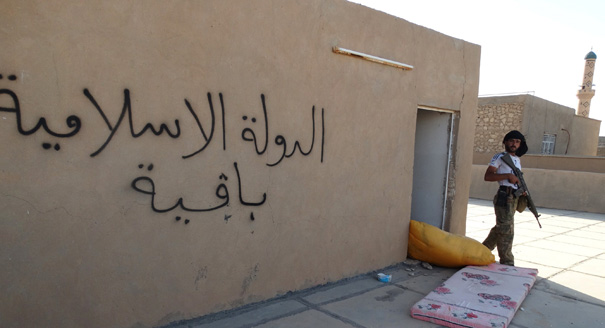
As the Islamic State continues to grow rapidly, questions are being raised about its origins.
Source: Al Jazeera Inside Story
The international alliance to fight the Islamic State group is gaining shape and momentum. The US secretary of state, John Kerry, met a number of Middle Eastern foreign ministers in Jeddah to discuss how best to deal with the group.
The Islamic State group's swift seizure of territory in Iraq and Syria was a shock to many countries in the region and beyond. The group is the successor to the Islamic State in Iraq. It has a seasoned military operation with a transnational membership, to which, despite heavy losses, it is constantly recruiting. With key leaders who were prominent in the Iraqi rebellion of the 2000s, it is also well-armed and financed.
On Inside Story a discussion on the root causes of the birth and emergence of the Islamic State group.
Presenter: Hazem Sika
Guests:
Mario Abou Zeid - political analyst with the Carnegie Middle East Center.
Aymenn Jawad Al-Tamimi - fellow with the Middle East forum and specialist on rebel groups in Iraq and Syria.
Juan Cole - history professor with the University of Michagan and author of the book, The New Arabs: How the Millennial Generation is Changing the Middle East.
This interview was originally broadcasted by Al Jazeera Inside Story.
Former Research Analyst, Middle East Center
Abou Zeid was a research analyst at the Carnegie Middle East Center, where his work focuses on political developments in Lebanon, Syria, Iraq, and Iran.
Juan Cole
Aymenn Jawad Al-Tamimi
Carnegie does not take institutional positions on public policy issues; the views represented herein are those of the author(s) and do not necessarily reflect the views of Carnegie, its staff, or its trustees.
Montenegro and Albania are frontrunners for EU enlargement in the Western Balkans, but they can’t just sit back and wait. To meet their 2030 accession ambitions, they must make a strong positive case.
Dimitar Bechev, Iliriana Gjoni
Donald Trump has repeatedly bashed NATO and European allies, threatening to annex Canada and Greenland and deploring their lack of enthusiasm for his war of choice in Iran. Is this latest round of abuse the final straw?
Rym Momtaz, ed.
Donald Trump has demanded that European allies send ships to the Strait of Hormuz while his war of choice in Iran rages on. He has constantly berated NATO while the alliance’s secretary-general has emphatically supported him.
Rym Momtaz, ed.
The war in Ukraine is costing Russia its leverage overseas. Across the South Caucasus and Middle East, this presents an opportunity for Europe to pick up the pieces and claim its own sphere of influence.
William Dixon, Maksym Beznosiuk
Economic growth is at the heart of a dilemma between planetary and international security.
Olivia Lazard