

Commentary
Are Germany’s economic, industrial, and political struggles becoming a liability for the EU’s ability to rise to the geopolitical moment?
Rym Momtaz, ed.
{
  "authors": [
    "Omar Dahi"
  ],
  "type": "legacyinthemedia",
  "centerAffiliationAll": "dc",
  "centers": [
    "Carnegie Endowment for International Peace",
    "Malcolm H. Kerr Carnegie Middle East Center"
  ],
  "collections": [
    "Conflict and Refugees"
  ],
  "englishNewsletterAll": "menaTransitions",
  "nonEnglishNewsletterAll": "",
  "primaryCenter": "Malcolm H. Kerr Carnegie Middle East Center",
  "programAffiliation": "MEP",
  "programs": [
    "Middle East"
  ],
  "projects": [],
  "regions": [
    "Levant",
    "Lebanon",
    "Syria",
    "Jordan",
    "Iraq",
    "Middle East"
  ],
  "topics": [
    "Political Reform",
    "Economy",
    "Security",
    "Foreign Policy"
  ]
}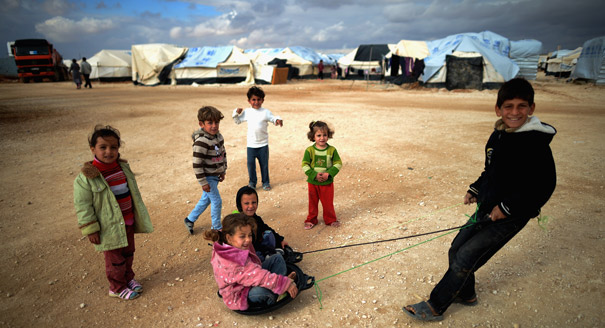
Source: Getty
The most effective way to tackle the Syrian refugee crisis is for neighboring states to assume a leading role in development spending, infrastructure upgrading, and job creation.
Source: Forced Migration Review
The entry of Syrian refugees into Lebanon and Jordan has resulted in unprecedented social and economic challenges to both countries. These are felt on a day-to-day basis by all Lebanese and Jordanian citizens whether through higher rents and declining public service availability, or through health and education infrastructure that is stretched beyond its limits. There is no doubt that both host countries have been incredibly generous to refugees, particularly at the societal level. However, the tensions between host communities and refugees within Lebanese society are obvious and in both countries a lot of government and societal discourse about refugees has become palpably resentful.
Even if a meaningful political settlement and ceasefire inside Syria are achieved, the refugees are likely to remain where they are for many years; the crisis therefore requires long-term planning on the part of host governments in collaboration with local civil society and multinational institutions. Specifically, it requires attention to economic development needs, including infrastructure upgrading and job creation, to improve life for all vulnerable populations, refugees, and host communities.
The crisis has put a huge strain on the fiscal capacity of both countries so urging more state spending may seem counter-intuitive. However, development spending is justified for several reasons. First, the economies of Lebanon and Jordan were suffering from economic problems beforehand. Second, economic spending will benefit these countries’ citizens as well as the Syrian refugees; not spending for fear that it will provide refugees with an incentive to remain will hurt the country’s citizens just as much as it hurts refugees. Third, the fact that most of the refugees in both countries are not in camps has created particularly challenging problems as reaching the refugees and serving their needs is even more expensive than it would otherwise be. It also means that across-the-board development spending is the most efficient way to address the humanitarian crisis.In both Jordan and Lebanon economic challenges preceded the refugee crisis. For example, the annual GDP growth rate dropped from 8.5 percent to 1.4 percent in Lebanon and from 5.5 percent to 2.7 percent in Jordan between 2009 and 2012. In Lebanon the onset of the Arab uprisings resulted in a reduction in foreign direct investment and a sharp decline in tourism. Flows of natural gas from Egypt to Jordan were sharply reduced through most of 2012 due to sabotage of the pipelines linking the two countries, resulting in increased fuel costs.
However, the economic challenges facing both countries run even deeper. A 2010 UNDP report found that in Jordan from 2006 to 2008 the number of poverty pockets, defined as districts or sub-districts with 25 percent or more of the population below the national poverty line, had increased from 22 to 32. The same report found that the three most densely populated governorates, Amman, Irbid and Zarqa, contain 57 percent of the people living under the poverty line. As of early March 2014, 58 percent of Syria’s registered refugees were located in those three governorates. Mafraq governorate—where Za’atari camp and just under 30 percent of registered Syrian refugees are located—contains the highest incidence of poverty and illiteracy rates in Jordan (along with Ma’an governorate).
The situation in Lebanon is marked by sharper economic and regional inequalities, accompanied by deep social cleavages and sectarian fault lines that have been exacerbated by the Syrian conflict. Sixty percent of the registered Syrian refugees are in the North and Beka’a Valley regions, that are also the poorest regions in Lebanon. The North region has the lowest per capita expenditure in the country, along with the highest levels of inequality. These two regions have been historically marginalised as reconstruction after the end of the civil war in Lebanon in 1990 saw most wealth flow to the greater Beirut region.
However, both Jordan and Lebanon are loath to embark on major development spending. There is fear that substantial investment in refugees will provide incentives for further inflows—or integration of existing refugees. A Jordanian minister admitted in 2013 that conditions are calibrated to provide minimal aid so that refugees will have no incentive to remain, and this appears to be an unspoken policy in other host countries as well.1
This line of thinking is erroneous, even from a self-interested perspective. First, neglecting this issue hurts the domestic population as much as the refugee population. Second, the decision or ability to return home for many Syrians will depend on a number of other issues too. Syrians who come from areas where there is no possibility for economic life or where they are too fearful for their lives will prefer to stay, even if it means living in destitution. Third, ignoring the issue will cause more problems than if attempts were made to tackle them head on. The host countries have an incentive to provide refugees with a decent living so as to avoid the social problems that will arise from extreme poverty and destitution. And everyone has an interest in keeping children in schools and away from exploitation. Finally, all the neighboring countries will benefit from a future Syria that is strong socially and economically. Allowing Syrians to pursue their livelihoods and build their capacity today is an investment in the long-term regional economy.
In the case of Lebanon, in addition to fears of integration, there is also the real issue of weak state capacity. Lebanese are known for routinely declaring “we have no state” when asked why services are poor, or infrastructure is dilapidated, and the current crisis is an opportunity to strengthen state capacity at all levels. The inflow of foreign aid could give the government the ability to strengthen its capacity without the accompanying fiscal strain.
Shifting to development means investment in upgrading the water, electricity and health infrastructure, as well as launching projects (perhaps with mixed public and private sector involvement) that can generate jobs and alleviate poverty. These must target the most vulnerable areas such as the Beka’a Valley and the North in Lebanon and the Mafraq governorate in Jordan. Such spending should target all vulnerable communities particularly in the most underserved areas. This should be accompanied by outreach that both allows local communities to express their grievances and publicises the efforts being made by the state and aid community in addressing their needs along with those of the refugees. Increased local input, transparency and media outreach are key to getting local and national communities on board with these projects and to better informing refugee communities of their rights.
Close cooperation is needed so that the efforts of multinational institutions such as the World Bank and the IMF complement the efforts of host countries, UNHCR and other aid organisations, rather than working at cross purposes.
The continuation of pre-existing policy goals such as fiscal consolidation and lowering debt-to-GDP ratios must be weighed against new needs for development and infrastructural investments. Though UNHCR’s approach has shifted towards development in the Regional Response Plan 6,2 this cannot materialize without buy-in and cooperation from all parties. Both the academic and the policy literature on economic policies in conflict and postconflict situations have shown that traditional economic policy that focuses on austerity or state retrenchment is inadequate or even counterproductive in these circumstances. In such situations, political goals must take precedence over economic ones.3 Though these countries are not in a state of war themselves, they are experiencing the contagion of an extended period of regional upheaval.
Development initiatives administered by the state such as infrastructural investment in services, health care, education and job creation, and targeting host communities as well as refugees, have the benefit of strengthening state capacity and relieving tensions at the same time as addressing refugees’ needs. Though large-scale initiatives carry certain risks, so does inaction, particularly as both refugee and host communities become increasingly restless.
This article was originally published by Forced Migration Review.
1 www.nytimes.com/2013/10/06/world/middleeast/as-syrian-refugees-develop-roots-jordan-grows-wary.html
2 See article by Roger Zetter and Héloïse Ruaudel on p5-10.
3 Boyce J K and O’Donnell M (2007) Peace and the Public Purse: Economic Policies for Postwar Statebuilding. Lynne Rienner, Boulder. www.peri.umass.edu/236/hash/66aec14aa0e2ccd4a1b4aaed1f9cd9b7/publication/266/
Omar Dahi
Former Visiting Scholar, Middle East Center
Dahi was a visiting scholar at the Carnegie Middle East Center, where he specialized in economic development and international trade, with a focus on South-South economic relations and the political economy of the Middle East and North Africa.
Carnegie does not take institutional positions on public policy issues; the views represented herein are those of the author(s) and do not necessarily reflect the views of Carnegie, its staff, or its trustees.

Are Germany’s economic, industrial, and political struggles becoming a liability for the EU’s ability to rise to the geopolitical moment?

Rym Momtaz, ed.

European Commission President Ursula von der Leyen is about to give her annual address on the state of the EU. Here’s what she won’t—but should—say.
Rym Momtaz

The aftermath of the Ceuta crisis shows Europe has drawn the wrong lessons. Rather than doubling down on failed migration policies, the EU needs to address the underlying roots of such episodes.

Richard Youngs

Canadian Prime Minister Mark Carney has twice inspired praise for standing up to U.S. President Donald Trump: at the 2026 World Economic Forum in Davos and on Canada-U.S. trade negotiations. Is Carney showing a third way better than the EU has in dealing with the Trump administration?
Rym Momtaz, ed.

The EU’s responses to two recent incidents expose the gulf between European perceptions and capabilities. Unless the union can bridge that gap, it will never become a real geostrategic power.
Rym Momtaz