

Commentary
European Commission President Ursula von der Leyen is about to give her annual address on the state of the EU. Here’s what she won’t—but should—say.
Rym Momtaz
{
  "authors": [
    "Paul Haenle",
    "Anne Sherman"
  ],
  "type": "legacyinthemedia",
  "centerAffiliationAll": "",
  "centers": [
    "Carnegie Endowment for International Peace",
    "Carnegie China"
  ],
  "collections": [
    "U.S.-China Relations",
    "China’s Foreign Relations"
  ],
  "englishNewsletterAll": "",
  "nonEnglishNewsletterAll": "",
  "primaryCenter": "Carnegie China",
  "programAffiliation": "",
  "programs": [],
  "projects": [],
  "regions": [
    "East Asia",
    "China",
    "North Korea"
  ],
  "topics": [
    "Security",
    "Arms Control",
    "Foreign Policy"
  ]
}
Source: Getty
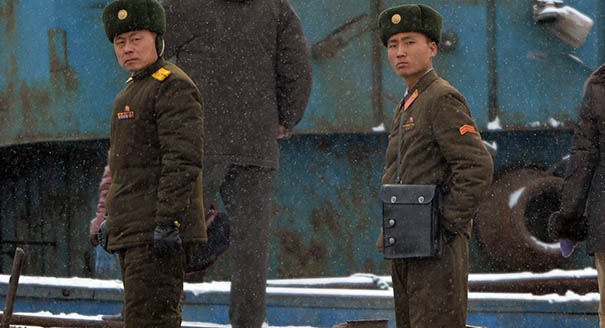
China’s tougher stance toward North Korea may be driving Pyongyang’s current wave of outreach.
Source: Diplomat
For several years now, there has been a debate over the future of China’s relations with North Korea. Some analysts have said a gradual policy recalibration is taking place as the Chinese government has grown tired of North Korea’s reckless behavior and its refusal to halt development of its nuclear and ballistic missiles programs and open its economy to market reforms. Others counter that China’s priorities on the Korean peninsula remain unchanged, despite occasional spikes in tension and discord. One person, however, appears to have concluded that Beijing has toughened its approach: North Korea’s own hereditary dictator, Kim Jong-un.
Chinese policy adjustments would not be difficult to understand. Despite Beijing providing the majority of North Korea’s energy and food assistance since the 1990s, Pyongyang continues to defy the wishes of its generous patron by advancing its nuclear weapons program and conducting military provocations that foster instability and arms buildups in China’s immediate neighborhood. In the past, Beijing turned a blind eye to these inimical developments because of its stated interest in stability and influence on the Korean peninsula. But increasingly, China’s evolving interests as a rising major power, including improving relations with South Korea, increasing its influence and presence in the Asia-Pacific, and shaping a regional and international environment that supports its rise, are running up against the defiant behavior of its juvenile client.
Much to Kim Jong-un’s alarm, Chinese leaders have raised their level of criticism and reduced their patience for Pyongyang’s provocations accordingly. China supported a UN Security Council resolution to expand sanctions against North Korea for its third nuclear test in March 2013. A vibrant domestic debate about China’s North Korea policy has been allowed in Chinese traditional and social media circles. Most notably, President Xi was the first Chinese leader ever to visit South Korea before the North in June 2014. This snub was compounded when China failed to acknowledge in state media or send an official to celebrate Beijing’s 65th anniversary of diplomatic relations with Pyongyang this October.Pyongyang has taken notice. Detecting the shift in China’s policy, Kim Jong-un appears to be moving along a multi-pronged approach to demonstrate his unhappiness with China’s less accommodating attitude and open up other avenues of engagement. Among its acts of defiance, North Korea executed Jang Song-thaek, China’s most trusted interlocutor, in December 2013 on treason charges that included underselling resources to China. More worrisome however, is North Korea’s charm offensive. In July, Kim Jong-un agreed to cooperate on investigations into Japanese abductees. In October, the North cooperated in human rights talks with the European Union and released an imprisoned American tourist. A surprise visit by several of North Korea’s most senior leaders to Seoul in October 2014 marked the highest level summit between the two sides in years and a potential interest in improving relations.
The reason North Korea’s surprising outburst of engagement is so disconcerting is because while its intentions are still unclear, the international community is prematurely responding in good faith. Already this year, North Korea has secured new aid, investment, and debt relief from Russia, an easing of sanctions from Japan, and an opening for talks and sanctions relief from South Korea. But what has North Korea done to deserve such concessions? While the U.S. and the global community should not be opposed to engagement with North Korea outright, especially that which can contribute to regional stability and to the overall goal of denuclearization, any policy change toward the North should be predicated on concrete steps by Pyongyang that demonstrate its seriousness about denuclearization.
North Korea’s recent engagement could signal a new willingness to return to the commitments it has made to the U.S. and its neighbors in the region to abandon all nuclear weapons and return to the Non-Proliferation Treaty (NPT) as soon as possible. If this is the case, then we should by all means be open to overtures by the North. However, we should keep in mind that this is not the first time North Korea has tried to secure new forms of cooperation, assistance, and friendship from the international community through manipulation. During the Cold War, Pyongyang proved its adept ability to play China and the Soviet Union against each other, opportunistically seeking to maximize their concessions while minimizing their individual leverage. In the current situation, it is possible that the North Korean leadership has concluded that China is shifting its policy, and the North therefore is adapting its diplomacy accordingly.
Thus, the international community should not dismiss North Korea’s diplomatic flurry, but we must be clear-eyed when engaging with the North. As we patiently test its resolve, it is imperative that nations ensure that any concessions or policy changes be made only as a result of concrete and measurable progress. We should be cautious to interpret this as any fundamental transformation in North Korea’s foreign policy or global outlook yet, and realize that this may be part of a new charm offensive intended to reduce its international isolation and China’s leverage. Undue optimism could lead to concessions to the North without concrete actions, which would undercut the goals of North Korean nuclear disarmament and further offset the realization of a nuclear-free peninsula.

Former Maurice R. Greenberg Director’s Chair, Carnegie China
Paul Haenle held the Maurice R. Greenberg Director’s Chair at the Carnegie Endowment for International Peace and is a visiting senior research fellow at the East Asian Institute, National University of Singapore. He served as the White House China director on the National Security Council staffs of former presidents George W. Bush and Barack Obama.
Anne Sherman
Carnegie does not take institutional positions on public policy issues; the views represented herein are those of the author(s) and do not necessarily reflect the views of Carnegie, its staff, or its trustees.

European Commission President Ursula von der Leyen is about to give her annual address on the state of the EU. Here’s what she won’t—but should—say.

Rym Momtaz

The aftermath of the Ceuta crisis shows Europe has drawn the wrong lessons. Rather than doubling down on failed migration policies, the EU needs to address the underlying roots of such episodes.

Richard Youngs

Canadian Prime Minister Mark Carney has twice inspired praise for standing up to U.S. President Donald Trump: at the 2026 World Economic Forum in Davos and on Canada-U.S. trade negotiations. Is Carney showing a third way better than the EU has in dealing with the Trump administration?
Rym Momtaz, ed.

The EU’s responses to two recent incidents expose the gulf between European perceptions and capabilities. Unless the union can bridge that gap, it will never become a real geostrategic power.
Rym Momtaz

European states control several Overseas Countries and Territories around the world that carry strategic, economic, and environmental weight. As great powers challenge the rules-based order, defending them is a geopolitical imperative for Europe.

Marc Pierini