

Research
- +5
Alper Coşkun, Fatih Ceylan, Tacan İldem, …
{
  "authors": [
    "Sinan Ülgen"
  ],
  "type": "legacyinthemedia",
  "centerAffiliationAll": "dc",
  "centers": [
    "Carnegie Endowment for International Peace",
    "Carnegie Europe",
    "Malcolm H. Kerr Carnegie Middle East Center"
  ],
  "collections": [
    "Turkey’s Transformation",
    "Europe’s Southern Neighborhood"
  ],
  "englishNewsletterAll": "menaTransitions",
  "nonEnglishNewsletterAll": "",
  "primaryCenter": "Carnegie Europe",
  "programAffiliation": "MEP",
  "programs": [
    "Middle East",
    "Europe"
  ],
  "projects": [],
  "regions": [
    "Middle East",
    "Europe",
    "Türkiye",
    "Levant",
    "Syria",
    "Iran"
  ],
  "topics": [
    "Political Reform",
    "Security"
  ]
}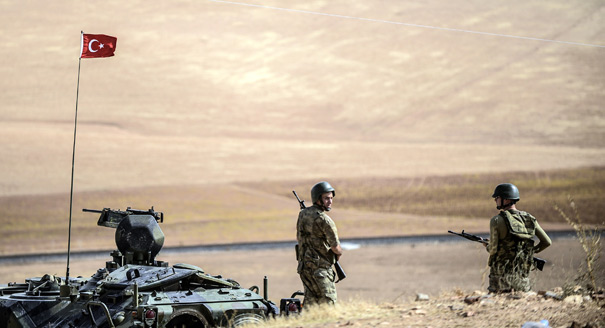
Source: Getty
Turkey fundamentally disagrees with the United States in its interpretation of the threat that the Islamic State poses, viewing the group as a symptom of deeper pathologies.
Source: Project Syndicate
ISTANBUL – Following the recent safe return of 46 Turkish hostages held by the Islamic State, hopes were raised in the United States that Turkey would finally commit to joining the US-led coalition now fighting the group. But Turkey’s willingness to contribute to the coalition remains constrained by the legacy of its ill-fated Syria policy, as well as by a fundamental strategic disconnect between President Recep Tayyip Erdoğan’s government and US President Barack Obama’s administration.
Since Syria’s civil war began three years ago, Turkey has provided logistical and financial support to virtually all elements of the Syrian opposition, while allowing them to use Turkish territory to regroup after launching military operations across the border. Committed to regime change in Syria, Turkey turned a blind eye to some of these groups’ brutal tactics, radical ideologies, and big ambitions. The fear now is that this benign neglect has allowed the Islamic State to embed itself in Turkey and build the capacity to conduct terrorist activities on Turkish soil – and thus to retaliate for Turkish participation in the US-led coalition.
But there is more behind Turkey’s reticent response to the coalition. Turkey fundamentally disagrees with the US in its interpretation of the threat that the Islamic State poses – and how to address it. Simply put, whereas the US is approaching the Islamic State as the Middle East’s most pressing problem, Turkey views the group as a symptom of deeper pathologies.According to this view, any campaign that focuses exclusively on destroying the Islamic State will do nothing to prevent the emergence of similar threats in the near future. And, unlike the US, Middle Eastern countries and their neighbors cannot decide to “pivot” away from the region when the consequences of their poorly designed interventions become too unruly.
In this context, Turkey’s leaders believe that the international community’s response to the Islamic State should be far more ambitious, seeking to redress the underlying causes of the current disorder. Such a strategy would have to include efforts to compel Iraq’s new government to break with the sectarianism of former Prime Minister Nouri al-Maliki, while supporting the new leadership’s efforts to provide basic health, educational, and municipal services to all of Iraq’s citizens. As for Syria, the only plausible route to normalcy begins with forcing President Bashar al-Assad to cede power. To this end, the US and its allies should consider striking Assad’s strongholds in Syria, while establishing safe havens for the moderate opposition under the protective cloak of a no-fly zone.
Here, Turkey, for which the establishment of safe havens is vital to accommodate Syrians who have been displaced by the conflict, could play a central role. Turkey is already bearing a heavy burden of Syrian refugees, having absorbed more than one million since the crisis began in 2011.
Following Islamic State attacks against Kurdish enclaves, more than 120,000 refugees crossed into Turkey in a single weekend. That is roughly the same number of Syrians allowed to seek refuge in the entire European Union since the crisis began in 2011.
An orchestrated military campaign against the Islamic State will undoubtedly displace even more Syrians. But, in Turkey’s view, they should not have to cross the border to be safe. Instead, Turkey wants to take the lead in building infrastructure that could serve the needs of Syria’s displaced people within the country’s borders. Such projects would make sense only within internationally guaranteed safe havens protected by a no-fly zone.
Given that the Islamic State poses a graver threat to Turkey than to any other Western country, Turkey has no choice other than to participate in the campaign against it. This means, first and foremost, adopting a zero-tolerance policy toward the Islamic State at home, aimed at preventing the group from fundraising and recruiting on Turkish soil. Continued improvement of border security and deeper cooperation with Western intelligence agencies on the issue of foreign fighters are also essential.
But Turkey’s imperative to fight the Islamic State does not trump – much less invalidate – Turkish leaders’ concerns about Obama’s long-term goals. If the US and Turkey are to work together to eradicate the Islamic State, they will first have to agree on a longer-term strategy for restoring some semblance of order to a crisis-ravaged region.

Senior Fellow, Carnegie Europe
Sinan Ülgen is a senior fellow at Carnegie Europe in Brussels, where his research focuses on Turkish foreign policy, transatlantic relations, international trade, economic security, and digital policy.
Recent Work

Alper Coşkun, Fatih Ceylan, Tacan İldem, …
Carnegie does not take institutional positions on public policy issues; the views represented herein are those of the author(s) and do not necessarily reflect the views of Carnegie, its staff, or its trustees.

European Commission President Ursula von der Leyen is about to give her annual address on the state of the EU. Here’s what she won’t—but should—say.

Rym Momtaz

Radical-right parties are expected to do well in upcoming elections in four of the EU's biggest member states. If successful, they could prevent the union from addressing key challenges ahead.

Stefan Lehne

The aftermath of the Ceuta crisis shows Europe has drawn the wrong lessons. Rather than doubling down on failed migration policies, the EU needs to address the underlying roots of such episodes.

Richard Youngs

An overwhelming victory by a far-right-wing party in a small state in eastern Germany will have major repercussions for Chancellor Friedrich Merz’s coalition.

Judy Dempsey

Canadian Prime Minister Mark Carney has twice inspired praise for standing up to U.S. President Donald Trump: at the 2026 World Economic Forum in Davos and on Canada-U.S. trade negotiations. Is Carney showing a third way better than the EU has in dealing with the Trump administration?
Rym Momtaz, ed.