

Commentary
Are Germany’s economic, industrial, and political struggles becoming a liability for the EU’s ability to rise to the geopolitical moment?
Rym Momtaz, ed.
{
  "authors": [
    "Vladimir Dvorkin"
  ],
  "type": "commentary",
  "centerAffiliationAll": "",
  "centers": [
    "Carnegie Endowment for International Peace",
    "Carnegie Russia Eurasia Center"
  ],
  "collections": [],
  "englishNewsletterAll": "",
  "nonEnglishNewsletterAll": "",
  "primaryCenter": "Carnegie Russia Eurasia Center",
  "programAffiliation": "",
  "programs": [],
  "projects": [],
  "regions": [
    "Russia"
  ],
  "topics": [
    "Security",
    "Military",
    "Foreign Policy",
    "Nuclear Policy",
    "Arms Control"
  ]
}
Source: Getty
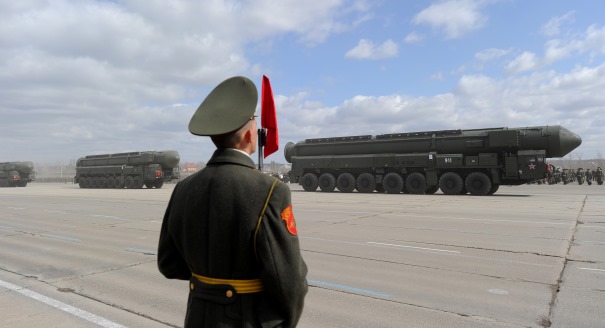
Some experts’ concern that the amended version of the Russian military doctrine would significantly alter conditions for nuclear weapons’ use in the context of the Ukraine crisis and the resulting sharp escalation of the military and political situation has turned out to be premature.
The Military Doctrine of the Russian Federation was amended in compliance with a July 5, 2013 decision of the Russian Security Council. The changes to the document were approved at the Security Council meeting on December 19, 2014.
The main conditions governing the use of nuclear weapons remain unchanged. “The Russian Federation reserves the right to use nuclear weapons in response to the use of nuclear and other types of weapons of mass destruction against it and/or its allies, and also in the event of aggression against the Russian Federation involving the use of conventional weapons when the very existence of the state is under threat.”
This wording in effect mirrors U.S., British, and French nuclear strategy principles during the Cold War, which allowed for a first nuclear strike, in the situation when the Soviet Union and its Warsaw Pact allies held a significant advantage in conventional forces. Given the West’s clear edge in non-nuclear forces now, Russia’s right to a first nuclear strike appears quite justifiable.
Thus, some experts’ concern that the amended version of the Russian military doctrine would significantly alter conditions for nuclear weapons’ use in the context of the Ukraine crisis and the resulting sharp escalation of the military and political situation has turned out to be premature.
One of the relatively poorly worded passages of the updated doctrine states that “in case of an armed conflict with the use of conventional weapons (large-scale war, regional war) that threatens the very existence of the state, possessing nuclear weapons may lead to the escalation of such a military conflict into a nuclear military conflict.” This passage can be interpreted as acknowledging the possibility of nuclear weapons use by states that have sustained politically tense relations on the regional level but are not officially recognized as nuclear powers and could lead to unpredictable escalation.
At the same time, the unchanged conditions for nuclear weapons use and the description of their role in ensuring Russia’s and U.S./NATO security fifteen years after the end of the Cold War reflects the fact that the principles of mutual nuclear deterrence have not been altered, although these principles are useless in counteracting new challenges and threats. Calls to abandon the principles made by the Russian and U.S. “Four Wise Men” and to acknowledge that these principles are in neither Russia’s nor the United States’ interest (which were reflected in the U.S. Senate document during the ratification of the New START Treaty), have had absolutely no effect on the official Russian and U.S. positions, nor on the positions of most of the experts in this field.
One of the reasons for this phenomenon is a strong confluence of two conservative outlooks: the legacy of the old confrontation-based military and political thinking on the one hand and the belief in the stability of the decades-old nuclear weapons systems, which must be kept on constant alert, on the other. But while the United States promotes reduced reliance on nuclear weapons, Russia consistently emphasizes their increased importance. In addition, the new Russian military doctrine’s restrained rhetoric is being accompanied by heightened efforts to develop strategic nuclear forces in order to maintain the strategic nuclear balance with the United States. Such efforts are reflected, for instance, in the irrational decision to increase the number of ICBM types to no less than five, in an atmosphere of severe economic crisis. In contrast, the United States has only one type, although it could afford to have considerably more.
Russia justifies this program by citing the need to respond to the development of global and European missile defense and high-precision strategic non-nuclear weapons, although independent experts have concluded that these kinds of weapons have practically no bearing on Russia’s nuclear deterrent. At the same time, the goal of “creating regulatory mechanisms for bilateral and multilateral cooperation in the sphere of missile defense” set forth in the military policy section of the doctrine testifies to the fact that, in this sphere, the window for agreement with the United States and NATO remains open.
Besides nuclear deterrence, the doctrine maintains that “in the context of the implementation of strategic deterrence measures of a forceful nature, the Russian Federation allows for the use of precision weapons.” This can be interpreted in different ways. The literal interpretation of the term “use” could indicate that high-precision weapons can be used in the course of an existing regional conflict in order to prevent its escalation to a strategic level. The broader interpretation, however, could be that the authors are introducing the concept of strategic non-nuclear deterrence as an alternative to nuclear deterrence. In any event, the authors of the military doctrine would be well-advised to use more precise definitions, unless this is in fact a deliberate ambiguity on their part.
Vladimir Dvorkin
Major General Dvorkin (retired) is a chief researcher at the Center for International Security at the Institute of World Economy and International Relations.
Carnegie does not take institutional positions on public policy issues; the views represented herein are those of the author(s) and do not necessarily reflect the views of Carnegie, its staff, or its trustees.

Are Germany’s economic, industrial, and political struggles becoming a liability for the EU’s ability to rise to the geopolitical moment?

Rym Momtaz, ed.

European Commission President Ursula von der Leyen is about to give her annual address on the state of the EU. Here’s what she won’t—but should—say.
Rym Momtaz

The aftermath of the Ceuta crisis shows Europe has drawn the wrong lessons. Rather than doubling down on failed migration policies, the EU needs to address the underlying roots of such episodes.

Richard Youngs

Canadian Prime Minister Mark Carney has twice inspired praise for standing up to U.S. President Donald Trump: at the 2026 World Economic Forum in Davos and on Canada-U.S. trade negotiations. Is Carney showing a third way better than the EU has in dealing with the Trump administration?
Rym Momtaz, ed.

The EU’s responses to two recent incidents expose the gulf between European perceptions and capabilities. Unless the union can bridge that gap, it will never become a real geostrategic power.
Rym Momtaz