

Paper
Ashley J. Tellis
{
  "authors": [
    "Ashley J. Tellis"
  ],
  "type": "legacyinthemedia",
  "centerAffiliationAll": "dc",
  "centers": [
    "Carnegie Endowment for International Peace"
  ],
  "collections": [],
  "englishNewsletterAll": "ctw",
  "nonEnglishNewsletterAll": "",
  "primaryCenter": "Carnegie Endowment for International Peace",
  "programAffiliation": "SAP",
  "programs": [
    "South Asia"
  ],
  "projects": [],
  "regions": [
    "North America",
    "United States",
    "South Asia",
    "India"
  ],
  "topics": [
    "Foreign Policy"
  ]
}
Source: Getty
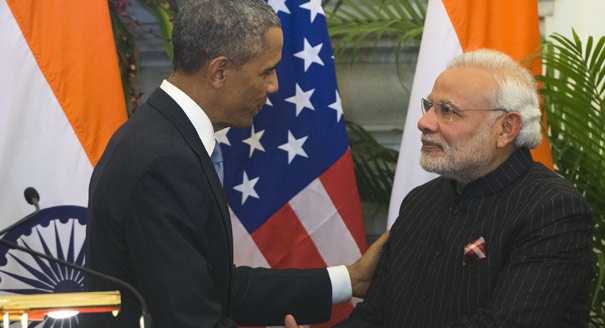
Modi’s engagement with the United States is driven fundamentally by considerations about India’s national interests, just as Obama’s outreach to Modi was driven by his judgement about India’s importance for American interests in Asia.
Source: Business Standard
There were misgivings in Delhi and Washington DC that a Narendra Modi-led government might not be as friendly to the Americans. But US President Barack Obama and Modi hit it off at their meetings in Washington DC and later at the East Asia Summit in Myanmar. What changed? How did Modi get Obama to be the chief guest at the Republic Day Parade?
Modi's past misgivings about the US, and the reasons for them, are well known. But what was not sufficiently appreciated either in the US or in India was the fact that if Washington were to reach out to him - as Obama did quickly after Modi became PM - the prime minister would respond fulsomely. This energetic response was driven fundamentally by considerations about India's national interests, just as Obama's outreach to Modi was driven by his judgement about India's importance for American interests in Asia.Every few years, we rejoice in India-US bilateral relations having entered a golden age. This Obama visit is one such occasion. But India-US relations have equally been a story of some or the other incident unravelling the bonhomie, rather too quickly at times. What will it take for Obama and Modi to give the relationship firmer foundational moorings?
The alternation in bilateral relations has been an unfortunate fact of life over the years. I don't think that will change for some time to come -and the reasons for that are structural. The US and India are divided by significant differences in relative power. The two states might look like peers, but they are not. Hence, both sides cannot engage at high levels of intensity consistently, in part because Washington has global interests that often involve India but sometimes do not.
Yet Obama and Modi can build on what George W Bush and Atal Bihari Vajpayee began, simply by following the formula that defined their transformational years: Washington must be generous towards New Delhi, and New Delhi must look for ways to be uniquely supportive of Washington.
The Devyani Khobragade issue soured India-US relations significantly. Salman Khurshid, the UPA's external affairs minister, had termed the "insult" to her a matter of India's honour, prestige and sovereignty. Would you say South Block has overcome that "insult"? What led to the U-turn?
What the Khobragade incident taught me was that US-Indian relations were still fragile, and that many Indian elite were still suspicious of the US. I don't know whether "South Block" has changed since that incident, but it should learn from Modi. Modi has had many reasons to be sceptical of the US, but he has put India's interests first and his own sentiments second. If India's elite can do the same, we will come out all right.
Are the periodic hiccups in the relationship a reflection of India and the US being fundamentally dissimilar, largely self-interested countries? Is it a result of many in their respective elite viewing the other through the prism of Cold War years, unable to trust the other? Are we essentially fair-weather friends?
The US and India share many commonalities - such as democracy, civic nationalism, liberal politics, and the zealous protection of sovereignty - but many differences as well. The hiccups that arise in the relationship are fundamentally because both nations are divided by significant structural differences that transcend the problems of process or history. The world views, national priorities, and power capabilities of the US and India are all sufficiently different, which make keeping relations on an even keel quite hard.
Moreover, both countries are large worlds unto themselves: despite their wide international interests, what happens within them matters more to their leaders than what happens outside. And, at the end of the day, neither country has been consistently important to ensuring the other's success, even though the considerable disparities in relative power between the US and India generally imply that New Delhi always depends more on Washington than the other way around. None of this implies that the US and India are fair-weather friends, but it means that building a real strategic partnership will take work and effort, and will not appear automatically even in the face of strong gravitational pulls such as represented by the rise of China.
What are your expectations from the Obama visit in terms of deliverables? What would the US need from India for it to play a key role in Modi's 'Make in India' vision?
I think the Obama visit will yield myriad deliverables, but to my mind the biggest deliverable is Modi's invitation to Obama and Obama's acceptance of Modi's invitation to be the chief guest at the Republic Day Parade. Beyond that, I hope that the two sides will be able to announce a renewal of the defence framework agreement, new projects for joint development and co-production of advanced defence technologies, a new vision of global cooperation, an interim solution to the problems caused by India's nuclear liability law, new cooperation on clean energy, and deeper engagement on economic issues to include increased US direct investment in India.
Where 'Make in India' is concerned, Modi does not need to convince the US, merely US business. If he pursues the reform agenda vigorously at home, that will go a long way towards enticing US business to increase investments in India. And Modi should, because it makes economic sense to do so, jettison past impediments such as local content requirements, retrospective taxation policies and the other procedural hurdles to doing business in India. Obviously, he has started down this road, but his work is far from complete.
Is there a better understanding in Washington and New Delhi of what their 'strategic partnership' should entail? What could be the contours of a truly 'strategic' partnership?
I fear that there is still no clarity in Washington about how India understands the notion of strategic partnership. Modi conspicuously shied away from engaging this issue in his private conversations with Obama thus far, but this conversation cannot be put off much longer. If the two sides cannot agree on what the 'strategic partnership' means, they will be unable to pull in the same direction and the relationship will not deliver on its promise. What is very important, therefore, is that there be a meeting of the minds arising from an honest conversation between the two leaders.
The Obama administration, however, wants more - a memorialisation of that understanding in a public document. If India can agree to the same, that would obviously send a powerful signal not only to the prime minister's domestic critics, but more importantly to India's neighbours and the world at large. So, I hope both leaders can agree to issue a public testament about the character of their strategic partnership. But even if they do not, an intimate discussion is essential because for the first time, after a long while, India now has a prime minister who is not merely convinced about the value of the partnership but actually has the political capacity to deliver his end of it.
This interview was originally published in the Business Standard.
Former Senior Fellow
Ashley J. Tellis was a senior fellow at the Carnegie Endowment for International Peace.
Recent Work
Ashley J. Tellis
Ashley J. Tellis
Carnegie does not take institutional positions on public policy issues; the views represented herein are those of the author(s) and do not necessarily reflect the views of Carnegie, its staff, or its trustees.

Are Germany’s economic, industrial, and political struggles becoming a liability for the EU’s ability to rise to the geopolitical moment?

Rym Momtaz, ed.

European Commission President Ursula von der Leyen is about to give her annual address on the state of the EU. Here’s what she won’t—but should—say.
Rym Momtaz

Radical-right parties are expected to do well in upcoming elections in four of the EU's biggest member states. If successful, they could prevent the union from addressing key challenges ahead.

Stefan Lehne

The aftermath of the Ceuta crisis shows Europe has drawn the wrong lessons. Rather than doubling down on failed migration policies, the EU needs to address the underlying roots of such episodes.

Richard Youngs

Canadian Prime Minister Mark Carney has twice inspired praise for standing up to U.S. President Donald Trump: at the 2026 World Economic Forum in Davos and on Canada-U.S. trade negotiations. Is Carney showing a third way better than the EU has in dealing with the Trump administration?
Rym Momtaz, ed.